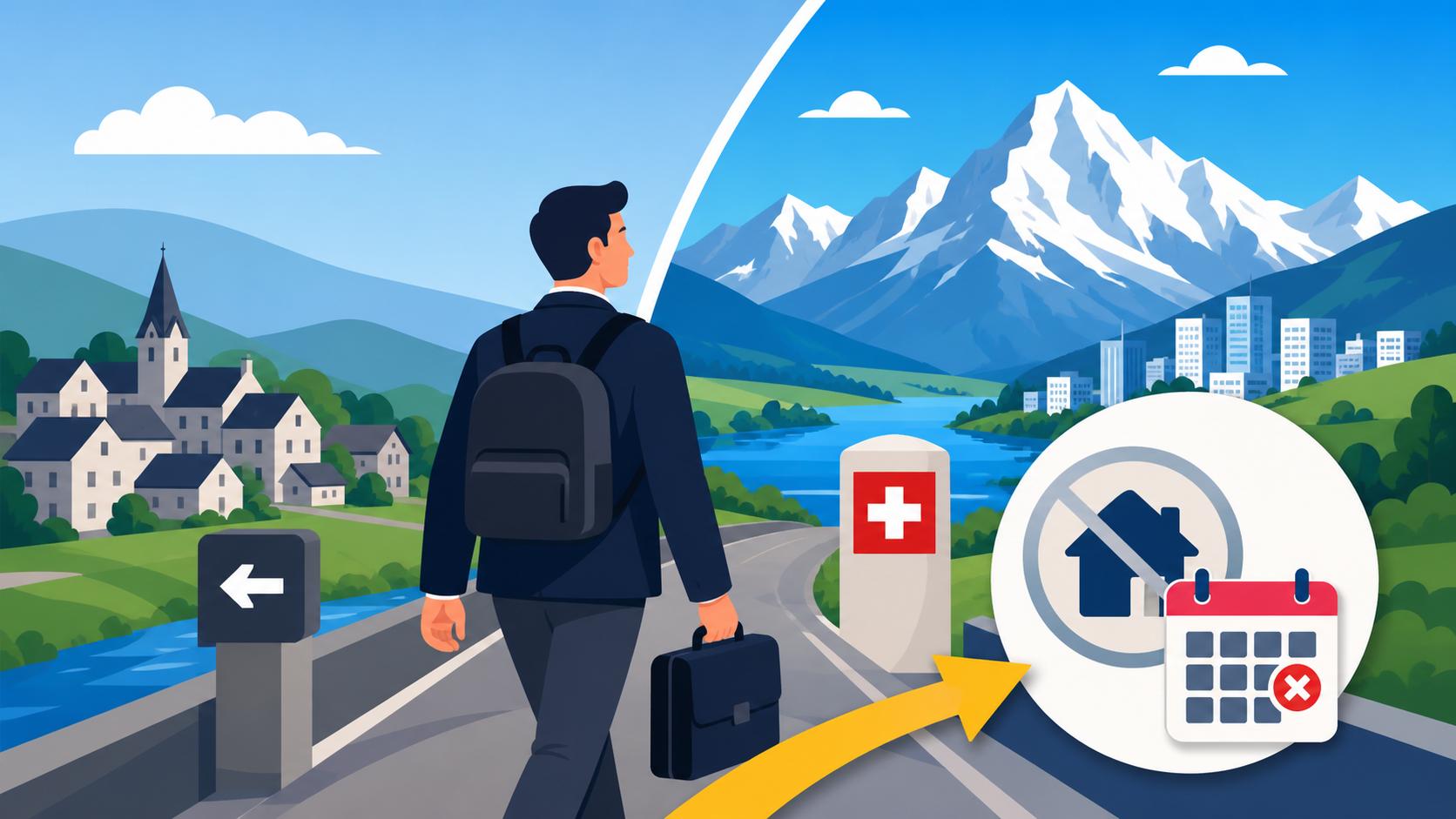
How to Handle Cross-Border Commuting Non-Return Days
The 45-day rule and the complex web of non-return regulations are often a rude awakening for new frontaliers. I spent my first winter in the Basel region constantly second-guessing whether a late-night project or a heavy snowfall would accidentally trigger a massive tax bill in the wrong country. This guide breaks down exactly how to manage your non-return days to protect your G permit status and your wallet.
Understanding the Definition of a Non-Return Day
In the world of Swiss cross-border commuting, a "non-return day" is technically any day where you do not return to your primary residence outside of Switzerland after your work shift. While that sounds simple on paper, the administrative reality is far more nuanced. It is not just about choosing to stay in a hotel because you are tired; it encompasses business trips, international conferences, and even late-night shifts that technically end on the following calendar day.
When you are Cross-Border Commuting: Working in Switzerland with a G Permit, your legal status is predicated on the idea that you are a transient worker. The moment you start spending too many nights within the Swiss borders, the tax authorities in both Switzerland and your home country (France, Germany, or Italy) begin to view you differently. For those in the French border zones, managing these days is the difference between being taxed at the source in Switzerland or paying your taxes in France.
There are three primary scenarios that count as a non-return day. First, there is the "professional necessity" stay, such as staying in Zurich for a two-day workshop when you normally live in France. Second, there is the "international mission," where your Swiss employer sends you to a third country, like the UK or USA, for a week. Third, there is the "environmental stay," where extreme weather or transport strikes make returning home impossible. Every single one of these nights must be tracked with surgical precision.
The Infamous 45-Day Rule for French Frontaliers
If you are working in a canton that has a tax agreement with France—such as Bern, Basel-City, Basel-Country, or Vaud—you generally pay your income tax in France. However, this privilege is contingent on you returning home almost every night. To account for the realities of modern work, the tax treaty allows for a maximum of 45 non-return days per calendar year.
Exceeding this 45-day limit is a "point of no return" for your fiscal year. If you hit day 46, you lose your status as a "frontalier" for tax purposes for that entire year. This often results in the Swiss authorities demanding Withholding Tax (Quellensteuer) vs Standard Taxation for Foreigners retrospectively. I have seen colleagues hit this limit because they didn't realize that a week-long training session in Singapore counted toward their 45-day Swiss quota.
It is important to note that G Permit France: Taxation Rules for Frontaliers in Geneva operate under a different set of rules. Geneva usually taxes at the source regardless, but the non-return days still impact how much of that tax can be claimed back or credited in France. To keep your French language skills sharp enough to navigate these conversations with your local "Mairie," using a tool like FrenchPod101 can be incredibly helpful for learning the specific fiscal vocabulary you will encounter in official letters.
Proportionality for Part-Time Workers
A common mistake is assuming every G permit holder gets 45 days. If you started your job mid-year or if you work a reduced workload, that 45-day quota is reduced proportionally. For example, if you work at an 80% capacity—a very popular model discussed in Working 80%: Why 4-Day Work Weeks Are Popular in Switzerland—your allowed non-return days are scaled down accordingly.
What Counts as a Day?
The definition of a "day" can be a source of intense debate. Generally, if you spend the night in Switzerland or a third country for professional reasons, it counts as one day. If you leave for a business trip on Monday morning and return Friday evening, that is four non-return days (Monday night, Tuesday night, Wednesday night, Thursday night). If your employer requires you to work a shift that ends at 2:00 AM, and you stay in a staff room until 6:00 AM to catch the first train home, that technically constitutes a non-return.
Social Security Implications and the 25 Percent Threshold
While non-return days are primarily a tax concern, they are closely linked to your social security status. Under EU/EFTA coordination rules, a cross-border worker must perform at least 75% of their work activity in Switzerland to remain under the Swiss social security system. If your "non-return" activities involve working from your home country or a third country too often, you might accidentally shift your social security liability to your country of residence.
Managing this is critical because Sickness Benefits Insurance (KTG): Why It’s Crucial for Expats and your pension contributions are tied to this status. If you are a high-earner, perhaps matching the Average Salary for Software Engineers in Zurich (2026 Benchmarks), a shift in social security systems could lead to a significant change in your take-home pay and future pension rights.
The recent 2023 and 2024 updates to the Working from Home with a G Permit: The 25% Social Security Threshold rules have provided some flexibility, allowing for more telecommuting, but "non-return" days spent working in a third country (like a business trip to Germany for a French-based worker) are still strictly scrutinized. If you are struggling to explain these complex logistics to your German-speaking HR manager in Zurich, taking a specialized course through Lingoda can help you master the professional German needed to advocate for your permit rights.
Essential Documentation and the Logbook Strategy
You cannot manage non-return days by memory. The Swiss cantonal tax offices and the French/German/Italian authorities are increasingly digitalized and may request proof of your movements at any time. I highly recommend maintaining a "Commuter Logbook." This should be a simple spreadsheet or an app where you log every single working day, your location of work, and where you spent the night.
Every year, your employer will likely need to issue an "Employer's Certificate" (Attestation de l'employeur) that confirms the number of days you did NOT return home. If this number contradicts your personal records, you are in for a long administrative battle. You should also keep copies of hotel receipts, train tickets, and boarding passes for any international business travel. These serve as the primary evidence if The 45-Day Non-Return Rule for Cross-Border Commuter Taxes is ever challenged during an audit.
Comparing Non-Return Rules by Border Country
| Border Country | Primary Tax Location | Non-Return Limit | Key Document |
|---|---|---|---|
| France (to most cantons) | France | 45 Days | Attestation d'employeur |
| France (to Geneva) | Switzerland (Source) | Varies by treaty | Formulaire 2041-AS |
| Germany (to Basel/Zurich) | Germany | 60 Days | Ansässigkeitsbescheinigung |
| Italy (to Ticino) | Switzerland (Source) | Strictly defined | Certificato di residenza |
Handling Business Travel and International Assignments
One of the biggest traps for expats in English-Speaking Jobs in Switzerland: Top Industries and Cantons is international travel. When your Swiss company sends you to a trade fair in Munich or a client meeting in London, those days are counted as non-return days from your primary residence.
Even though you aren't physically in Switzerland, you are still "not returning" to your home in France or Germany while on business for a Swiss employer. This is where many people accidentally exceed their 45 or 60-day limits. If your role requires heavy travel, you may need to negotiate a different contract type or accept that you will be Filing a Swiss Tax Return (C Permit or High Earners on B Permit) as a resident for tax purposes, even if you live across the border.
If your travel is mostly within German-speaking regions, using GermanPod101 can assist you in understanding the specific terminology used in German travel expenses and tax certificates (Reisekostenabrechnung), ensuring you don't miss any deductible expenses while tracking your non-return days.
What Happens if You Exceed the Limit?
If you realize in October that you have already used 44 days and have a mandatory week-long conference in November, you need to act immediately. First, speak with your HR department. They may be able to reclassify some of your work or allow you to take unpaid leave to avoid hitting the limit.
If you do exceed the limit, you must notify both the Swiss cantonal tax office and your local tax office in your home country. You will likely transition to being taxed at the source in Switzerland. For some, this is actually a financial benefit if they live in a high-tax region of France or Germany, but for others, it can be a logistical nightmare.
You should also check How to Read a Swiss Medical Bill (Rückforderungsbeleg) and Claim Refunds because your insurance status might be questioned if your tax residency shifts unexpectedly. Always ensure you have a "Greffier" or similar certificate from your home country to prevent double taxation during the transition period.
Practical Tips for Staying Under the Limit
- The "Last Train" Rule: Always try to catch the last train or bus home, even if it means an extra two hours of travel. It preserves your non-return quota for genuine emergencies.
- Buffer Your Days: Aim to keep 5-10 days of your quota unused until December. You never know when a strike, a snowstorm, or a sudden "all-hands" meeting will occur.
- Internal Meetings: Whenever possible, suggest that multi-day internal meetings be held virtually or that you attend only one of the two days in person.
- Vacation Timing: If you have used a lot of non-return days, consider taking your remaining holiday during periods when you would otherwise be expected to stay late in the office.
Navigating the German Cross-Border Commuters: Navigating Health Insurance Exemptions and the tax hurdles of the G permit requires constant vigilance. By staying organized and understanding the specific treaties governing your canton and home country, you can enjoy the high Swiss salaries while maintaining your lifestyle abroad without the fear of a sudden tax audit.
Disclaimer
This guide is for informational purposes only and does not constitute legal, financial, or tax advice. Swiss tax treaties and cross-border regulations are subject to frequent change and vary significantly by canton and individual circumstances. Always consult with a qualified tax professional or the relevant cantonal migration and tax authorities before making decisions regarding your residency or tax status.