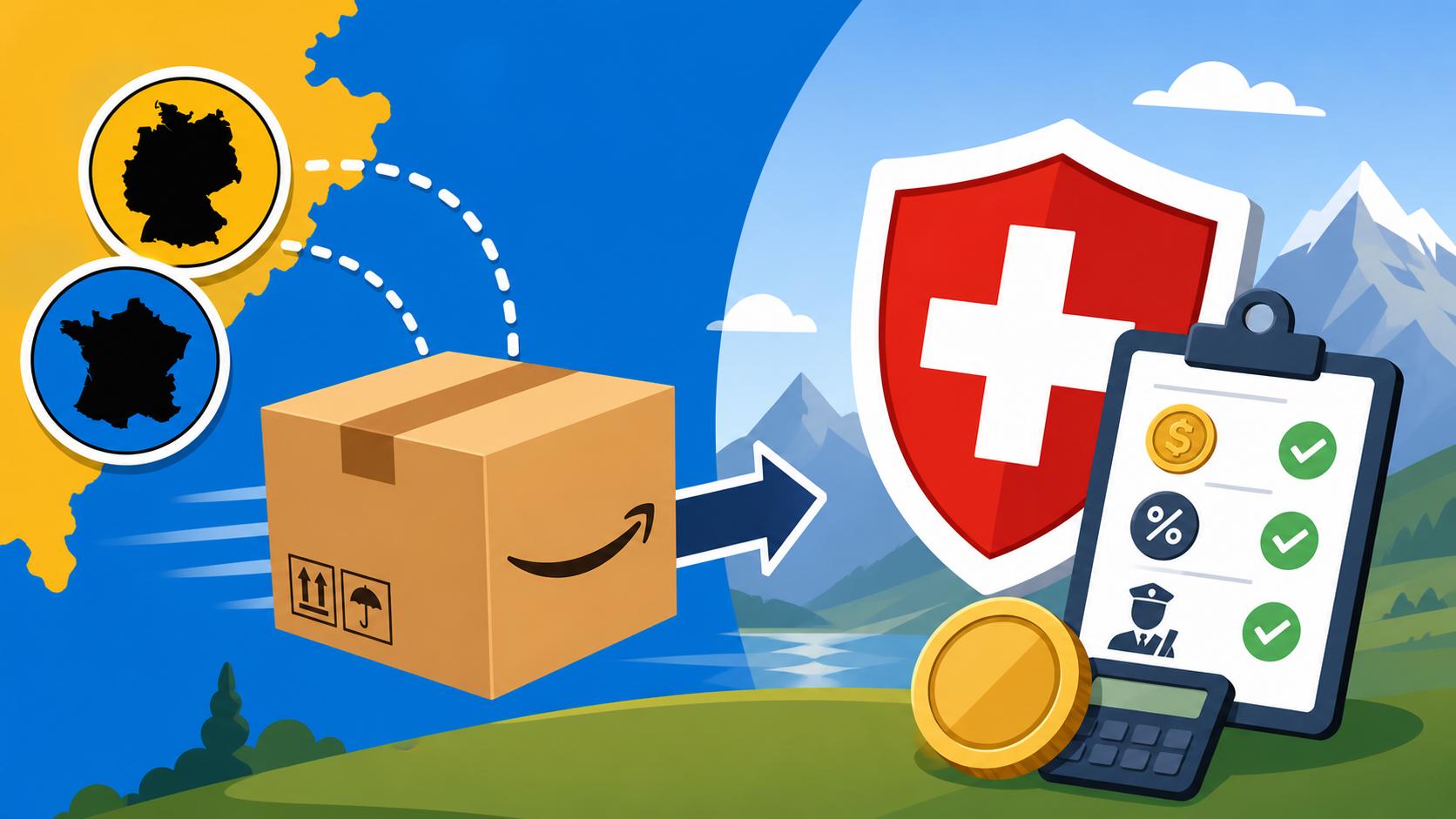
Receiving Packages from Amazon DE/FR: Swiss Customs Fees and VAT
You finally found that specific ergonomic keyboard or a niche kitchen gadget on Amazon.de that isn't available at Galaxus, and the price looks like a steal. I remember my first month in Zurich, thinking I had gamed the system by ordering a 100 Euro coffee maker, only to be slapped with a 40 CHF surprise bill at my doorstep. This guide breaks down exactly how to navigate Swiss customs, VAT, and those pesky administrative fees when ordering from Amazon Germany or France.
The Invisible Border and the Swiss VAT Reality
When you live in Switzerland, you are technically outside the EU's fiscal zone, even though you are geographically surrounded by it. This is the first hurdle every expat must clear mentally. When you browse Amazon.de or Amazon.fr, the prices you see initially include German (19%) or French (20%) VAT. However, the moment you set your delivery address to a Swiss postcode, that foreign VAT should disappear. In its place, the Swiss government wants its cut.
As of 2026, the standard Swiss VAT rate is 8.1%. For certain "essential" goods like books, food, and non-alcoholic beverages, a reduced rate of 2.6% applies. The Swiss Federal Office for Customs and Border Security (BAZG) is incredibly efficient at spotting packages that haven't had their taxes paid. The "magic" happens at the border. If the VAT amount calculated on your package is less than 5 CHF, the Swiss authorities graciously waive it. This creates a "de minimis" threshold that is vital for your Financial Checklist for Your First 30 Days as an Expat in Switzerland if you plan on doing a lot of online shopping.
For standard goods (8.1%), the threshold is approximately 62 CHF. If your total invoice, including shipping, is below this, you usually won't pay a cent in tax. For items under the reduced rate (2.6%), that threshold jumps to about 192 CHF. It is a common mistake to think these limits apply only to the product price. No, the Swiss authorities calculate tax on the "landed cost," which includes the shipping fees and any insurance. Understanding this is a core part of managing your Cost of Living in Switzerland 2026: Budgeting for Singles and Families effectively.
Why Amazon DE and FR are the Expats Best Friends
Amazon has actually made life much easier for Swiss residents compared to other international retailers. When you buy items that are "Dispatched from and sold by Amazon," they use a system called "Import Fees Deposit." Essentially, Amazon estimates the Swiss VAT and any customs duties at checkout and charges you upfront.
This is a game-changer because it means the package is sent "Delivered Duty Paid" (DDP). When the delivery driver arrives at your apartment in Geneva or Basel, they just hand you the box. There are no surprise bills, no "yellow slips" from Die Post asking you to come to the counter with cash, and no administrative handling fees. If their estimate was too high, Amazon eventually refunds the difference to your original payment method. If it was too low, they absorb the cost.
However, the danger lies in third-party sellers on the Amazon Marketplace. If a seller is shipping from their own warehouse and hasn't integrated with the Swiss tax system, they will ship "Delivered Duty Unpaid" (DDU). This is where the nightmare begins. You might think you've saved 10 Euros, but you are about to pay significantly more in administrative fees than the tax itself. Always check the "Sold by" and "Dispatched by" labels before clicking buy.
The Administrative Fee Trap
This is the part that makes veteran expats' blood boil. If your package arrives and the VAT hasn't been pre-paid (DDU), the carrier—whether it’s Swiss Post, DHL, UPS, or FedEx—has to "advance" the tax to the government on your behalf. They don't do this out of the goodness of their hearts. They charge a "Customs Clearance Fee" or "Handling Fee."
Swiss Post (Die Post) generally charges a base fee of 11.50 CHF for packages coming from Germany or France, plus a surcharge of 3% of the taxable value. If the package comes from a more "exotic" location or requires complex clearing, that base fee can jump to 16.00 CHF or higher. DHL and UPS are even more aggressive, often charging upwards of 20-30 CHF just for the "privilege" of them paying a 6 CHF VAT bill for you.
To avoid this, I always recommend sticking to items sold directly by Amazon or using a Swiss-based alternative like Brack or Digitec when the price is comparable. If you are regularly sending money back home or managing various currencies to pay for these orders, using the Cheapest Ways to Transfer CHF Abroad: Wise vs Revolut vs Swiss Banks can help offset some of the general high costs of living here.
Calculating Your Expected Costs
To give you a clear picture of how these costs stack up, let's look at three common scenarios for items ordered from Amazon.de. Note that exchange rates fluctuate, but the logic remains the same.
| Item Category | Item Price (EUR) | Shipping to CH | VAT Rate | Expected Swiss VAT | Handling Fee (if not DDP) | Total Extra Cost |
|---|---|---|---|---|---|---|
| Hardcover Books | 150.00 | 12.00 | 2.6% | ~4.20 CHF | 0.00 CHF (Waived < 5 CHF) | 0.00 CHF |
| Espresso Machine | 450.00 | 25.00 | 8.1% | ~38.50 CHF | 11.50 + 3% (approx 25 CHF) | ~63.50 CHF |
| Smartphone | 800.00 | 15.00 | 8.1% | ~66.00 CHF | DDP (Pre-paid by Amazon) | ~66.00 CHF |
In the first scenario, the book stays under the 5 CHF tax limit, so it's a "clean" delivery. In the second, a third-party seller is used, triggering the handling fee. In the third, Amazon handles the customs itself, so you pay only the tax and zero extra fees. If you are savvy with your money, you might even keep your savings in a high-yield environment; many expats use Best Neobanks in Switzerland: Neon, Yuh, and Zak Compared alongside a platform like Trade Republic to ensure their "VAT savings" are actually working for them.
The Parcel Shop Strategy: Border Hopping for Savings
If you live in a border city like Basel, Schaffhausen, or Kreuzlingen, you have a secret weapon: the German or French parcel shop (Paketshop). Many Swiss residents maintain a "delivery address" across the border. You order from Amazon.de using a German address, pay the 19% German VAT, and then drive across the border to pick it up.
Why would you do this? First, some items simply won't ship to Switzerland. Second, you can often claim the 19% German VAT back. You get the shop to stamp a "Global Blue" form or a custom export document at the German customs office (Zoll) as you leave, then you present that to the retailer for a refund. However, you must then declare the item to the Swiss customs if it exceeds the 300 CHF per person allowance for Cross-Border Shopping: Import Duty Limits for Meat, Alcohol, and Cheese.
This method requires time and a car, but for high-value items, it can save you hundreds of francs. Just remember that the Swiss are very strict about the 300 CHF limit. If you are caught with a 1,000 CHF TV in your trunk and didn't stop at the red lane, the fines are eye-watering. It's often easier to just pay the bills via your banking app, perhaps even using a QR code setup; learning How to Set Up and Use the TWINT Payment App as an Expat is essential for these minor local transactions.
Currency Conversion and Payment Tips
When you reach the final checkout page on Amazon, you will often be asked if you want to pay in CHF (Amazon's conversion) or the original currency (EUR). Always choose the original currency. Amazon’s exchange rates are notoriously poor, often 3-5% worse than the mid-market rate.
Instead, use a multi-currency card. I personally use Wise for all my Amazon.de purchases. By holding a balance in Euros, I avoid the conversion fee entirely at the point of sale. If you haven't set this up yet, it should be high on your priority list alongside other administrative tasks like The Serafe Fee 2026: Paying the Mandatory CHF 335 Media Tax. Even if you are buying tech gadgets to secure your assets on Binance, the principle of avoiding bad exchange rates applies to every single transaction you make as a Swiss resident.
Dealing with Customs Red Flags
Certain items will always trigger a closer look at the border, regardless of the value. These include:
- Health Supplements and Vitamins: Switzerland has very strict rules on what constitutes a "medicine." Ordering more than a 30-day supply of certain vitamins from Amazon can lead to the package being seized or sent to a lab for testing—at your expense.
- Alcohol and Tobacco: These carry high "excise duties" that are separate from VAT. Unless you are using the 300 CHF personal allowance while physically crossing the border, ordering these online is rarely worth the hassle.
- Counterfeit Goods: The Swiss are protective of their brands. If customs suspects those "designer" sneakers are fake, they will destroy them and might even send you a bill for the disposal.
If you ever receive a customs bill that seems wildly incorrect, you can contest it. You usually have 30 days to file a "Request for Amendment." You will need the original invoice and the "Veranlagungsverfügung" (the official customs document). It’s a bit of a bureaucratic mountain to climb, but for a 100 CHF error, it's worth the effort. For most of us, though, the goal is to avoid the bill in the first place by understanding the difference between DDP and DDU. Just like Why Groceries in Switzerland Are So Expensive: Tariff Protection Explained, the customs system is designed to protect the local economy, but with a bit of planning, you can still enjoy the variety of the global marketplace without breaking the bank.
Disclaimer
This guide is for informational purposes only and reflects the personal experiences of a veteran expat. Customs laws and VAT rates in Switzerland can change, and the 2026 data provided is based on current projections and legislation. Always check the official website of the Swiss Federal Office for Customs and Border Security (BAZG) before making significant international purchases. We are not responsible for any fines, seized packages, or unexpected fees you may incur.