Why Groceries in Switzerland Are So Expensive: Tariff Protection Explained
Walking into a Swiss supermarket for the first time is often the moment the "high salary" dream meets a very cold, very expensive reality. I remember my first week in Basel, standing in front of a refrigerator case staring at two chicken breasts priced at twenty-four francs, genuinely wondering if I had misread the label or if the chicken was gold-plated. This guide breaks down the complex machinery of Swiss tariff protection and the supply chain factors that make your weekly food shop a major financial hurdle.
The Reality of the Swiss Sticker Shock
The initial shock of Swiss grocery prices is a shared trauma for almost every newcomer. It is one thing to read about the high Cost of Living in Switzerland 2026: Budgeting for Singles and Families and quite another to see your receipt for a basic bag of pasta, some peppers, and a liter of milk hit forty francs. This isn't just about the "Swiss brand" of luxury; it is a structural reality of how the country chooses to manage its internal market. When you first arrive, the urge to convert every price back to your home currency is overwhelming, and frankly, it is depressing. You find yourself doing mental gymnastics to justify a steak, eventually settling for lentils because the price-per-kilo for beef can easily exceed eighty francs for high-quality cuts.
To navigate this, you need to understand that the Swiss market is essentially an island. While it is surrounded by the European Union, it does not play by the same rules when it comes to food. This isolation is a deliberate policy choice. The government prioritizes food security and the survival of small-scale Alpine farming over cheap consumer prices. For an expat, this means your Financial Checklist for Your First 30 Days as an Expat in Switzerland must include a significantly higher allocation for food than you might have ever anticipated, often double or triple what you would pay in neighboring Germany or France.
The psychological impact of these prices often leads to "grocery anxiety," where you spend more time looking at yellow "Aktion" stickers than the actual food. I spent my first six months refusing to buy red peppers because they weren't on sale, only to realize that in Switzerland, "on sale" still means they are more expensive than the regular price in London or New York. Accepting this reality is the first step toward integrated living. You aren't being ripped off by the store; you are participating in a highly regulated, high-wage ecosystem that values local production above all else.
Understanding Swiss Tariff Protection and Border Controls
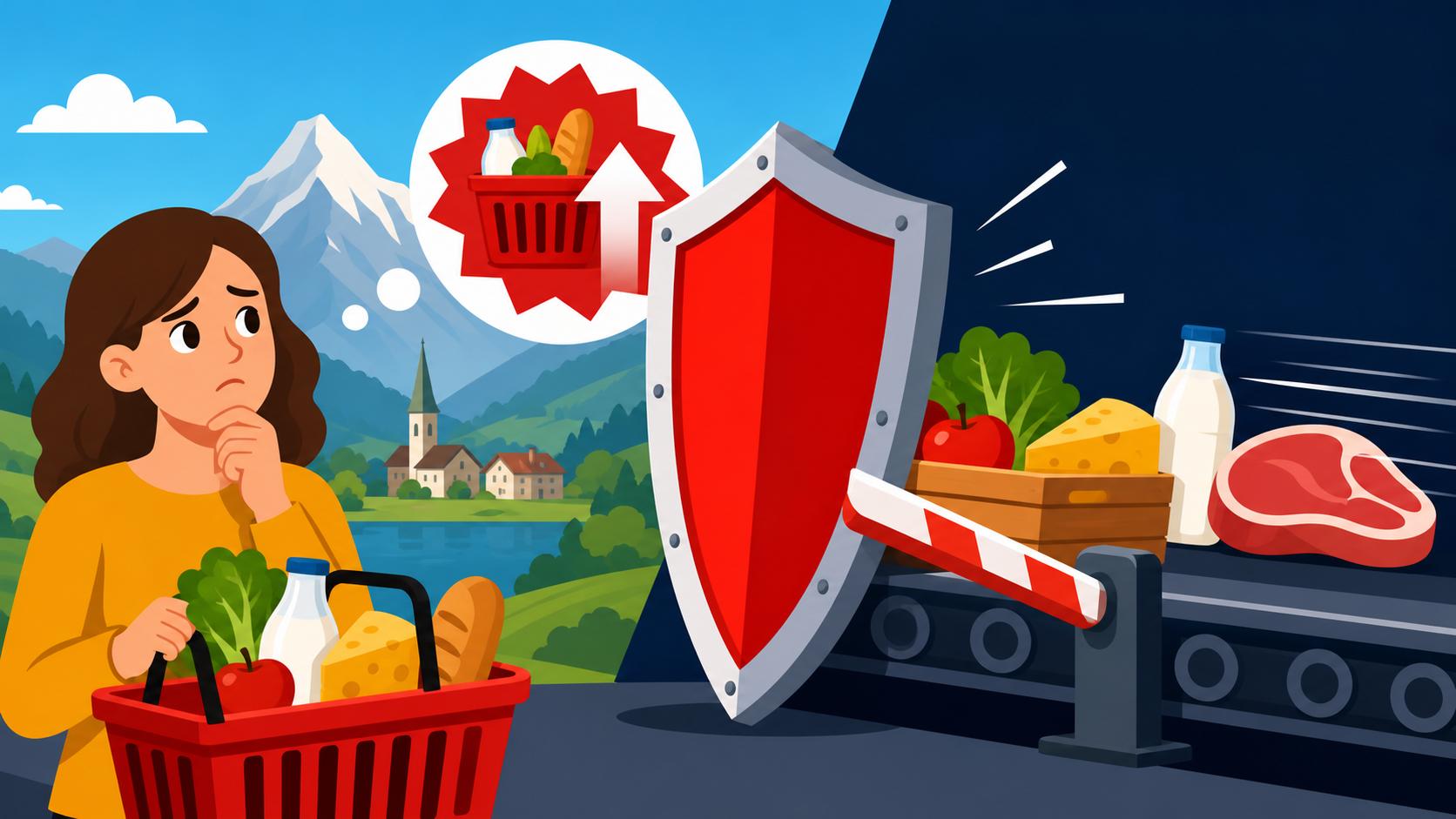
The primary reason a head of broccoli can double in price overnight is the Swiss system of seasonal import duties, often referred to as the "Phase System." The Federal Office for Agriculture (FOAG) monitors exactly how much of a certain crop is currently being harvested within Switzerland. If Swiss farmers have enough tomatoes to supply the country, the government slaps a massive tariff on imported tomatoes to ensure the Swiss ones sell first. As soon as the Swiss harvest runs out, the tariffs are lowered, and cheaper imports are allowed in. This is why you will see the price of seasonal vegetables fluctuate wildly depending on the time of year and the success of the local crop.
This protectionism extends even more fiercely to the meat and dairy sectors. Switzerland maintains some of the strictest animal welfare laws in the world, which naturally increases the cost of production. To prevent Swiss farmers from being undercut by massive industrial farms in the EU or South America, the border is guarded by heavy import quotas. Once the quota for the day or week is met, any additional meat coming across the border is hit with a duty that effectively doubles its price. This is a core part of the Cost of Living Realities: Groceries, Telecoms, and Household Expenses that catches people off guard. It is a deliberate "price wall" designed to keep the Swiss agricultural sector from collapsing under the weight of cheaper, foreign industrial competition.
When you look at the price of butter or cream, you are seeing the result of the "Green Side" of Swiss politics meeting the "Protectionist Side." The government provides subsidies to farmers, but those farmers are also protected from the global market. While this results in incredibly high-quality, fresh produce, it also means the consumer bears the brunt of the cost. For those living near the borders, this leads to the popular sport of cross-border shopping, but even that is strictly regulated. You must be aware of the Cross-Border Shopping: Import Duty Limits for Meat, Alcohol, and Cheese to avoid heavy fines at the customs office when returning from a trip to Konstanz or Annemasse.
| Food Category | Estimated Price Premium vs. EU | Reason for High Cost |
|---|---|---|
| Beef and Poultry | 150% – 200% | Strict import quotas and high animal welfare standards. |
| Dairy (Milk/Butter) | 40% – 60% | Swiss milk price protection and small-scale farming. |
| Seasonal Vegetables | 30% – 100% | Floating tariff rates based on local harvest volume. |
| Alcohol (Wine/Beer) | 10% – 20% | Lower tax compared to food, but higher retail margins. |
| Processed Goods | 20% – 40% | High domestic labor costs in manufacturing. |
The High Cost of the Swiss Supply Chain
Beyond the tariffs, the sheer cost of doing business in Switzerland is astronomical. When you buy a loaf of bread, you aren't just paying for flour and water; you are paying for the salary of the baker, the truck driver, and the cashier. Swiss wages are among the highest in the world, and this reflects in every step of the supply chain. Even the person stocking the shelves at 6:00 AM is earning a wage that allows them a dignified life in one of the world's most expensive countries. This is why even a software engineer's Average Salary for Software Engineers in Zurich (2026 Benchmarks) can feel stretched if they aren't careful with their spending habits.
Logistics also play a massive role. Switzerland’s geography—the mountains, the tunnels, and the strict laws regarding night-time truck driving—makes moving goods expensive. Furthermore, the retail market is dominated by a powerful duopoly: Migros and Coop. Together, they control a vast majority of the market share. While they are both cooperatives and technically owned by their members, they operate with significant pricing power. They have their own processing plants, their own transport fleets, and their own labels, which allows them to maintain high margins. While they offer excellent loyalty programs, as discussed in Migros vs Coop: Decoding the Swiss Supermarket Loyalty Programs, these points and stickers are often just a small rebate on a very high initial price.
Furthermore, Swiss consumers have historically shown a high "willingness to pay" for quality and local origin. There is a deep cultural pride in buying "Suisse Garantie" products. The Swiss are generally happy to pay more if it means supporting a farmer in the next village or ensuring a cow spent its summer in an Alpine pasture rather than a concrete stall. As an expat, you are essentially forced into this cultural pact. You cannot opt out of the high-wage, high-quality cycle unless you are willing to spend your weekends driving across the border and dealing with the logistical headache of currency conversion and customs limits.
Practical Tips for Surviving the Grocery Bill
Survival in the Swiss grocery landscape requires a change in strategy. You cannot shop the way you did in London, Sydney, or San Francisco. The first rule is to embrace the discounters. While Migros and Coop are the "big two," brands like Denner and Aldi: Budget Grocery Shopping in Switzerland have become essential for the savvy expat. Aldi and Lidl, in particular, have broken the traditional Swiss pricing model by bringing in more EU-sourced goods where the law allows and operating with leaner staff. I personally do my "dry goods" and cleaning supply run at Aldi, saving my Migros trips for fresh produce and specific Swiss treats that the discounters don't carry.
Another tip is to use technology to manage your funds and avoid hidden costs. If you are doing cross-border shopping or buying specialty items online from abroad, using a service like Wise is vital for getting the real exchange rate. I often use Wise to hold Euros for my monthly trip to Germany, which avoids the terrible conversion rates offered by traditional Swiss banks at the point of sale. If you manage to save a few hundred francs a month by shopping at discounters, putting that extra cash into a high-interest environment like Trade Republic or diversifying your assets through Binance can help build a "Switzerland buffer" for your long-term savings. The goal is to make sure the high cost of groceries doesn't eat into your ability to build wealth while you are here.
Finally, pay attention to the "M-Budget" and "Prix Garantie" lines. These are the value brands within Migros and Coop, respectively. They are often the exact same product as the name brand, just in simpler packaging. I have found that M-Budget flour, sugar, and basic pasta are indistinguishable from the luxury versions but cost 40% less. Also, timing is everything. Most Swiss supermarkets start marking down fresh items by 25% or 50% about two hours before closing, and on Saturday afternoons (since they are closed on Sundays), the discounts are even more aggressive. It might feel a bit frantic, but snagging a half-price rotisserie chicken or a bag of salad can make a huge difference in your monthly budget.
Maximizing Your Budget Beyond the Supermarket
If you are struggling with the grocery bill, you have to look at your finances as a whole. Sometimes, the easiest way to afford the food you want is to cut costs in other areas of your Swiss life. For example, finding Cheapest Ways to Transfer CHF Abroad: Wise vs Revolut vs Swiss Banks can save you hundreds of francs in fees over a year—money that can go directly into your food budget. Every franc saved on an international transfer or a banking fee is a franc that can go toward that expensive Swiss beef.
Furthermore, consider the "Stockpile and Save" method for non-perishables. When Migros has a 40% discount on coffee or laundry detergent (which they do several times a year in bulk "Action" weeks), buy enough to last six months. The Swiss system is designed around these cycles of high prices punctuated by aggressive, short-term sales. If you buy at full price, you are subsidizing the people who wait for the sales. Being proactive and using apps to track weekly flyers is not "cheap"—in Switzerland, it is considered being a responsible and "integriert" (integrated) resident.
Lastly, don't forget that your lifestyle choices impact your grocery needs. Eating a hot meal at a company canteen is often cheaper than buying the ingredients and cooking it yourself, thanks to employer subsidies. In Switzerland, the "Lunch Culture" is strong, and many people take advantage of these subsidies to have their main meal of the day at work. This leaves you with only a light "Abendbrot" (evening bread) to prepare at home, which can significantly lower your weekly supermarket spend and reduce the stress of navigating the meat aisle.
Disclaimer
The information provided in this guide is for general informational purposes only and does not constitute financial or legal advice. Prices, tariff regulations, and customs limits in Switzerland are subject to frequent change by federal and cantonal authorities. Always verify current import quotas and duty-free allowances with the Swiss Federal Customs Administration before attempting cross-border shopping. While we strive to keep our data accurate for 2026, the complexity of Swiss agricultural law means individual experiences may vary.