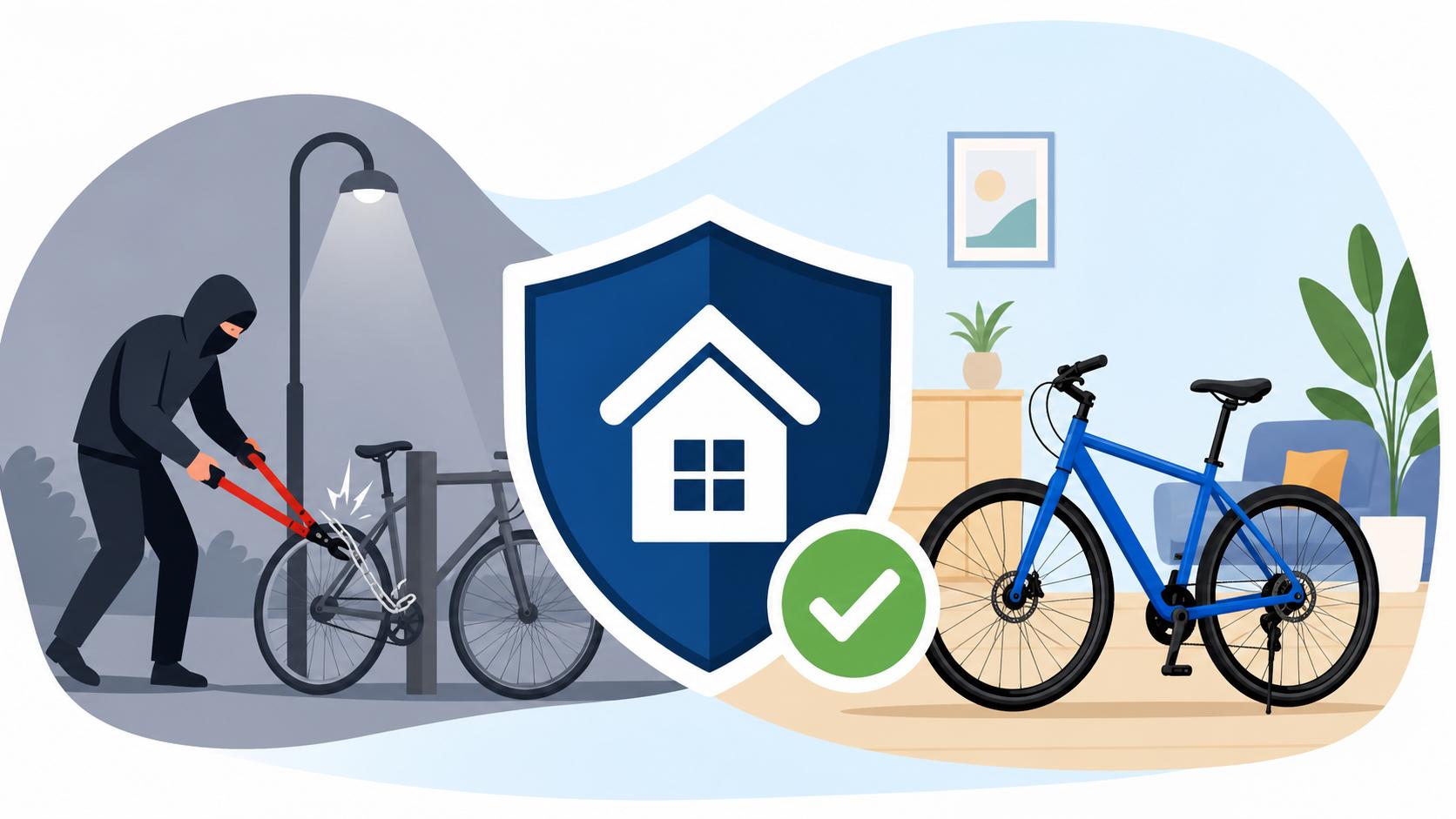
Adding Bicycle Theft Coverage to Your Hausratversicherung
You finally splurged on that sleek BMC or Flyer e-bike to conquer the steep hills of Lausanne, only to walk out of a cafe and find an empty space where your pride and joy used to be. I remember the sinking feeling when my unlocked city cruiser vanished in Basel; I foolishly thought Switzerland was immune to such petty crimes. This guide solves the mystery of the "Simple Theft Abroad" clause and shows you exactly how to protect your bicycle through your household insurance.
Understanding Hausratversicherung and the Simple Theft Abroad Clause
When you first arrive in Switzerland, the sheer volume of insurance acronyms can be overwhelming. You likely already know that Household Contents Insurance (Hausratversicherung): Burglary and Fire Coverage is a staple for anyone renting an apartment. However, what many expats fail to realize until it is too late is that the standard policy only covers your bicycle if it is stolen from your locked apartment or your private, locked cellar box. If your bike is snatched from the street, a train station, or even the shared bike room in your building, the basic policy usually offers zero protection.
To cover these common scenarios, you must add a specific rider to your policy known as "Einfacher Diebstahl auswärts" or Simple Theft Abroad. Despite the word "abroad," in Swiss insurance terminology, this actually means "anywhere outside your home premises," including within Switzerland. This clause is the single most important addition for any cyclist. It covers situations where your bike is taken without the use of violence or a break-in to a building—for example, if someone snips your lock while you are inside a supermarket.
The Definition of Simple Theft
In the eyes of a Swiss insurance adjuster, there is a massive legal distinction between a burglary and a simple theft. A burglary (Einbruchdiebstahl) involves someone breaking into a locked room to take your property. Simple theft (einfacher Diebstahl) occurs in public spaces. Without the specific add-on, your Mandatory and Optional Insurance: Liability, Legal, and Household coverage will treat a bike stolen from a public "Veloständer" as a total loss that you must bear personally.
When I first reviewed my policy after my Basel incident, I realized I hadn't ticked the box for simple theft abroad. I was out 800 CHF because I hadn't spent the extra 30 CHF a year for the rider. It is a frustrating lesson that many of us learn the hard way. The add-on doesn't just cover bikes; it often covers your phone, laptop, or skis if they are stolen while you are out and about.
Shared Bike Rooms and the Insurance Trap
Many Swiss apartment blocks have a communal "Veloraum." You might assume that because this room is inside the building, your standard insurance covers you. This is a dangerous misconception. Most insurance companies view the shared bike room as a "semi-public" space. Unless you have the simple theft abroad coverage, or unless your bike was stolen during a proven break-in where the main door to the room was forced open, they may deny the claim.
Even within a shared room, I always recommend locking your bike to a fixed object. If the thief enters through an accidentally propped-open door and your bike isn't locked, the insurance company might argue "Grobe Fahrlässigkeit" (gross negligence). If you find yourself needing to pay a high premium or a deductible after a theft, using a platform like Wise can be a cost-effective way to manage those unexpected international transfers if you are still using your home-country savings to bridge the gap.
How to Add Coverage and Calculate the Costs
Adding bicycle theft coverage to your Banking and Finance for Expats in Switzerland: The 2027 Guide plan is usually a straightforward process that can be done via your insurance provider’s app or website. Most major players like AXA, Mobiliar, or Zurich Insurance allow you to toggle this on instantly. However, you need to be precise about the value you are insuring.
The cost of adding "Simple Theft Abroad" usually ranges from 30 CHF to 100 CHF per year, depending on the "sum insured." You aren't just insuring the bike; you are setting a maximum limit that the insurance will pay out for any single event of theft outside the home. If you own a high-end e-bike worth 5,000 CHF, setting your simple theft limit at the standard 2,000 CHF will leave you with a massive financial hole.
Determining the Sum Insured
You should audit all the items you typically carry with you. If you go to a cafe with a 1,500 CHF bike and a 1,000 CHF laptop, you need a simple theft limit of at least 2,500 CHF. Swiss insurers usually offer limits in increments (2,000, 5,000, or 10,000 CHF). Be honest with yourself about the replacement cost. Remember that most Swiss policies pay out the "replacement value" (Neuwert), which is the price of buying a brand-new equivalent today, not what you paid for your bike three years ago.
If you are a hardcore cyclist with multiple bikes, check if your policy covers the total sum of all bikes or if the limit applies per incident. In most cases, it is per incident. If two of your bikes are stolen from your car rack at once, the limit applies to the total value of that specific theft. If you have extra cash sitting in a Best Neobanks in Switzerland: Neon, Yuh, and Zak Compared account, it might be tempting to self-insure, but for the sake of 40 CHF a year, the peace of mind is worth it.
The Deductible Factor
Almost every household insurance policy in Switzerland comes with a deductible (Selbstbehalt), usually 200 CHF. This means if your 800 CHF bike is stolen, the insurance company will pay you 600 CHF. Some insurers allow you to reduce this deductible to zero for an extra fee, but this is rarely worth the cost unless you are particularly prone to losing things.
| Coverage Type | Where it Applies | Required Insurance | Deductible |
|---|---|---|---|
| Burglary | Inside your locked apartment/cellar | Standard Hausrat | Usually 200 CHF |
| Simple Theft | Public bike racks, train stations | Simple Theft Add-on | Usually 200 CHF |
| Robbery | Theft involving force or threats | Standard Hausrat | Often 0 CHF |
| Shared Bike Room | Communal area in your building | Simple Theft Add-on | Usually 200 CHF |
If you manage to save money by choosing a higher deductible or a more competitive insurance provider, you might consider putting those savings into a diversified portfolio through Trade Republic to let your "insurance savings" grow over time.
The Claims Process What to Do When Your Bike Disappears
When you walk back to where you parked and find only a snipped lock—or nothing at all—time is of the essence. The Swiss system is incredibly efficient, but it requires you to follow a specific "paper trail" to ensure your claim isn't rejected. The frustration of dealing with a theft is high, but the bureaucracy doesn't have to be.
First, you must report the theft to the police. In most cantons, you don't even need to visit a police station; you can file a report through the "Suisse e-Police" online portal. You will need your bike’s frame number (Rahmennummer), brand, and model. If you haven't recorded your frame number yet, stop reading this and go do it now. Without a frame number, the police report is almost useless for recovery, and some insurance companies might give you a harder time.
Documentation Needed for the Insurer
Once you have the police report number (Polizeirapport), you can contact your insurance company. They will typically ask for:
- The official police report.
- The original purchase receipt for the bike.
- Proof of the lock you were using (sometimes).
- Photos of the bike (if available).
If you bought your bike second-hand, ensure you have a written receipt from the previous owner. You might want to refer to our guide on Buying a Used Bicycle: Checking Frame Numbers for Stolen Bikes to ensure you didn't accidentally buy a stolen bike yourself, which would obviously invalidate any future insurance claims. If the bike was a gift or the receipt is lost, you may need to provide a photo and a contemporary price list for a similar model.
Lock Requirements and Negligence
Does Swiss insurance require a specific type of lock? Generally, the "Simple Theft Abroad" clause requires the bike to be "sufficiently secured." This is a vague term. Most insurers don't mandate a specific brand, but they do require that the bike was actually locked. Leaving your bike "just for a minute" outside a bakery without a lock is considered gross negligence.
Some high-value policies for expensive e-bikes might require a lock with a specific security rating (like ART-2). Always read the fine print. If your lock was cut and left at the scene, take a photo of it. It serves as evidence that you took reasonable precautions. While we often think of Swiss culture as one of high trust, the Swiss Everyday Rules: Recycling, Quiet Hours, and Neighborhood Etiquette don't unfortunately apply to the international bike theft rings that operate in major cities like Zurich and Geneva.
Maximizing Your Protection Beyond Basic Insurance
If you own a high-end racing bike or a cargo e-bike worth more than 7,000 CHF, your standard household insurance might not be enough even with the add-on. In these cases, you might look into specialized bicycle insurance. These policies often cover accidental damage, wear and tear, and even battery failure for e-bikes—things a standard Cost of Living in Switzerland 2026: Budgeting for Singles and Families audit would show are significant risks.
Specialized insurance is more expensive but often has a zero-franc deductible and global coverage. This is particularly useful if you take your bike on cycling holidays to Italy or France. Just as you might secure your digital assets on Binance with multiple layers of authentication, your high-value physical assets deserve more than just a basic policy rider.
Registering Your Bike with National Databases
The old "Velovignette" (the little red sticker) was abolished in 2012, but it was replaced by private registration databases. I highly recommend registering your bike with a service like "Veloregister" or "BikeFinder." These services allow the police to quickly link a recovered bike to its owner. Some insurance companies even offer a discount on your premium if your bike is registered and microchipped.
Additionally, consider using a hidden GPS tracker like an AirTag or a specialized bike GPS. While the police might not always rush to a location based on an AirTag ping, having that data can be a game-changer if you can prove to the insurer that you tracked the bike to a specific warehouse or location.
Final Tips for the Expat Cyclist
Being an expat means navigating a new set of risks. Don't let a stolen bike ruin your experience of the beautiful Swiss outdoors. Double-check your policy today. Look for the line item "Einfacher Diebstahl auswärts" and ensure the sum insured matches your current "Velo" fleet. If you are regularly transferring money for your Cost of Living Realities: Groceries, Telecoms, and Household Expenses, make sure your insurance premiums are factored into your monthly budget. A small investment in the right coverage today prevents a massive headache tomorrow.
Disclaimer
This guide is for informational purposes only and does not constitute professional insurance or financial advice. Insurance terms and conditions in Switzerland can vary significantly between providers and cantons. Always read your specific policy "Allgemeine Versicherungsbedingungen" (AVB) and consult with a licensed insurance broker before making any decisions regarding your coverage.