Earning Over CHF 120,000: Transitioning to Standard Taxation
Crossing the CHF 120,000 threshold in Switzerland feels like a major career milestone until you realize the administrative shift it triggers for your personal finances. I still remember the cold sweat I broke into when I realized my simple monthly deductions were no longer enough to satisfy the cantonal tax office. This guide breaks down exactly how to transition to standard taxation without losing your mind or your hard-earned savings.
Crossing the Threshold: What Actually Happens at CHF 120,000
For most expats arriving in Switzerland on a B permit, the tax system is blissfully invisible. Your employer deducts a flat rate from your salary every month, handles the paperwork, and you receive your net pay. This is known as withholding tax, and for many, it is the end of the story. However, the moment your gross global income exceeds CHF 120,000 in a single tax year, the Swiss authorities shift you into a different category. You are now required to undergo what is called "Nachträgliche Ordentliche Veranlagung" (NOV), or retrospective ordinary assessment.
The first thing to understand is that the CHF 120,000 limit is not just about your base salary. The tax office looks at your total compensation package. This includes your 13th-month salary, any performance bonuses, equity grants, and even fringe benefits like a company car or housing allowance. I’ve seen colleagues caught off guard because a one-time signing bonus pushed them CHF 500 over the limit, triggering a mandatory filing requirement they weren't prepared for. You can find a detailed breakdown of these items by Understanding Your Swiss Salary Certificate (Lohnausweis) for Tax Season to see exactly what counts toward that magic number.
It is also vital to note that once you cross this threshold, you are generally in the "standard" system for good. Even if your income drops back down to CHF 115,000 the following year, most cantons will require you to continue filing a full tax return. This is a significant shift in your relationship with the Swiss state. You are no longer just a passive participant in the tax system; you are now an active filer responsible for the accuracy of your financial declarations. This is why Withholding Tax (Quellensteuer) vs Standard Taxation for Foreigners is such a critical topic to master as your career progresses.
The transition doesn't mean your employer stops deducting tax. They will still take the Quellensteuer out of your monthly paycheque. However, that amount is now treated merely as an "advance payment." At the end of the year, you file a return, the tax office calculates your actual tax liability based on your specific life circumstances, and you either pay the difference or receive a refund. In high-tax cantons like Zurich or Geneva, the difference between the withholding rate and the ordinary rate can be thousands of francs, making it essential to understand Swiss Taxes Explained: Federal, Cantonal, and Municipal Rates before the bill arrives.
The Mandatory Tax Return: Navigating the NOV Process
Once you hit that 120k mark, the "yellow envelope" becomes a fixture of your spring. In Switzerland, the tax year follows the calendar year, and you are typically required to submit your return by March 31st of the following year. If you are used to the simplicity of withholding tax, the sudden requirement to document every bank account, insurance policy, and asset can feel overwhelming. I remember my first time sitting with the "Private Tax" software, staring at the screen and wondering why on earth they needed to know about a savings account I hadn't used in five years.
The documentation phase is where most expats struggle. You will need your salary certificate, but you also need to gather statements for every bank account you hold globally. If you use international services like Wise to manage your multi-currency life, you must include those balances as of December 31st. Swiss tax authorities are increasingly diligent about global asset transparency. When Filing a Swiss Tax Return (C Permit or High Earners on B Permit), you are declaring your worldwide wealth, not just your Swiss income. This is part of the Wealth Tax in Switzerland: How Global Assets Are Assessed process, which applies to everyone in the ordinary taxation system.
To make the process easier, every canton provides its own tax software (like Zurich’s "ZHprivateTax" or Vaud’s "VaudTax"). These programs are generally quite logical, but they are rarely available in English. This is where many high-earning expats choose to hire a tax consultant. While a consultant might cost you CHF 500 to CHF 1,000, they often find deductions you would have missed, such as specific professional training costs or international social security offsets. If you're managing a complex portfolio across platforms like Trade Republic, having a professional ensure your dividend income is correctly reported can save you from a stressful audit later.
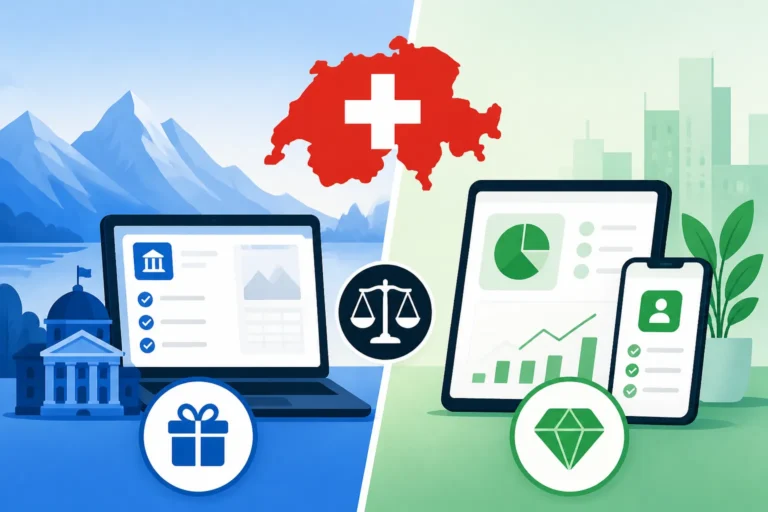
The following table illustrates the primary differences you will face when moving from simple withholding to the ordinary assessment system:
| Feature | Withholding Tax (Quellensteuer) | Standard Taxation (NOV) |
|---|---|---|
| Filing Requirement | None (unless requesting corrections) | Mandatory annual return |
| Deductions | Flat-rate / Standardized | Itemized (Real costs) |
| Wealth Tax | Usually ignored in the flat rate | Mandatory declaration of global assets |
| Finality | Monthly deduction is final | Monthly deduction is an advance payment |
| Global Income | Often only Swiss income is taxed | Worldwide income and assets assessed |
Maximizing Deductions: How to Lower Your Taxable Income
The "silver lining" of being forced into the standard taxation system is that you can finally claim itemized deductions. Under the withholding tax system, the government assumes a certain level of expenses for you. Once you file a full return, you can prove that your actual expenses were higher. This is where you can significantly lower your taxable income. For high earners, the most powerful tool in the shed is Pillar 3a in 2026: Tax Deductions, Limits, and Investment Options. Every franc you contribute to your 3a account (up to the annual limit) is deducted directly from your taxable income.
I cannot emphasize this enough: if you earn over 120k and you aren't maximizing your Pillar 3a, you are essentially leaving money on the table. For 2026, the limit for employees is CHF 7,258. If you are in a high-tax bracket, this contribution could reduce your tax bill by CHF 1,500 to CHF 2,500 depending on your canton of residence. You can even choose to invest these funds into low-cost ETFs to grow your wealth while saving on taxes. For a step-by-step on how to do this, check out Exactly How to Claim the CHF 7,258 Pillar 3a Tax Deduction for 2026.
Beyond pensions, you should look at your professional expenses. Do you commute by train? You can deduct the cost of your SBB travelcard. Do you eat lunch away from home? There is a standard deduction for that. Have you invested in a home office or professional development courses? These are all fair game. Even the interest on your credit cards or personal loans can sometimes be deducted. When you are managing your daily finances and Banking and Finance for Expats in Switzerland: The 2027 Guide, keep a folder—digital or physical—for every receipt that could potentially be a deduction.
Finally, don't overlook medical expenses and charitable donations. While standard Swiss health insurance premiums aren't fully deductible in all cantons, the out-of-pocket costs (your franchise and 10% co-pay) can be deducted if they exceed a certain percentage of your income. If you are someone who optimizes their health by ordering supplements via iHerb or using private clinics, keep those records. Even small things add up when you are trying to offset the Cost of Living in Switzerland 2026: Budgeting for Singles and Families and keep more of your 120k+ salary in your own pocket.
Financial Management for High Earners: Life After the Transition
Transitioning to standard taxation requires a mental shift in how you view your monthly paycheque. When you were on simple withholding tax, the money that hit your account was "yours." Now, you have to operate with the awareness that you might owe the government a significant sum at the end of the year. I always advise expats in this bracket to set aside an additional 5% to 10% of their net income into a separate high-interest savings account. If you use a modern investment platform like Trade Republic, you can earn interest on that "tax cash" while you wait for the final bill to arrive.
Another layer of complexity for high earners is the declaration of "alternative" assets. If you have been active in the crypto markets using Binance or other exchanges, these must be declared as part of your wealth. Switzerland is actually quite crypto-friendly; there is generally no capital gains tax for private investors. However, the value of your holdings on December 31st counts toward your wealth tax. If you fail to declare these and the tax office finds out later—perhaps through international data sharing—the fines and back-taxes can be brutal. It is always better to be transparent from day one.
You should also take this transition as an opportunity to review your overall long-term strategy. Being in the standard tax system makes you a "real" player in the Swiss economy. You might start looking at The Three-Pillar Pension System: AHV, BVG, and Private Savings with more scrutiny. Perhaps you’ll consider a "voluntary buy-in" to your Pillar 2 (company pension). These buy-ins are also fully tax-deductible and can be a massive win for someone earning over 120k who wants to reduce their tax burden while securing their future in the Alps.
Ultimately, crossing the 120k threshold is a "good problem" to have. It means you are succeeding in one of the most competitive job markets in the world. Yes, the paperwork is a nuisance, and yes, the first time you see a five-figure tax bill it will hurt. But with a bit of preparation, a solid understanding of the deductions available to you, and a disciplined approach to your global asset reporting, you can navigate this transition smoothly. Welcome to the world of standard Swiss taxation—it's a bit more complex, but it's a journey every successful expat eventually takes.
Disclaimer
This article is for informational purposes only and does not constitute professional tax, legal, or financial advice. Swiss tax laws are subject to frequent changes at the federal, cantonal, and municipal levels. Always consult with a qualified Swiss tax fiduciary or accountant to discuss your specific financial situation and ensure compliance with current regulations. This content is based on the 2026 tax year standards.