Understanding Swiss Table Manners and Dining Customs
You've just landed a dinner invitation to a Swiss home, or perhaps you're venturing out to a charming local restaurant, and suddenly, a quiet panic sets in: what are the rules? The Swiss, while incredibly hospitable, have a subtly nuanced approach to dining that can feel like navigating a minefield if you're not in the know. From the sacred timing of your arrival to the precise use of cutlery, and even the unwritten laws of fondue, misunderstandings can easily arise. This guide is here to demystify Swiss table manners and dining customs, offering you the insights of a seasoned expat so you can enjoy your meals with confidence and avoid those awkward moments.
The Punctuality Principle and Pre-Meal Etiquette
Let's be real, the Swiss are famous for their precision, and this absolutely extends to social engagements, especially dining. Unlike some cultures where "fashionably late" is a thing, here it’s more like "fashionably on time, or even a smidgen early."
Timeliness is a Virtue Not Just a Suggestion
If you're invited to dinner at 7 PM, your host expects you to be there at 7 PM. Not 7:05, and definitely not 7:15. This isn't about being rigid; it's a deep-seated respect for other people's time and planning. Imagine your host has meticulously timed their cooking, perhaps the cheese soufflé will be perfect then, or the fondue is just about to melt. Your delay disrupts this flow, suggesting a lack of consideration.
In many other parts of the world, arriving 10-15 minutes late is totally acceptable, sometimes even preferred. Not in Switzerland. Here, lateness can genuinely be perceived as rude. It implies you don't value your host's effort or time. The best approach is to aim to arrive precisely on time. If you find yourself a few minutes early, it's often better to wait outside discreetly for a minute or two rather than ringing the doorbell too soon. It gives your host a final moment of preparation.
Now, life happens, right? Trains get delayed, traffic snarls, or you get utterly lost despite Google Maps. If you anticipate being unavoidably late – even by five minutes – the absolute golden rule is to communicate immediately. A quick SMS or phone call with a sincere apology and an estimated arrival time goes a long way. "I am so sorry, my train is delayed by five minutes, I will be there at 7:05 sharp!" will save you a lot of social discomfort. It shows you respect their schedule even when circumstances conspire against you.
The Apéro Ritual: More Than Just a Drink
Before the main event, especially at private home invitations, you'll often be invited for an Apéro. This isn't just a casual pre-drink; it's a structured social preamble. Think of it as a warm-up act for the dinner itself. The Apéro typically involves a selection of drinks – often white wine, beer, or a non-alcoholic option – and light finger foods. You might find delicious local cheeses, olives, nuts, or small crackers.
The purpose of the Apéro is to allow guests to arrive, mingle, and relax before sitting down for the formal meal. It's a chance to catch up, introduce new faces, and ease into the evening. Crucially, it is not a mini-meal. Do not arrive ravenous and proceed to fill up on all the Apéro snacks. While your host wants you to enjoy them, they are appetizers, meant to whet your appetite, not satiate it. Overindulging might suggest you're not looking forward to the actual dinner, or worse, that you're cheaping out on the main course.
During the Apéro, feel free to engage in light conversation. It’s also a good time to observe others: do they take small portions? How quickly are drinks refilled? If you're wondering if you should offer to bring something, a bottle of wine or a nice dessert are generally appreciated if you're the guest of honor, but sometimes a host might prefer to handle everything. If you're attending a larger event, perhaps even one organized through platforms like Booking.com that might include catering, the Apéro serves the same social purpose. If you're planning on joining any social events during your stay, understanding the local "apéro culture" will serve you well. Our guide on Apéro Culture: Socializing with Coworkers After Work dives deeper into this essential Swiss tradition.
Gift-Giving and Guest Contributions
When invited to someone's home, it's customary to bring a small gift for the host. This gesture of appreciation is always well-received and shows you value their hospitality. It doesn't need to be extravagant; thoughtfulness is key.
Appropriate gifts often include a good bottle of wine (ideally Swiss, but a nice international bottle is also fine), a bouquet of flowers, or high-quality Swiss chocolates. If you bring flowers, make sure they are unwrapped or elegantly presented; bringing them in their supermarket plastic might seem a bit rushed. Avoid overly personal gifts unless you know the host very well. The idea is to contribute a little something to the evening's enjoyment or as a token of thanks.
Once you've presented your gift, your host might offer to take your coat or show you around. It's polite to offer to help, for example, by asking, "Can I help set the table?" or "Is there anything I can do in the kitchen?" However, be prepared for a polite refusal. Swiss hosts often prefer to manage everything themselves and might see your help as an imposition rather than a genuine offer. If they decline, respect their wishes and don't insist. Your presence and good company are truly what they're after.
Navigating the Main Course: Utensils, Portions, and Conversation
Once the Apéro winds down, you'll usually be invited to sit at the dinner table. This is where a bit of quiet observation and knowledge of proper etiquette can make all the difference.
The Utensil Dance: From Outside In
Swiss dining, even in a home setting, can be surprisingly formal when it comes comes to table settings. Don't be alarmed if you see a full array of forks, knives, and spoons laid out. This isn't to test your etiquette skills, but rather a reflection of organized dining.
The golden rule for using cutlery is simple: work from the outside in. The fork furthest from your plate on the left, and the knife furthest on the right, are for your first course. As each course is served, you'll move to the next set of utensils closer to your plate. If there's a small fork or spoon above your plate, that's typically for dessert. This system is designed for ease, but it can feel a bit like a test if you're not used to it!
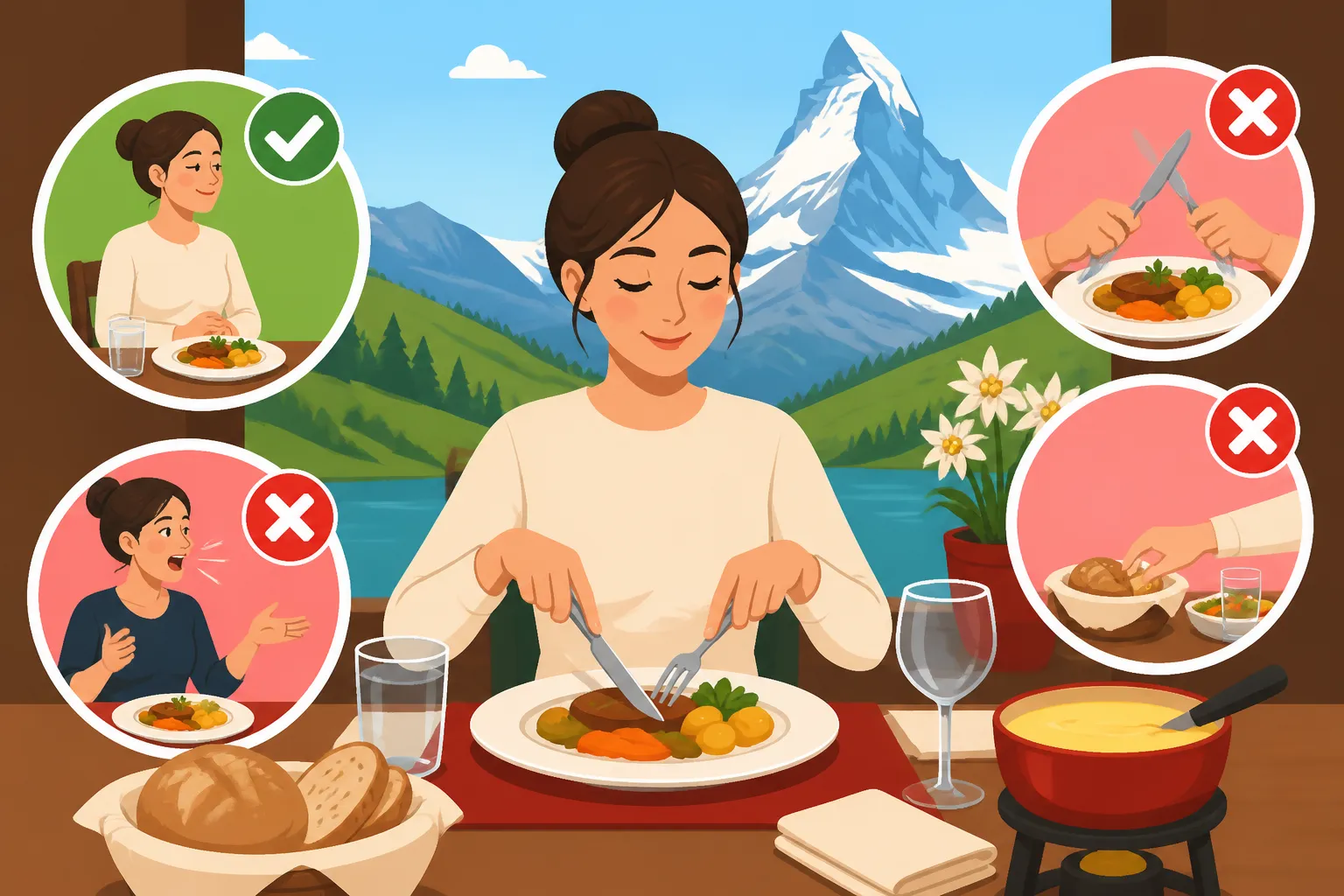
As for how to hold your utensils, the continental style is common: fork in the left hand (tines down), knife in the right. Food is cut with the knife and eaten directly with the fork in the left hand, without switching hands. When resting between bites, place your knife and fork on your plate in an "X" shape or angled inwards, resting on the plate, not on the table. Once you are completely finished with a course, place your knife and fork parallel to each other at the 4 o'clock position on your plate, signaling that your plate can be cleared. Mastering these subtle signals will make you feel much more comfortable.
Portion Sizes and Second Helpings
Unlike some countries where larger-than-life portions are the norm, Swiss serving sizes are generally moderate and considered. This aligns with a culture that values quality over sheer quantity, and aims to avoid waste. Don't expect your plate to be overflowing from the start.
If it's a family-style meal where dishes are passed around, serve yourself a reasonable portion first. You can always ask for more later. It’s polite to wait for the host to offer second helpings, which they almost always will if there's plenty of food. If you'd like more, accept gracefully. If you're full, a simple "Nein danke, es war sehr gut, aber ich bin satt" (No thank you, it was very good, but I am full) is perfectly acceptable. Avoid piling your plate high at the first pass, as it can be seen as greedy.
A crucial, often unspoken rule: always try everything offered, even if it’s just a small bite. Refusing food outright without trying it can be perceived as disrespectful to the host’s cooking efforts. If you have dietary restrictions, it's always best to inform your host in advance. They will almost certainly accommodate you. For a deeper dive into the delicious local offerings, check out our guide on Swiss Food and Drink Culture: Regional Specialties and Dining Etiquette.
Toasting and Table Talk
The Swiss enjoy their meals, but it’s rarely a boisterous affair at a private dinner. Conversation tends to be polite, engaging, and generally steers clear of highly controversial topics, especially at initial meetings.
Toasting is a definite ritual. When someone raises a glass and says "Prost!" (German), "Santé!" (French), or "Salute!" (Italian), make sure to look each person in the eye as you clink glasses (or just raise your glass in their direction if they're across the table). It’s a moment of connection and mutual respect. Don't sip before you've made eye contact.
Table talk should generally be light and pleasant. Safe topics include travel, culture, work (generalities, not specifics about salary or company politics unless you know people well), hobbies, and observations about Switzerland. Avoid bringing up politics, religion, or personal finances unless you are very close friends and the topic is introduced by someone else. The Swiss value privacy, and these topics can quickly make people uncomfortable. Keep your elbows off the table, and while it's okay to gesture, avoid overly dramatic hand movements that might knock things over. A good expat tip: if you're ever visiting a new city and want to find unique dining experiences, platforms like GetYourGuide sometimes offer culinary tours that can help you ease into local customs while enjoying the food.
The After-Meal Experience: Coffee, Digestifs, and Departure
The end of the meal isn't a race to the door. It's a gradual winding down, an extension of the hospitality, and it has its own set of expectations.
Coffee, Dessert, and the Digestif
Once the main course plates are cleared, the next phase of the evening begins. Typically, dessert will be served, followed by coffee. This isn't just a caffeine fix; it's another opportunity for conversation and enjoyment. Desserts might range from simple fruit tarts to more elaborate cakes.
After coffee, it's common for a digestif to be offered. These are alcoholic beverages meant to aid digestion, hence the name. Popular choices include local fruit brandies like Kirsch (cherry schnapps), Pflümli (plum schnapps), or Grappa. If you're not a drinker, it's perfectly fine to decline with a polite "Nein danke." No one will be offended.
The key here is not to rush. These post-meal moments are integral to Swiss hospitality. It's when guests often feel most relaxed, and conversations can become a bit more personal. Embrace the slower pace, savor the flavors, and enjoy the company. It's a time for lingering and making memories, not checking your watch every five minutes. Don't be surprised if the evening stretches on a bit longer than you'd expect, especially at a private home.
The Departure Protocol
Deciding when to leave a dinner party can be tricky in any culture, and Switzerland is no exception. Leaving immediately after dessert or coffee is generally considered abrupt. The lingering conversation over digestifs is part of the experience.
However, you also don't want to overstay your welcome. A good rule of thumb is to wait for a natural lull in the conversation or observe if other guests are starting to make their goodbyes. When you're ready to leave, stand up and approach your hosts. Offer a sincere thank you for their hospitality, for the wonderful food, and for inviting you. A simple "Danke vielmals für den schönen Abend und das köstliche Essen!" (Many thanks for the lovely evening and delicious food!) goes a long way.
A follow-up thank you is also highly appreciated. This could be a text message, an email, or even a handwritten card sent the next day. It reinforces your gratitude and makes a lasting positive impression. This politeness extends to all social interactions here. For more insights into general social norms, our article on Swiss Customs and Etiquette: Social Norms Every Newcomer Should Know offers a broader perspective.
Restaurant Realities: Tipping and Splitting Bills
Dining out in Switzerland is a different beast compared to home invitations, but some core principles remain. The service culture is professional, though perhaps not as effusive as in other countries.
First off, let’s talk about tipping. Unlike North America where 15-20% is expected, in Switzerland, service is always included in the bill. You are not obligated to leave an additional tip. However, it's customary and appreciated to round up the bill slightly, especially if the service was good. For example, if your bill is CHF 47, you might round it up to CHF 50. For larger bills, a few francs (CHF 2-5) for excellent service is a generous gesture, but never feel pressured to leave a significant percentage. Our guide on Tipping in Switzerland: Is Service Included in Restaurant Bills? provides a comprehensive overview.
Splitting bills can be straightforward or slightly complicated depending on the group. If you're with friends, it's common for everyone to pay for their individual orders. Don't assume the bill will be split evenly unless it's explicitly discussed and agreed upon. Most restaurants are equipped to handle separate payments by card or cash, but it’s always easier if you clearly state "Wir möchten getrennt bezahlen" (We would like to pay separately) at the beginning of the transaction. For making restaurant reservations, especially in popular spots or during peak tourist seasons, using platforms like Booking.com, which sometimes integrate restaurant reservations, or even just calling directly, is highly advisable. Exploring the dining scene is part of the experience, and you can easily plan your journeys to different culinary hotspots using platforms like Omio.
Cultural Nuances and Practical Tips for Expats
Beyond the specific mechanics of dining, there are broader cultural undercurrents that influence how meals are experienced in Switzerland. Understanding these will help you integrate more smoothly.
The Unspoken Rules of Swiss Hospitality
Swiss hospitality, while perhaps more reserved than Mediterranean cultures, is deeply genuine. It’s built on reliability, quality, and a quiet warmth. You won’t always find effusive displays, but you will find meticulous planning and thoughtful execution.
One key aspect is the value placed on cleanliness and orderliness. This isn’t just about the dining table; it extends to the entire home and public spaces. A well-kept home is a point of pride for a host, and showing respect for it (e.g., taking off shoes if requested, being tidy) is important. During a meal, maintaining a clean eating space around your plate is also a subtle sign of good manners.
Swiss people also value quiet and personal space. While dinner conversation is encouraged, it’s rarely boisterous. Loud talking, shouting across the table, or excessive laughter might be seen as disruptive. Conversations tend to be contained within smaller groups at the table, creating a more intimate atmosphere. It’s about being present and engaged with those immediately around you without imposing on the entire room.
Language and Regional Differences
Switzerland is a fascinating mosaic of cultures and languages, and dining customs can have subtle regional variations. While the core principles of politeness and punctuality apply everywhere, the feel can be different.
In the German-speaking parts (like Zurich, Bern, Basel), dining tends to be a bit more structured and formal. Conversations might be more direct. In the French-speaking Romandie (Geneva, Lausanne), there might be a slightly more relaxed, leisurely pace, perhaps a bit more emphasis on the culinary experience itself. In the Italian-speaking Ticino, meals might feel more convivial and drawn out, reminiscent of Italian family dinners. Learning a few basic phrases in the local language – such as "Guten Appetit!" or "En Guete!" (Swiss German for "Enjoy your meal"), "Bon appétit!" (French), and "Buon appetito!" (Italian) – will always be appreciated. Similarly, "Danke schön," "Merci beaucoup," or "Grazie mille" for "thank you" will show respect for the local culture. Exploring different regions will not only expose you to varying dining etiquette but also to Switzerland's four language regions.
Mastering the Art of Eating Fondue and Raclette
These aren’t just meals; they’re social rituals with their own specific rules. Mastering them is a badge of honor for any expat.
Fondue: Whether it’s cheese fondue or Fondue Chinoise (meat fondue), the communal pot is central. For cheese fondue, the primary rule is: don't lose your bread in the pot! If you do, tradition dictates some form of playful "punishment" – perhaps buying a round of drinks, doing a silly dance, or telling a joke. It’s all in good fun, but it keeps everyone mindful. And definitely, no double-dipping. Your bread cube should be impaled on your long fork, swirled once, and then transferred to your plate before eating. The "religieuse" (the crispy cheese crust at the bottom) is often scraped out and shared at the end, a delicacy.
Raclette: This is a more individual experience, but still very social. Each person has a small pan (coupelle) to melt their slice of raclette cheese under a grill. The melted cheese is then scraped onto a plate, usually accompanied by boiled potatoes, pickled onions, and gherkins. The pace is slow, allowing for multiple rounds of melting and plenty of conversation. Don't rush others, and take your time to enjoy the simple, delicious ritual. The goal is enjoyment and shared time, not speed-eating. Learning the ins and outs of these beloved dishes is crucial, and our dedicated article on Fondue and Raclette Culture: How and When the Swiss Eat Them offers all the juicy details.
Here's a quick summary table to keep you on the right track:
| Aspect | Do | Don't |
|---|---|---|
| Punctuality | Arrive precisely on time (or 1-2 min early). | Arrive late without prior communication. |
| Apéro | Enjoy light snacks and conversation. | Fill up entirely on appetizers. |
| Host Gift | Bring a small, thoughtful gift (wine, flowers). | Show up empty-handed or with a cheap, last-minute item. |
| Cutlery Use | Use from outside-in; knife in right, fork in left. | Switch hands constantly or eat with just a fork. |
| Portions | Take moderate portions; wait for second helpings. | Pile your plate high or refuse to try food. |
| Toasting | Make eye contact with everyone. | Sip before toasting or look away. |
| Conversation | Keep it light and pleasant; listen attentively. | Talk loudly, interrupt, or discuss controversial topics. |
| Departure | Thank hosts sincerely; send a follow-up message. | Leave abruptly after the main course. |
| Restaurant Tipping | Round up bill slightly for good service (CHF 2-5). | Leave a large percentage or no tip at all for good service. |
| Fondue Etiquette | Don't lose bread in the pot; no double-dipping. | Be careless with your bread cube. |
Understanding and respecting these customs will not only help you avoid awkward situations but will also deepen your appreciation for Swiss culture and enhance your dining experiences, making you feel more at home in this beautiful, precise, and genuinely warm country.
Disclaimer
The information provided in this guide is for general informational purposes only and does not constitute professional advice. While we strive to offer accurate and up-to-date content, customs and regulations can change. Always verify information with official sources or local experts. Personal experiences may vary.