Palliative Care and Advanced Directives (Patientenverfügung) in Switzerland
Dealing with the Swiss medical system is a headache when you are healthy, but facing end-of-life decisions in a second language feels like hitting an insurmountable wall. I remember sitting in a sterile waiting room in Zurich, helping a friend’s parents navigate paperwork after a sudden stroke, and realizing how little we understood about Swiss medical autonomy. This guide demystifies palliative care and advanced directives in Switzerland, ensuring your wishes are respected legally and culturally.
The Swiss Approach to Palliative Care Quality of Life and Autonomy
When we talk about palliative care in Switzerland, we are looking at a system that is world-renowned for its focus on dignity, but it operates with a "Swiss-ness" that can feel quite bureaucratic to an outsider. Palliative medicine here isn't just about the final days; it is a holistic approach to life-limiting illnesses, focusing on pain management, psychological support, and social care. The goal is to maximize the quality of life, which often aligns with the Swiss value of self-determination.
In my years here, I’ve seen how Healthcare in Switzerland for Expats: The Complete System Overview (2027) provides the foundation, but palliative care is where the system gets deeply personal. You can receive this care in various settings: at home via specialized Spitex Services for Elderly Expat Relatives Living in Switzerland, in a dedicated hospice (like the Villa-Aduna in Zurich), or within a palliative ward in a major hospital like the University Hospital Basel or CHUV in Lausanne. The integration of these services is high, but the cost-sharing can be complex. While the Understanding KVG/LAMal: Mandatory Basic Health Insurance Explained covers a significant portion of medical treatments, the non-medical "care" costs—the daily room and board in a hospice, for example—often fall on the patient or require specific supplementary insurance.
For many expats, especially those moving here mid-career or bringing older parents, the standard Swiss health insurance may feel restrictive regarding which "luxury" care facilities you can access. This is where brands like Cigna Global become highly relevant. Having international coverage can often bridge the gap between basic Swiss wards and the private, more comfortable palliative suites that offer a bit more "home away from home" feel for international families. I’ve noticed that having that extra layer of private insurance reduces the stress of wondering if your The Swiss Franchise System: How Deductibles and Copays Work will suddenly spike during a time when you should be focusing on family, not bank statements.
Creating Your Patientenverfügung The Legal Shield for Your Medical Wishes
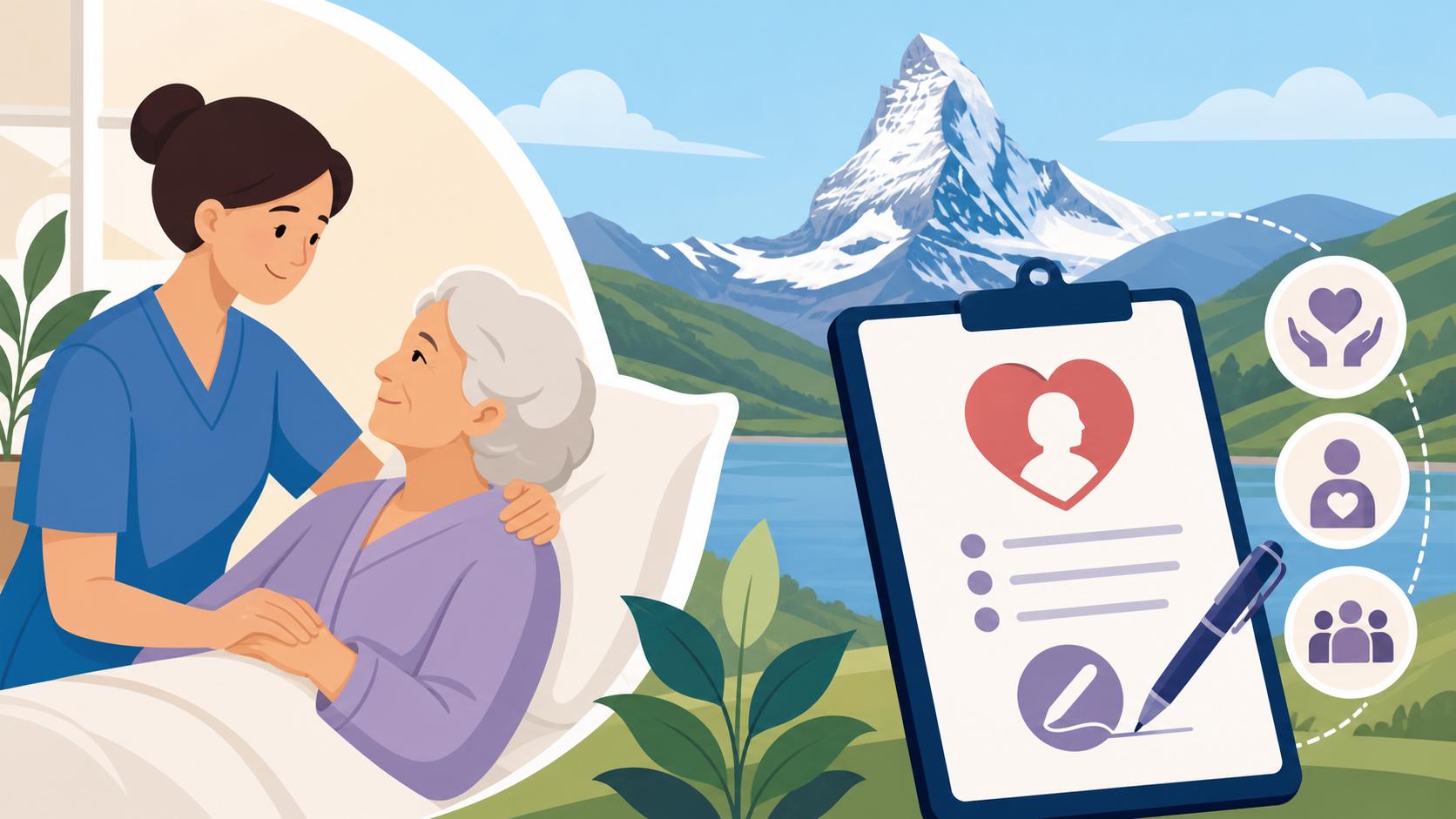
In Switzerland, the Patientenverfügung (Advanced Directive) is your most powerful tool. It is a written document where you specify which medical treatments you accept or reject in case you lose the capacity to judge or communicate. Without this, the burden falls on your next of kin, who may be forced to make agonizing decisions under the pressure of Swiss medical protocols. Swiss doctors are legally obligated to follow a valid directive, so this isn't just a "suggestion"—it’s a command.
Writing a directive in a foreign country is intimidating because the terminology is so specific. I’ve seen people struggle to find the right words to describe "ventilation" or "artificial nutrition" in German or French. This is why Translating Medical Records from English to German/French for Your Hausarzt is a crucial step if you have pre-existing conditions. You want your directive to be crystal clear. Most expats find that the templates provided by FMH (the Swiss Medical Association) or Pro Senectute are the most "doctor-friendly." These templates are structured in a way that Swiss medical professionals recognize immediately, reducing the risk of a "wait-and-see" approach during Emergency Medical Services: Ambulances, REGA, and Crisis Protocols.
| Feature | FMH Template | Pro Senectute Template | DIY Letter |
|---|---|---|---|
| Legal Standing | Very High | Very High | Moderate (Risk of ambiguity) |
| Medical Clarity | High (Uses clinical terms) | High (User-friendly) | Low |
| Ease of Use | Requires some medical knowledge | Designed for laypeople | Difficult |
| Cost | Free (Online) | Small fee for booklet | Free |
When filling this out, you should also designate a Vorsorgebeauftragte (a healthcare proxy). This is someone who has the power to represent you. For many of us, our family is back in the UK, US, or India. This creates a massive logistical hurdle. If your proxy isn't in Switzerland, the hospital might involve the KESB (Child and Adult Protection Authority), which can feel very invasive. I always recommend finding a local friend or a trusted Finding an English-Speaking Family Doctor in Zug or whatever canton you reside in, to act as a local point of contact who knows where your documents are stored.
Storage and Communication Making Sure Your Directive is Found
A Patientenverfügung is useless if it’s locked in a safe-deposit box while you’re in an ICU. In Switzerland, there is no central federal database for these documents yet, although some cantons are moving toward electronic patient dossiers (EPD). For now, the system relies on physical cards and stickers. Most Swiss health insurance cards have a chip where this information can be stored, but many doctors still prefer a physical "emergency card" in your wallet that states: "I have an advanced directive. It is located at [Location]."
You should also provide a copy to your primary physician. If you are still in the process of Finding Medical Care in Switzerland: Doctors, Specialists, and Referrals, make this a priority during your first consultation. I remember one expat who had his directive perfectly translated but hadn't told his wife where it was. When he had a skiing accident, she spent hours searching through their home in Lausanne instead of being at the hospital. Don't be that person. Share the PDF with your proxy, your doctor, and keep a copy in your bedside drawer.
While medical care covers the essentials, the emotional toll of palliative care often leads people to seek comfort outside the pharmacy. During long-term care or palliative stages, many expats turn to iHerb for items like high-quality aromatherapy oils, specialized herbal teas, or specific vitamins and supplements that aren't always stocked in a local Swiss Apotheke. Having these "small comforts" can make a sterile hospital room feel a lot more personal. The Swiss system is great at keeping you stable, but the "soul-care" often requires a bit of expat ingenuity and international ordering.
Assisted Dying and Palliative Care Navigating a Complex Legal Landscape
We cannot talk about end-of-life in Switzerland without mentioning assisted suicide. It is a topic that many expats find jarring, yet it is a deeply integrated part of the Swiss conversation on autonomy. Organizations like Exit and Dignitas operate legally here, provided the assistance is not for selfish motives. However, it is vital to understand that assisted suicide is separate from the palliative care system. Hospitals and hospices focus on "dying with dignity" through symptom control, whereas assisted suicide is an active choice made by the patient.
If you are navigating Mental Health in Switzerland: Accessing Therapists and Psychiatric Care, you may find that the discussion around end-of-life choices is much more open here than in your home country. This can be a culture shock. Swiss doctors will often ask very direct questions about your wishes. They aren't being cold; they are respecting your right to choose. It is important to remember that your advanced directive can specifically exclude assisted suicide if that is your wish, or it can state the conditions under which you would want to explore those options.
For those with international lifestyles, insurance becomes a factor here as well. Some international policies, including certain tiers of Cigna Global, have specific clauses regarding end-of-life care and how "treatment" is defined. Always check if your policy covers the psychological counseling that often accompanies palliative care for both the patient and the family. In the Swiss system, these sessions are usually covered under the Mental Health Coverage: What Basic KVG Insurance Actually Pays For rules, but having that extra layer of international support can be a lifesaver when you need a therapist who speaks your native language and understands your specific cultural background.
The administrative weight of living in Switzerland can feel heavy, especially when dealing with the "Final Folder" of life. But once you have your Patientenverfügung signed and your How to Use Your Swiss Health Card (VeKa) at the Clinic updated with your emergency contact info, a strange sense of peace usually follows. You’ve done the hard work of translating your values into the Swiss legal framework, ensuring that even in your most vulnerable moment, your voice is the loudest one in the room.
Disclaimer
This article is for informational purposes only and does not constitute legal or medical advice. Swiss laws regarding advanced directives and palliative care can vary by canton and are subject to change. Always consult with a qualified Swiss attorney or a medical professional to ensure your specific documents meet current legal requirements.