Using Your Apartment’s Nuclear Bunker (Schutzkeller) for Storage: Legal Rules
Walking into a Swiss basement for the first time often feels like entering a Cold War film set because of the massive steel doors and thick concrete walls. I still remember the confusion of my first move to Lausanne, staring at a gas-filtration system in my storage unit and wondering if I was allowed to put my skis there. This guide explains the strict legal requirements for using your apartment's nuclear bunker (Schutzkeller) for storage without facing fines or eviction issues.
Understanding the Legal Mandate of the Swiss Schutzkeller
The presence of these bunkers isn't just a quirky architectural choice; it is mandated by federal law. Switzerland has a unique policy of "a place of shelter for every inhabitant," which means that since the 1960s, most residential buildings have been required to include a protected shelter. When you are looking at Where to Live in Switzerland: Cantons, Cities, and Commuter Zones, you will notice that even the newest luxury builds in Zug or Zurich still feature these reinforced basements.
The Federal Act on Civil Protection
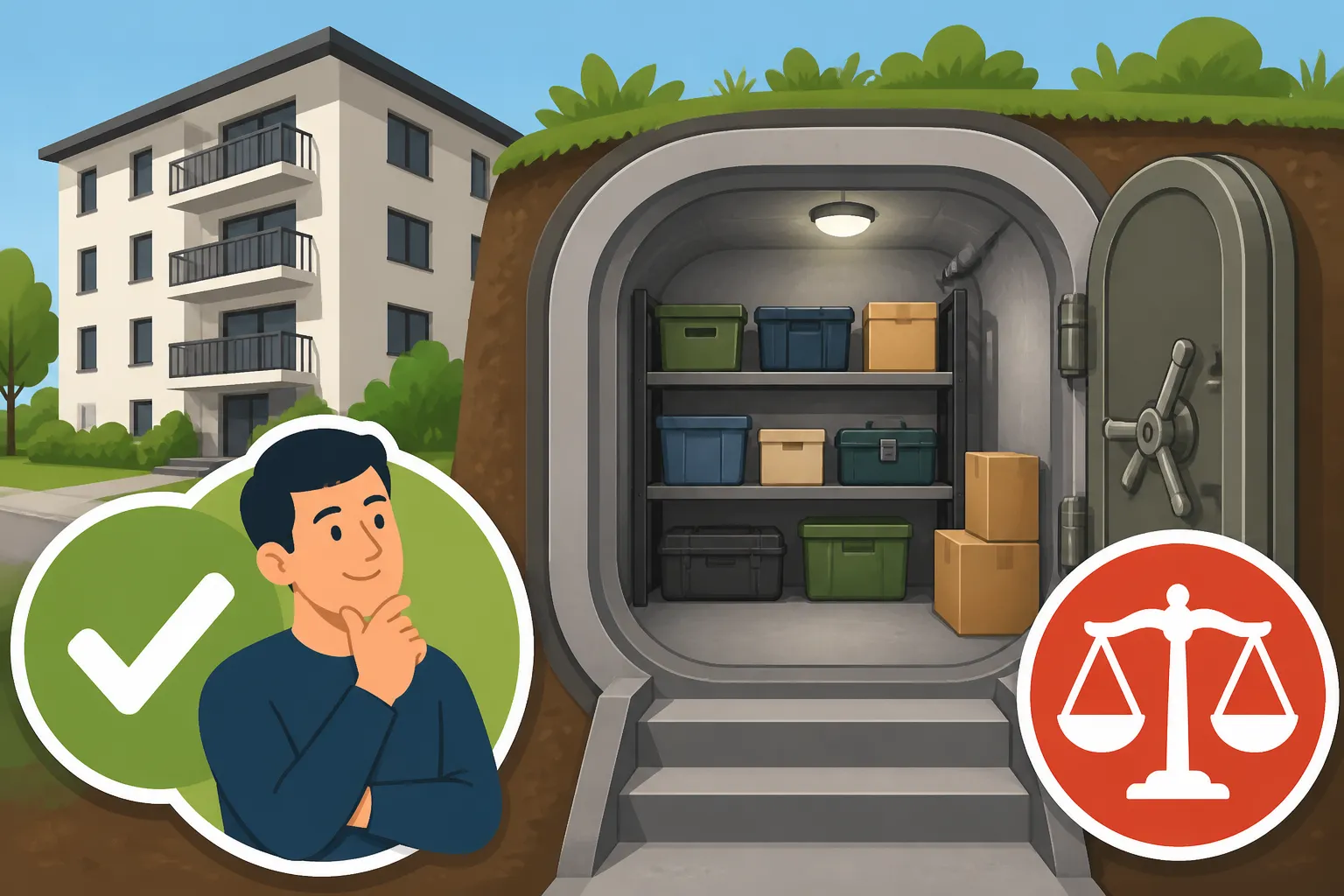
The legal framework governing these spaces is the Federal Act on Civil Protection and Civil Defense. This law dictates that the owner of the building is responsible for the maintenance and readiness of the shelter. While the space is legally designated for protection during an armed conflict or a major disaster, the law allows for "dual-use" during peacetime. This means your landlord can legally rent out sections of the bunker to you as a cellar or storage room. However, this permission comes with a heavy caveat: the space must be capable of being restored to its original protective purpose within a very short timeframe.
If you used HousingAnywhere to find your current apartment, you likely saw "cellar" or "basement storage" listed as an amenity. In most Swiss apartment blocks, this "cellar" is actually a partitioned section of the nuclear bunker. The partitions are usually made of lightweight wood or metal slats that can be easily dismantled. You are essentially a guest in a military-grade facility, and your right to store your belongings there is secondary to the federal mandate for civil safety.
Mandatory Equipment and Maintenance
Within these bunkers, you will often see strange equipment that you are legally forbidden to tamper with. This includes the ventilation system (the VA-40 or similar models), the hand-cranked air pumps, and the emergency exits which often lead to a vertical shaft with a ladder. There are also specific "dry toilets" and bunk bed frames that are usually stored in a corner of the communal area or within a specific "inventory room" in the basement.
It is vital to understand that the federal government or the local commune performs periodic inspections of these shelters. During these inspections, officials check if the rubber seals on the blast doors are still pliable and if the ventilation filters are functional. If your storage prevents an inspector from accessing a vent or a door, the landlord will receive a notice, and that frustration will quickly trickle down to you. Knowing the Swiss Everyday Rules: Recycling, Quiet Hours, and Neighborhood Etiquette is helpful here, as keeping your bunker space tidy is considered a part of being a "good neighbor" and a responsible tenant.
The 24-Hour Readiness Rule and Storage Restrictions
The most critical legal rule you must follow when using your Schutzkeller for storage is the 24-hour clearance rule. In the event of a national emergency—which is signaled by the general sirens—the bunker must be fully cleared of all private storage and prepared for inhabitants within 24 hours. This includes the installation of the bunk beds and the dry toilets.
What You Can and Cannot Store
Because of the 24-hour rule, you cannot store anything that is "permanently installed." You are forbidden from bolting heavy shelving units into the concrete floor or walls. If you need shelving, it must be free-standing and easily removable. I learned this the hard way when I tried to install a custom bike rack; my Hauswart (building manager) politely but firmly told me it had to go.
Furthermore, fire safety regulations in Switzerland are incredibly strict. You are strictly prohibited from storing flammable liquids, gas canisters, or explosives in the Schutzkeller. This includes extra petrol for a lawnmower, propane tanks for your balcony grill, or large quantities of paint thinner. Even a large collection of cardboard boxes can be flagged as a fire hazard if they obstruct the walkway or the ventilation intake. When ordering storage supplies from Amazon Germany, look for heavy-duty plastic bins rather than cardboard boxes; they are safer and more compliant with Swiss basement norms.
Prohibited Items in a Swiss Bunker
| Item Category | Status | Legal Reasoning |
|---|---|---|
| Flammable Liquids | Strictly Forbidden | Fire hazard in an enclosed, ventilated space. |
| Gas Canisters | Strictly Forbidden | Explosion risk; violates civil defense protocols. |
| Permanent Shelving | Prohibited | Prevents 24-hour clearance of the shelter. |
| Heavy Machinery | Restricted | Usually too heavy to move within 24 hours. |
| Perishable Food | Not Recommended | Attracts pests; smells can linger in the ventilation. |
| Motorbikes/Cars | Prohibited | Fire risk and blocks emergency movement. |
The Impact on Your Lease and Insurance
Failure to follow these rules doesn't just annoy the building manager; it can invalidate your Private Liability Insurance (Privathaftpflicht): Why Expats Need It. If a fire starts in your storage area because of prohibited items, your insurance provider will likely refuse to cover the damages to the building.
Additionally, during the Apartment Handovers (Wohnungsübergabe): Protocols and Deposits, the state of your cellar is inspected just as closely as your kitchen. If you have caused damage to the bunker walls by drilling unauthorized holes, you will likely see a deduction from your rental deposit. Landlords take the integrity of the "protected shell" very seriously because the fines from the canton for a non-compliant bunker are significant.
Dealing with Humidity and Practical Organization
One reality of Swiss bunkers that isn't always mentioned in the lease is the humidity. These are concrete boxes buried underground, often with limited airflow during peacetime to prevent the ventilation filters from wearing out. If you store high-value items like leather jackets, books, or upholstered furniture without protection, they will likely be ruined by mold within a single season.
Moisture Protection Strategies
When I first moved, I lost a beautiful set of leather suitcases to "basement bloom"—that fuzzy white mold that thrives in Swiss bunkers. To prevent this, never store items directly on the concrete floor. Use pallets or plastic shelving to allow air to circulate underneath your belongings. This is also a legal advantage; if the bunker needs to be cleared, items on wheels or easily grabbable pallets are much faster to move.
For those who travel frequently or are just arriving, staying connected to manage these logistics is key. Using an eSIM from Airalo ensures you can look up local recycling centers or order dehumidifying crystals as soon as you realize your basement is damp. Many expats also invest in small, portable dehumidifiers for their specific storage cage, though you must ensure this doesn't violate the building's rules on electricity usage in communal areas. You might need to check your Utilities in Switzerland: Electricity, Water, Heating, and Internet Setup agreement to see if "cellar electricity" is included in your Nebenkosten or if it's tied to your specific meter.
Navigating Communal vs. Private Space
In many buildings, the bunker is a large open room with "cages" for each apartment. These cages are usually made of wooden slats. While it looks like a private room, remember that it is technically a communal facility. You should never block the "corridors" of the bunker. If you are Registering Your Address at the Kreisbüro Within 14 Days of Moving, you might be given a key to the basement at the same time. Treat that key with respect; if you lose it, the landlord might have to replace the locks for the entire bunker system for security reasons.
If your building has a communal bunker where there are no individual partitions, the rules for organization are even stricter. You must clearly label everything with your name and apartment number. In these scenarios, it is even more vital to be aware of the What Does the Annual Sirenentest in February Actually Mean? because that is often the time when building managers do a "spring cleaning" and will dispose of any unlabeled or obstructive items found in the bunker.
Managing the Shared Responsibilities of the Schutzkeller
Living in a Swiss apartment means participating in a collective responsibility for the building's safety. The Schutzkeller is the ultimate expression of this. Unlike a standard basement in the US or UK, the Swiss bunker requires you to be mindful of your neighbors' access and the government's potential need for the space.
The Role of the Hauswart
The building manager, or Hauswart, is the gatekeeper of the bunker. They are the ones who will notice if you are breaking the Quiet Hours (Ruhezeiten): Sunday Rules for Laundry, Mowing, and Noise by dragging heavy boxes around at 11 PM on a Sunday. They also conduct the "peacetime checks." If you have a good relationship with your Hauswart, they can be a fountain of information on how to best utilize your storage space. For example, they might tell you which corners of the bunker stay the driest during the winter thaw.
If you find that your bunker is being used improperly by others—perhaps a neighbor is storing a moped or has blocked the emergency exit—you should report it. In the context of Managing the Shared Waschküche: Wash Calendars and Cleaning the Lint Filter, we often talk about the "social pressure" of Swiss apartment living. The same applies to the bunker. It is everyone's job to ensure the space is safe and compliant.
Preparing for Move-Out and Inspections
When it is time to leave your apartment, the Schutzkeller must be returned to its original state. This means removing all your shelving, sweeping the floor, and ensuring the door to your partition is functional. If you have been Changing Your Swiss Health Insurance Provider: Deadlines and Notice Periods, you know how much the Swiss love a deadline; the same applies to clearing your cellar. You cannot leave a "few items" behind for the next tenant unless it is explicitly agreed upon in writing.
Most expats find that once they understand the rules, the Schutzkeller is actually a fantastic perk. It provides a level of security and storage space that is rare in other European cities. Just remember: it’s a bunker first and a closet second. By following the 24-hour rule, avoiding fire hazards, and protecting your items from humidity, you can navigate the "bunker life" like a seasoned local.
Disclaimer
This article is for informational purposes only and does not constitute legal advice. Swiss rental laws and civil defense regulations can vary by canton and specific municipality. Always refer to your individual lease agreement and consult with your landlord or the local civil defense office (Zivilschutz) for the most current rules and safety protocols.