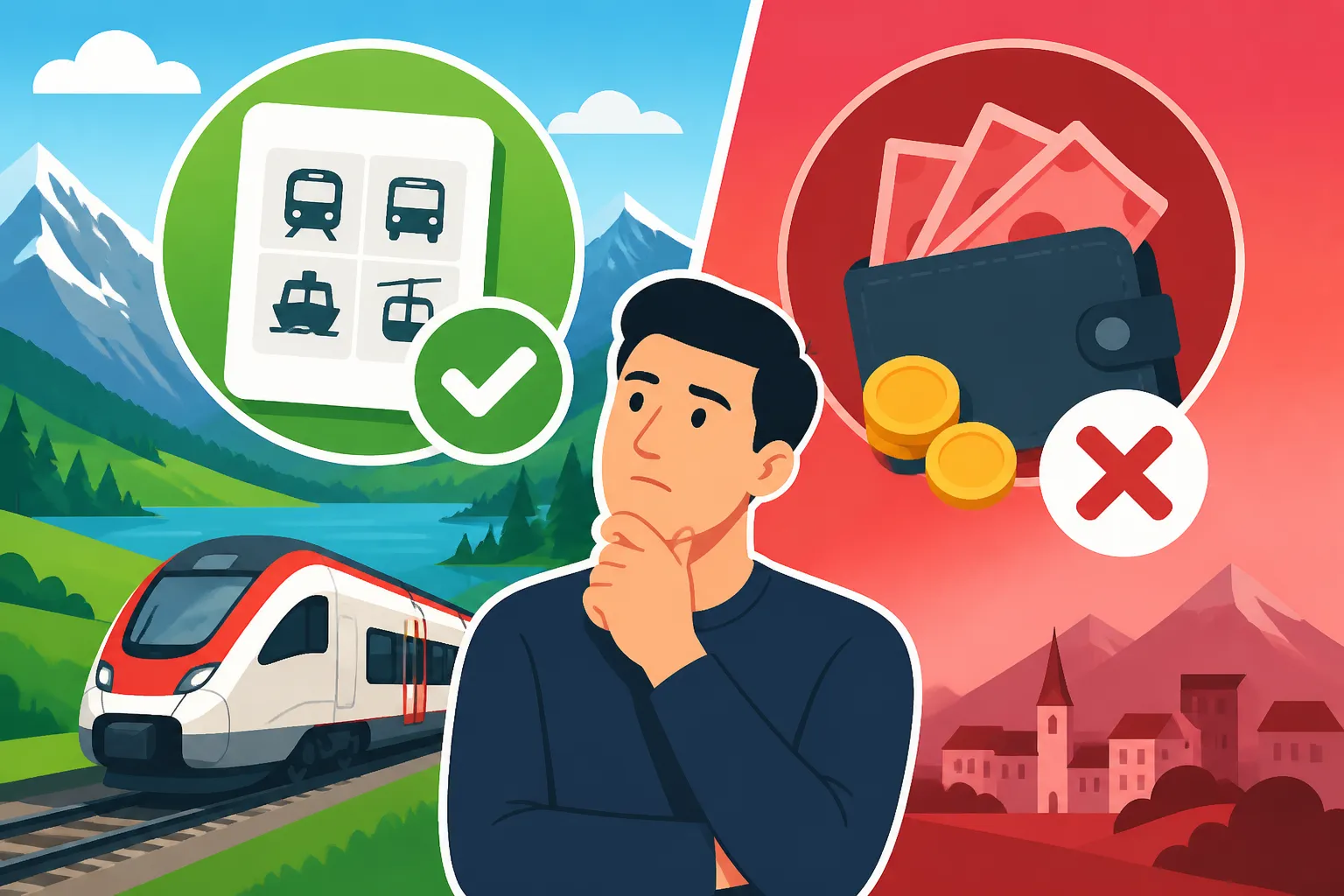
SBB Travelcards: Is the Generalabonnement (GA) Worth the CHF 4000+ Cost?
Staring at the SBB ticket machine and seeing a four-figure price tag for a single plastic card is a rite of passage for every newcomer in Switzerland. I remember sitting in my first unfurnished apartment in Oerlikon, staring at the CHF 3,995 bill for a second-class Generalabonnement and wondering if I’d accidentally signed up for a small car loan instead. This guide solves the ultimate Swiss dilemma: is the GA actually a savvy financial move or just an expensive luxury for the transport-obsessed?
Understanding the Scope of the Generalabonnement
The Generalabonnement, universally known as the GA, is the "One Ring to rule them all" in the world of Swiss public transport. It is a flat-rate annual pass that grants you unlimited travel across the entire SBB (Swiss Federal Railways) network, but its reach extends far beyond just the silver and red trains. When you hold a GA, you are essentially buying a ticket to almost every corner of the country, covering not just trains, but also postal buses (PostAuto), trams, and urban buses in nearly every Swiss city.
In my first year, I underestimated how much the "unlimited" aspect changes your relationship with the country. Normally, even with a discount, a round-trip from Zurich to Geneva can feel like a significant financial commitment. With a GA, that barrier vanishes. You start thinking in terms of time rather than cost. You might find yourself hopping on a train to Lugano just because the weather looks better south of the Alps, or taking a boat across Lake Lucerne because it’s a Tuesday and you want a different view for your afternoon coffee. This level of freedom is hard to quantify on a spreadsheet, but it defines the Swiss expat experience for many.
The coverage isn't limited to the valley floors. While many mountain cable cars require a separate fee, the GA covers several major mountain excursions entirely and offers a 50% discount on most others. For example, trips to Rigi or Stanserhorn are included. If you’ve just arrived and are still searching for a permanent home through a platform like HousingAnywhere, having a GA allows you to scout different neighborhoods across various cantons without worrying about the mounting cost of individual train tickets. It turns the entire country into your potential backyard.
The Network of Trains Trams and Buses
The backbone of the GA is the SBB rail network, but the magic happens when you realize it covers almost all private rail lines as well. Whether you are taking the Rhätische Bahn through the tunnels of Graubünden or a tiny local train in the Jura mountains, your Swisspass is all you need. In urban centers like Zurich, Basel, or Geneva, the GA replaces all local zone tickets. You don’t need to look at zone maps or worry about whether you’ve crossed from Zone 110 to Zone 121; you simply board.
For those who rely on digital connectivity while traveling, using a service like Airalo to ensure your phone has a steady data stream is a great companion to the GA lifestyle. Since you’ll be spending more time on trains, having reliable data for work or entertainment becomes a necessity. I’ve spent many hours on the InterCity trains between Bern and Zurich, turning the 2nd class carriage into my mobile office. The reliability of the infrastructure combined with the simplicity of the GA creates a seamless flow between work and life that is rare elsewhere.
Nautical Miles and Alpine Routes
One of the most overlooked perks of the GA is the inclusion of the Swiss lake steamers. Switzerland’s lakes are not just for tourists; they are vital transport links. With a GA, you can commute by boat on Lake Zurich or Lake Thun as easily as you would by bus. During the summer, I often took the boat from Thalwil to Zurich Enge instead of the S—Bahn. It takes longer, but with a GA, it costs nothing extra and provides a much-needed mental reset.
The PostAuto network is another jewel in the GA crown. These iconic yellow buses reach the tiny Alpine villages where trains cannot go. If you are an avid hiker or skier, the GA is your gateway to trailheads in the furthest reaches of the Valais or the Engadine. This comprehensive coverage is why many people who live in Switzerland for years never bother to buy a car. When you factor in the efficiency of the network, the GA starts to look less like a luxury and more like a highly functional utility.
Comparing the GA with Other SBB Travelcards
To determine if the GA is worth it, you have to look at the alternatives. Most expats start with The Half-Fare Travelcard (Halbtax): The Must-Have Pass for Swiss Residents. The Halbtax costs significantly less (around CHF 190 per year) and gives you a 50% discount on almost all tickets. If you have a Halbtax, you are paying as you go. This is the most logical choice if your office is within walking distance or if you only travel long distances once or twice a month.
The next step up is the Point-to-Point Travelcard. This is designed for the classic commuter who lives in one city and works in another—say, living in Winterthur and working in Zurich. This card allows unlimited travel only on that specific route. However, the price of a Point-to-Point card between two major hubs often comes surprisingly close to the price of a full GA. This is where the "GA calculation" begins. If the difference between a route-specific card and a GA is only CHF 500 a year, the GA almost always wins because of the weekend flexibility it provides.
Then there is the Seven25 card for those under 25, which offers unlimited travel after 7 PM for a very low price. For the older demographic, SBB also offers regional passes like the ZVV network pass for the Zurich area. While these are great for local travel, they lack the national reach of the GA. If you find yourself frequently leaving your local canton for weekend trips, those individual "half-fare" tickets will quickly add up and bridge the price gap to a GA.
When the Half-Fare Card is Sufficient
If your lifestyle is relatively stationary, the GA is likely overkill. I have friends in Basel who work locally and rarely leave the city. For them, a local BVB pass combined with a Halbtax for the occasional trip to the airport or a mountain hike is perfectly sufficient. You should look at your past three months of travel. If you are spending less than CHF 250 a month on transport (even with the 50% discount), the GA won't save you money.
However, if you are a frequent traveler who enjoys visiting friends in different cantons, the Halbtax can lead to "ticket fatigue." There is a psychological cost to seeing CHF 40 leave your bank account every time you want to visit a museum in Lucerne. With the GA, that "per-trip" cost disappears, which often encourages you to explore more of the country. This is a common theme in Cost of Living in Switzerland 2026: Budgeting for Singles and Families, where transport often becomes the third-largest expense after rent and health insurance.
The Regional Pass Alternative
In many cases, a regional pass is the "sweet spot" for expats. For example, a full ZVV pass for all zones in Zurich is excellent if you live in the gold coast and work in the city. However, the moment you want to go to the mountains in Graubünden, you are back to buying tickets. Many people find that they spend CHF 2,000 on a regional pass and then another CHF 1,500 on weekend tickets. At that point, you are so close to the GA price that the upgrade is a no-brainer.
If you are just settling in, you might want to wait a few months before committing to a GA. Use that time to understand your commute and weekend habits. If you’ve recently moved into a new place and need to buy essentials, you can order from Amazon Germany to save on local Swiss prices, but you'll still need to get around to pick up other items. This initial period of high mobility often makes people realize just how much they’ll be using the rail network.
The Financial Tipping Point: When Does the GA Pay for Itself?
Let’s get down to the hard math. As of 2026, a 2nd class GA for an adult costs approximately CHF 3,995 (or slightly more depending on the latest price adjustments). To "break even" compared to using a Half-Fare card, you need to spend more than CHF 333 per month on tickets at the half-price rate. In other words, you need to be doing more than CHF 666 worth of full-price travel every single month.
A round-trip from Zurich to Geneva at the full price is roughly CHF 180. If you do this trip once a week, you are already at CHF 720 per month. In this scenario, the GA is saving you a significant amount of money. If you commute daily between cities like Bern and Zurich, the GA is almost always cheaper than buying individual tickets or even a Point-to-Point pass when you factor in the "free" weekend travel.
| Feature | Half-Fare Travelcard | Generalabonnement (GA) |
|---|---|---|
| Annual Cost (Approx) | CHF 190 | CHF 3,995 |
| Monthly Break-even | N/A | ~CHF 333 (at half-price) |
| Best For | Occasional travelers | Daily commuters / Explorers |
| Urban Transport | 50% Discount | Included |
| Scenic Boats | 50% Discount | Included |
| Psychological Barrier | High (Pay per trip) | Zero (Unlimited) |
For many expats, the decision is also influenced by Salary and Compensation: Navigating Swiss Pay, Bonuses, and Deductions. Many Swiss employers offer a "Half-Fare Card" for free as a perk, or they may even subsidize a GA. If your company pays for half of your GA, the tipping point moves drastically in your favor. Always check your employment contract or ask HR before purchasing the card yourself.
The 1st Class vs 2nd Class Debate
This is a common point of contention. A 1st class GA costs significantly more (upwards of CHF 6,500). Is it worth it? In Switzerland, 2nd class is already better than the 1st class in many other countries. It’s clean, punctual, and generally quiet. However, during peak commute hours (7 AM to 8:30 AM and 5 PM to 6:30 PM), 2nd class can become very crowded.
If you plan to work on the train every day, the 1st class GA offers "Quiet Zones" where phone calls and loud talking are prohibited, and you are almost guaranteed a seat with a large table. For high-earning professionals, this extra cost is often viewed as a "mobile office" expense. If you're interested in how this fits into your overall budget, I suggest reading Banking and Finance for Expats in Switzerland: The 2027 Guide to see how to manage such large annual payments.
Tax Deductions for Commuters
Here is a veteran tip: your GA might be tax-deductible. In Switzerland, you can often deduct the cost of your commute from your taxable income. However, there are caps. The federal tax deduction for commute costs is capped at CHF 3,200. Some cantons have different limits.
If you live in a canton with high taxes and have a long commute, the tax savings can effectively "discount" your GA by several hundred francs. You’ll need to declare this on your annual tax return. For more details on how to navigate this, see Filing a Swiss Tax Return (C Permit or High Earners on B Permit). This deduction makes the GA even more attractive for those on a B or C permit who are required to file a full return.
The Emotional and Practical Benefits of Unlimited Travel
Beyond the numbers, there is an "emotional ROI" to the GA. Switzerland is a country designed to be seen by train. Some of the most beautiful routes in the world—like the Albula line or the climb up to the Jura—are part of the standard network. When you have a GA, you stop viewing travel as a chore and start viewing it as a hobby.
I remember a particularly stressful month at work where I used my GA every Sunday just to ride the Voralpen-Express from St. Gallen to Lucerne. I didn't have a destination; I just sat by the window with a book and watched the rolling hills of Appenzell go by. The fact that I didn't have to "pay" for that experience in the moment was incredibly therapeutic. This "hop-on, hop-off" lifestyle is part of what makes Community and Integration: Making Friends and Adapting to Swiss Life easier; you can join a hiking group in a different canton on a whim without checking your bank balance.
Practically, the GA simplifies your life. You no longer need to use the SBB app to buy tickets two minutes before the train leaves. You don't have to worry about your phone battery dying and being unable to show a digital ticket (though you should keep it charged). Your Swisspass is a physical card that the conductor scans. It’s one less thing to manage in a country that already has quite a few administrative hurdles.
Spontaneity and the Guest Factor
The GA also makes you a better host. When friends or family visit, you can use your GA to get "Day Passes for Friends" at a discounted rate. While the GA itself isn't transferable, the perks associated with it often extend to your social circle. If you have children, combining your GA with the SBB Junior Travelcard for CHF 30/Year means your kids travel for free with you everywhere. This makes family outings to the zoo in Basel or the transport museum in Lucerne remarkably affordable.
If you are still in the process of setting up your household, perhaps having just arrived and looking at Finding Temporary Serviced Apartments: Vision Apartments and CityPop, the GA is your best friend. You can live in a temporary spot in a cheaper town like Olten and commute easily to Zurich or Basel while you find your feet. Olten is the "secret capital" for GA holders because almost every major train line in the country passes through it.
The Freedom of the "Golden Pass"
There are certain legendary routes, like the GoldenPass Express from Montreux to Interlaken, that are fully included in the GA. Normally, these tickets are quite expensive for tourists. As a resident with a GA, you can take these scenic routes as often as you like. You start to see the country through the eyes of a traveler rather than just a resident. This perspective is vital for long-term integration. If you spend all your time in your "expat bubble" in a single city, you miss out on the incredible linguistic and cultural diversity of the different cantons. The GA is your key to Language Skills for the Workplace: German, French, and English Demands, as it allows you to practice your French in Lausanne one day and your Italian in Lugano the next.
Buying, Renewing, and Canceling Your GA
The process of getting a GA is straightforward but requires some preparation. You can buy it at any SBB ticket counter or online. You will need a high-quality passport photo and a valid ID. The GA is then loaded onto your Swisspass—a red plastic card that also serves as your membership for everything from Mobility car-sharing to your local library.
One thing that surprises many expats is that the GA is technically a subscription that renews automatically. If you don't want it to renew for the following year, you must cancel it at least one month in advance. SBB will send you a "reminder" (Verfallanzeige), but if you miss that window, you are on the hook for another year of payments. This is a common trap mentioned in Canceling Swiss Contracts: Deadlines for Internet, Mobile, and Insurance.
Payment Plans: Monthly vs Annual
You don't have to pay the full CHF 4,000 upfront. SBB offers a monthly payment plan. While this is slightly more expensive over the course of a year (due to a small interest/administrative fee), it is much easier on the monthly budget. For someone just starting out in Switzerland, the monthly GA is a fantastic way to test the waters without a massive initial investment.
If you decide after six months that you aren't using it enough, you can cancel the monthly subscription (after an initial minimum term, usually 6 months). This flexibility is a lifesaver if your job situation changes or if you decide to move closer to your office. It's also worth noting that you can "deposit" your GA for a minimum of 5 days and up to 30 days if you are going on a long holiday abroad. You won't get a cash refund, but you'll receive a credit or a voucher for the days you didn't use it.
What Happens if You Leave Switzerland?
If you decide to leave the country permanently, you can cancel your GA and get a pro-rated refund for the remaining months. You will need to provide proof of your "Abmeldung" (the official deregistration from your commune). This is a crucial step in the Leaving Switzerland Financially: Closing Accounts and Pension Payouts process. SBB is generally quite fair about this, provided you have the right paperwork from your local Kreisbüro or Gemeinde.
The refund isn't 100% linear—they tend to value the first few months more highly—but you won't lose your entire investment if you have to leave six months into your subscription. Just make sure you visit an SBB counter in person to handle the return of the card and the final calculation.
Is the GA Worth It in 2026?
The answer depends entirely on your lifestyle, but for a large percentage of Swiss expats, the answer is a resounding "yes." If you live in one city and work in another, or if you are an active person who wants to explore the Alps every weekend, the GA provides a level of convenience and freedom that is uniquely Swiss.
If you're still on the fence, I recommend starting with The Half-Fare Travelcard (Halbtax): The Must-Have Pass for Swiss Residents and using the SBB app to track your spending for three months. If you find yourself consistently hitting that CHF 300+ mark, make the jump to the GA. It is more than just a transport pass; it is a lifestyle choice that encourages you to see everything this incredible country has to offer. Whether you are commuting to a high-rise in Zurich West or heading to a remote valley in Ticino for a weekend of polenta and sunshine, the GA ensures that the journey is just as easy as the destination.
Important Information and Disclaimer
The information provided in this guide is for educational and informational purposes only. While every effort has been made to ensure the accuracy of the transport prices and regulations, SBB (Swiss Federal Railways) and regional transport authorities may change their pricing, terms, and conditions at any time. We strongly recommend visiting the official SBB website or an SBB travel center to confirm the latest rates and contract terms before making a purchase. This guide does not constitute financial advice, and individual tax deductibility for transport costs should be verified with a qualified tax professional in your specific canton.