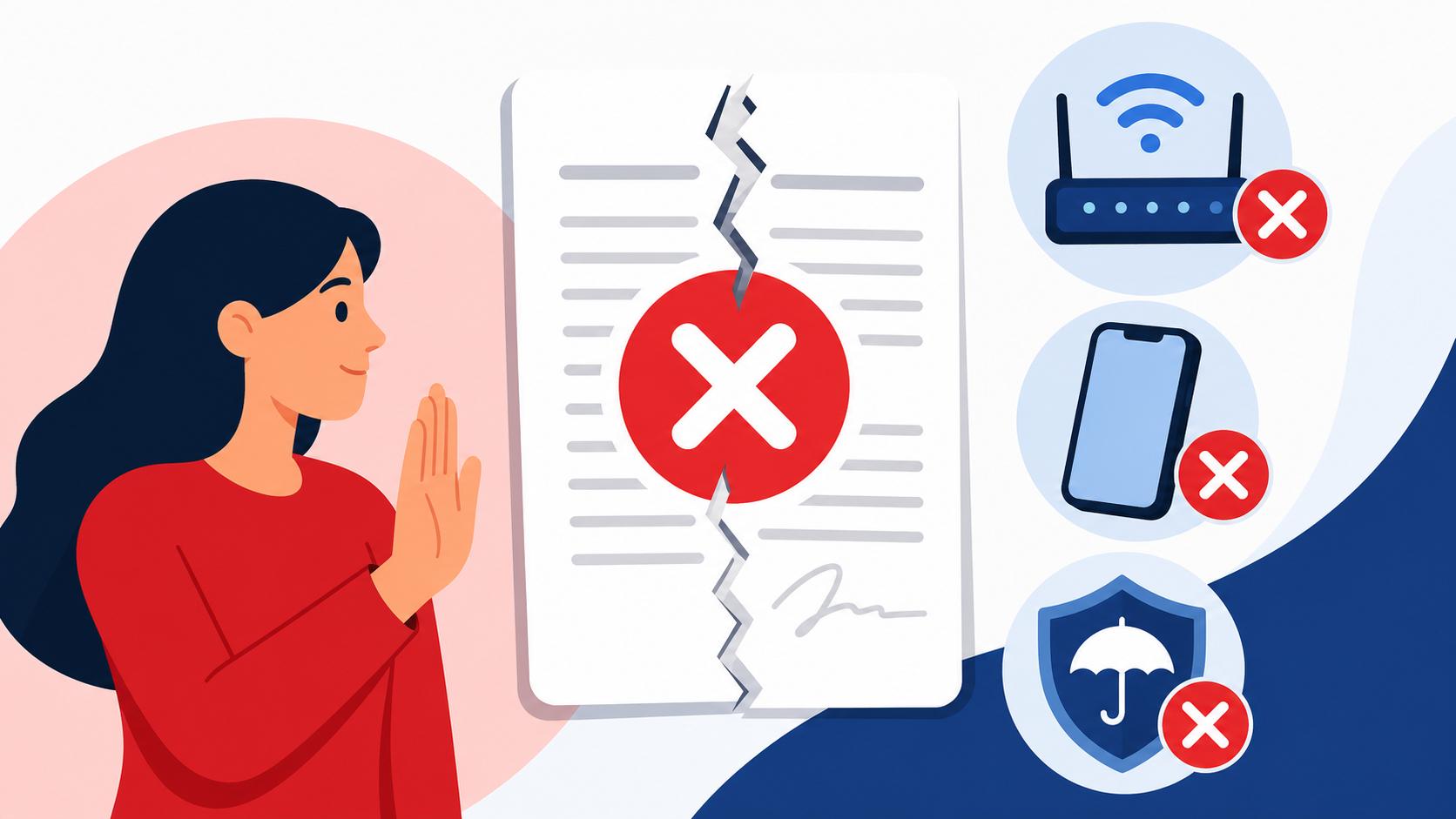
Canceling Swiss Contracts: Deadlines for Internet, Mobile, and Insurance
Missing a Swiss cancellation deadline by a single day is a rite of passage that most expats would rather skip. I still remember the sinking feeling in my gut when I realized I was stuck paying for a high-end Zurich gym membership for an extra twelve months just because I mailed my letter on a Tuesday instead of a Monday. This guide is your tactical map for navigating the rigid, often unforgiving world of Swiss contract terminations so you never pay for a service you no longer use.
The Golden Rule of Swiss Cancellations: The Power of the Registered Letter
In many countries, clicking a "cancel" button in an app is the norm. In Switzerland, the legal culture remains firmly rooted in physical paper and verifiable evidence. If you want to ensure a contract is truly dead, you must embrace the Einschreiben (registered letter). This is the only way to prove to a court or a debt collection office that your notice was delivered on time.
Understanding the Difference Between Postmark and Arrival
One of the most common traps for foreigners is the "Postmark Myth." You might think that as long as the post office stamps your letter on the 30th of the month, you are safe. However, for the vast majority of Swiss contracts, the "arrival principle" (Empfangsprinzip) applies. This means the cancellation is only legally valid when it reaches the recipient, not when you drop it in the yellow mailbox.
If your contract has a three-month notice period ending on December 31st, your letter must be physically in the hands of the provider by the last working day of September. If the mailman tries to deliver it on September 30th but the office is closed, or if it sits in their PO Box until October 1st, you have officially missed the window. I always recommend sending your Einschreiben at least five to seven working days before the end of the month to account for public holidays or administrative delays.
Why You Should Never Cancel Over the Phone
You will often see "convenient" options to cancel your mobile or internet plan via a phone call or a chat window. My advice? Don't do it. While companies like Swisscom or Sunrise might process these, you have zero paper trail if they "lose" the recording or fail to update their system. I have heard countless stories from expats in Basel and Geneva who thought they cancelled over the phone, only to receive a bill and a late fee notice three months later.
When you send a registered letter, you get a tracking number. You can print the delivery confirmation from the Swiss Post website and staple it to your copy of the cancellation letter. This folder of "dead contracts" is your best defense against a Betreibung (debt collection) action. If you are unsure how to frame your letter, remember that it doesn't need to be fancy German or French. A simple "I hereby cancel my contract [Number] at the earliest possible date" is legally sufficient.
Terminating Telecoms: Internet and Mobile Subscriptions
The Swiss telecom market is a minefield of "minimum durations." Whether you are with a major player or a budget provider like Yallo or Wingo, you are likely tied into a 12 or 24-month initial term. Canceling early usually triggers a penalty equivalent to the remaining months of your contract, which can easily run into the hundreds of francs.
Navigating the Minimum Contract Term
Before you send that letter, check your original contract for the Mindestlaufzeit. If you signed up for a "special deal" that gave you a free iPhone or a discounted monthly rate, you are almost certainly locked in for two years. If you try to leave before this period ends, the provider will charge you the full monthly fee for the remaining time.
However, once that initial period ends, most contracts move to a rolling basis with a 60-day or 90-day notice period. This is where the November 30 Deadline: The Exact Steps to Switch Your Swiss Health Insurance logic applies in spirit—you need to be proactive. If you are planning to move within Switzerland, check if your provider can actually offer service at your new address. If they cannot provide the same speed or technology (e.g., fiber vs. copper), you might have grounds for an early termination without penalty, though they will fight you on it.
Moving Abroad as a "Get Out of Jail Free" Card
If you are leaving Switzerland permanently, most telecom providers will allow you to cancel your contract outside of the standard windows. To do this, you will need to provide a copy of your Abmeldung (de-registration certificate) from your local Gemeinde. This document is the ultimate proof that your "center of life" is no longer in the country.
When I left my first apartment in Lausanne, my internet provider tried to hold me to a 60-day notice. I walked into their shop with my stamped de-registration paper, and they waived the remaining fees on the spot. If you are in this situation, ensure you mention "departure from Switzerland" clearly in your registered letter and attach the certificate. For financial logistics during such a move, using a service like Wise is incredibly helpful for settling final bills in CHF while your main assets are already being converted to your next currency.
Health Insurance Deadlines: The Most Important Dates in Your Calendar
In Switzerland, health insurance isn't just a service; it's a legal requirement with very specific exit doors. Unlike a Netflix subscription, you can't just quit whenever you feel like it. The system is built around the calendar year, and if you miss the window, you are stuck with your current premium for another 365 days.
The November 30 Deadline for Basic Insurance (KVG)
For your mandatory basic insurance, the most critical date is November 30th. This is the deadline by which your current insurer must receive your cancellation notice if you want to switch providers for January 1st. Because everyone in the country is trying to do this at the same time, the mailrooms of insurers like CSS or Helsana are overwhelmed in late November.
I always suggest checking Understanding KVG/LAMal: Mandatory Basic Health Insurance Explained to ensure you understand what you are switching from. If you miss the November 30th deadline, even by an hour, your current insurer will legally ignore your request. The only exception is if you have a "standard" model with a CHF 300 deductible, in which case you might have a second window in June, but most expats are on higher deductibles to save money, making the November date the only one that matters.
The Trap of Supplementary Insurance (VVG)
This is where things get complicated. While basic insurance is easy to switch (provided you meet the deadline), supplementary insurance follows different rules. Most Supplementary Health Insurance (VVG): What It Covers and When to Buy It policies have a six-month notice period, meaning you must cancel by the end of June to leave by December 31st.
Furthermore, many supplementary policies are "multi-year" contracts. I once signed a three-year deal for dental and travel coverage without realizing it. When I tried to cancel after two years, I was told I had to wait another twelve months. Always look for the Vertragsdauer in your policy. If you are unhappy with your supplementary provider, you must be much more strategic and plan your exit nearly a year in advance.
Housing-Related Contracts: Insurance and Utilities
When you sign Swiss Lease Contracts: Notice Periods and Termination Dates Explained, you aren't just committing to rent; you are entering a web of secondary obligations. From the electricity bill to the mandatory liability insurance, each has its own "off-ramp."
Private Liability and Household Insurance
Most landlords in Switzerland will not even give you the keys unless you show proof of Privathaftpflicht (private liability insurance). These contracts are typically annual. If you are moving to a new apartment, you don't necessarily need to cancel this insurance; you can simply update your address. However, if you want to switch to a cheaper provider, you usually need to give three months' notice before the policy's anniversary date.
A common mistake is thinking that if you move, the insurance automatically ends. It doesn't. It follows the person, not the building. If you are leaving the country, you again use your Abmeldung to cancel. While managing these transitions, many expats keep their investments in platforms like Trade Republic which are more portable than a Swiss-specific pension fund, but the local insurance remains a local headache until that final letter is sent.
Electricity, Gas, and the Serafe Fee
Fortunately, utilities are the easiest to manage. When you move, you don't "cancel" your electricity; you perform a "final reading." You notify the provider (like EWZ in Zurich or SIG in Geneva) of your move-out date, and they send a final bill.
The Serafe Fee 2026: Paying the Mandatory CHF 335 Media Tax is slightly different. It is tied to your household registration. When you register your new address at the Registering Your Address at the Kreisbüro Within 14 Days of Moving, the information is automatically passed to Serafe. You will receive a pro-rated bill or a credit at your new address. If you are leaving Switzerland, the data from your de-registration will eventually reach them, but I always recommend sending a quick message through their online portal just to be safe.
| Contract Type | Typical Notice Period | Legal Requirement for Proof | Best Cancellation Method |
|---|---|---|---|
| Basic Health (KVG) | 1 Month (By Nov 30) | Yes (Arrival at Insurer) | Registered Mail |
| Supplementary Health (VVG) | 3 to 6 Months | Yes | Registered Mail |
| Mobile / Internet | 30 to 90 Days | No, but highly recommended | Registered Mail |
| Private Liability | 3 Months before renewal | No | Registered Mail / Portal |
| Gym Memberships | 1 to 3 Months | Yes | Registered Mail |
| Swiss Lease | 3 Months (specific dates) | Yes | Registered Mail |
Financial Services and Modern Alternatives
Closing your financial life in Switzerland requires a delicate touch. You cannot simply empty your bank account and walk away; the banks will continue to charge "account maintenance fees" until the account is formally closed.
Closing Traditional Bank Accounts
If you have been Opening a Swiss Bank Account: UBS, ZKB, PostFinance, and Neobanks, you know how much they love their quarterly fees. To close an account at a major bank like UBS, you often have to show up in person or send a notarized letter if you are already abroad. They will ask where you want the remaining balance sent.
For those who have integrated into the digital economy, using Binance for crypto assets or Trade Republic for stocks can make the transition easier, as these aren't tied to your Swiss residency in the same restrictive way a cantonal bank account is. However, ensure you have paid every last cent of your credit card balance. A single forgotten "forgotten" CHF 10 fee can lead to a Betreibung that will haunt your credit score if you ever decide to return to Switzerland.
Managing the Debt Register Extract
Before you can truly "cancel" your life in a specific canton, you should ensure your Betreibungsauszug (Debt Register Extract) is clean. If you have any outstanding disputes with a telecom provider or a landlord, resolve them before you leave. In Switzerland, a "pending" debt is like a digital ghost; it doesn't go away just because you moved to London or New York. If you are moving cantons, your new landlord will definitely ask for this document, and having "unresolved" cancellations on there is a surefire way to lose out on a new apartment.
Final Steps: The Checklist for a Clean Break
If you are reading this because you are preparing for a major life change, remember that organization is your only weapon against the Swiss bureaucracy. The system isn't designed to be mean; it’s designed to be predictable. If you follow the rules of the calendar, the system works perfectly. If you try to "wing it," it gets expensive very quickly.
The Power of the Abmeldung
I cannot stress enough how important the de-registration document is. It is the "Master Key" that unlocks almost every contract in the country. You usually get this from your Kreisbüro or Gemeindehaus about two weeks before your actual departure date. Make ten photocopies immediately. You will need to send one to your health insurer, your car insurance provider, your internet company, and even your local library.
Mail Forwarding (Post-Nachsendeauftrag)
Even the best-laid plans can fail. A stray bill or a final tax adjustment will inevitably arrive after you have handed over your keys. Go to the Swiss Post website and set up a Nachsendeauftrag (mail forwarding service) for at least six months. It costs a small fee, but it ensures that any "missed" cancellations or final invoices reach you at your new address.
When you are finally sitting in your new home, whether it’s in a different canton or a different country, you want to look back at your time in Switzerland with fond memories of fondue and mountains, not bitter memories of paying for an internet connection in an apartment where you no longer live. Taking three hours this weekend to audit your contracts and write those registered letters is the best investment you can make in your future peace of mind.
Disclaimer
This guide is intended for informational purposes only and does not constitute legal or financial advice. Contract laws in Switzerland can vary by canton and specific provider terms. Always review your individual contract documents and consult with a legal professional or the Swiss Tenants' Association (ASLOCA/Mieterverband) for specific disputes. The author is an expat sharing personal experience and research, not a licensed Swiss attorney.