Contact Lens Fitting Costs and Subscription Services in Switzerland
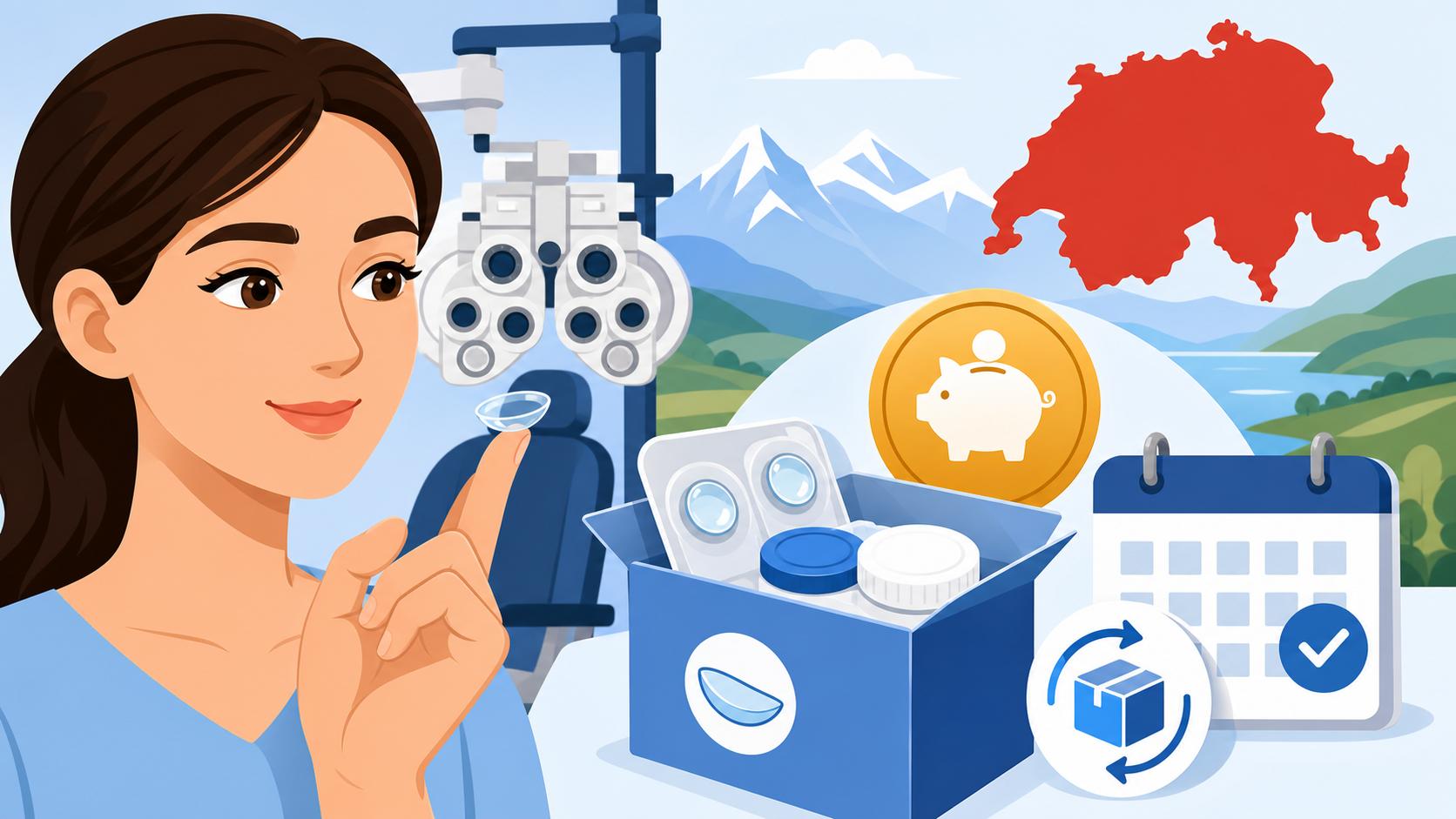
Walking into a Swiss optician for the first time usually results in a distinct form of sticker shock that has nothing to do with the designer frames on the wall. I remember my first attempt to buy a simple box of monthlies in Basel; I thought I could just hand over my glasses prescription and walk out, but I was quickly informed that without a Swiss-certified fitting, I was essentially legally blind in the eyes of the retailer. This guide breaks down the complex, often frustrating world of Swiss contact lens logistics, from the mandatory fitting fees to the subscription models that might actually save your budget.
The Mandatory Fitting Process and Initial Hurdles
In many countries, your glasses prescription is a golden ticket that allows you to buy contact lenses anywhere. In Switzerland, the system treats contact lenses more like a medical device than a retail commodity. If you are a new wearer or even an experienced wearer moving from abroad, almost every reputable optician—from the big chains like Fielmann and Visilab to the boutique shops in the Altstadt—will insist on a "first-time fitting" (Erstanpassung).
This isn't just a quick check to see if you can read the bottom line of a chart. It is a comprehensive ocular health assessment. The optician or optometrist will use a slit-lamp microscope to check the health of your cornea, measure the curvature of your eye (keratometry), and assess your tear film production. This level of detail is why Finding Medical Care in Switzerland: Doctors, Specialists, and Referrals often feels more thorough than what you might be used to back home. They are looking for signs of oxygen deprivation or "neovascularization," which can happen if you wear lenses that don't fit your specific eye shape.
The "fitting" usually involves a trial period. After the initial exam, you’ll be given a pair of trial lenses to wear for a week or two. You then return for a follow-up appointment where the optician checks how the lens sits on your eye after several hours of wear. Only after this follow-up will they release your specific contact lens prescription. Be prepared: this prescription belongs to the optician's database, and while you have a right to your data, some smaller shops can be surprisingly prickly about handing it over if they know you intend to buy online.
Breaking Down the Costs of Fittings and Exams
The cost of a contact lens fitting in Switzerland is rarely "free with purchase." You are paying for the professional time of the optometrist. Depending on the complexity of your eyes—such as whether you need simple spherical lenses, toric lenses for astigmatism, or multifocal lenses—the prices can vary wildly between cantons.
In Zurich or Geneva, a basic initial fitting for spherical lenses typically ranges from CHF 80 to CHF 150. If you require a fitting for multifocal lenses, which involves more complex calculations and trial-and-error, you could easily see a bill of CHF 200 or more. This is an out-of-pocket expense for most, as Is Basic Health Insurance (KVG) Mandatory for Expats? A Plain-English Guide clarifies that basic insurance is notoriously stingy when it comes to vision care for adults.
Once you are "fitted," you aren't done with fees. The Swiss standard is an annual check-up (Nachkontrolle). These usually cost between CHF 60 and CHF 100. Many expats try to skip these, but if you are on a subscription service with a local provider, they will often "freeze" your deliveries if you haven't had your eyes checked within the last 12 to 18 months. It’s a paternalistic system, but it’s designed to prevent long-term corneal damage.
| Service Type | Estimated Cost (CHF) | Frequency | Included in Basic Insurance? |
|---|---|---|---|
| Initial Spherical Fitting | 80 – 150 | Once (per provider) | No |
| Toric/Multifocal Fitting | 150 – 250 | Once (per provider) | No |
| Annual Eye Health Check | 60 – 100 | Every 12 months | No |
| 6-Month Supply (Dailies) | 300 – 500 | Twice a year | No |
| 6-Month Supply (Monthlies) | 120 – 200 | Twice a year | No |
If you are concerned about these recurring costs, checking your Supplementary Health Insurance (VVG): What It Covers and When to Buy It is essential. Some "Ambulatory" add-on plans provide a yearly credit of CHF 100 to CHF 300 for "Sehhilfen" (vision aids), which can effectively negate the cost of your annual check-up. For those with high-end international coverage, like Cigna Global, these fittings and the lenses themselves may be covered under a vision rider, which is a lifesaver given the Swiss price points.
Subscription Services and Local Retailers
Once you have your prescription, the next hurdle is the "subscription" sell. Most major Swiss opticians have moved toward a "Lens Subscription" (Linsen-Abo) model. Brands like McOptic and Fielmann offer these to ensure customer loyalty. The pitch is simple: you pay a monthly fee, and they ship your lenses to your door every six months, usually throwing in the annual check-up for "free" as part of the package.
These subscriptions can be convenient, especially if you have a complex prescription that isn't always in stock. However, you are often paying a premium for that convenience. A monthly subscription for high-quality daily disposables can run between CHF 60 and CHF 90 per month. If you prefer to manage your own eye health supplies, you might look to external platforms like iHerb for supplementary eye drops, lid wipes, or ocular vitamins, which are often significantly cheaper than the Swiss pharmacy prices for the same ingredients.
For those who want to avoid the high-street prices, online portals like Lensvision.ch or Mister Spex are popular alternatives. They allow you to upload your Swiss prescription and order at a 20-40% discount. However, be wary: if you order from a German or French site to save money, you must keep Receiving Packages from Amazon DE/FR: Swiss Customs Fees and VAT in mind. If the value of your lenses exceeds the CHF 65 threshold (including shipping), you will be hit with an administrative fee from Swiss Post and VAT, which often wipes out the savings.
Why Health Insurance Rarely Covers the Bill
One of the biggest frustrations for new arrivals is realizing that the expensive monthly premium they pay for health insurance covers almost nothing for their eyes. Unless you are under the age of 18 or have a severe medical condition like keratoconus or a massive change in diopters due to illness, the basic KVG (LAMal) insurance does not pay for contact lenses or glasses.
This is where understanding The Swiss Franchise System: How Deductibles and Copays Work becomes vital. Even if you did have a medical reason for coverage, if you have a high deductible (like the common CHF 2,500), you would still be paying for your lenses out of pocket until that deductible is met. For most expats, vision care is simply a "planned expense" that needs to be budgeted alongside groceries and rent.
For those who prioritize vision, I always suggest looking into specific supplementary plans early on. Once you are already wearing a high prescription, some insurers might place a "reservation" (exclusion) on your policy for vision care, so it's best to sign up when your eyes are stable. If you are struggling with the overall costs of the system, it’s worth investigating Cantonal Premium Reductions (Prämienverbilligung) for Low-Income Households to see if you can save money on your core premiums, freeing up cash for your vision needs.
Maximizing Value and Eye Health in Switzerland
If you're determined to keep your costs down while living in Switzerland, there are a few "pro-tips" I've learned the hard way. First, always ask for a copy of your "Linsenpass" (lens passport) after your fitting. This document contains your base curve (BC), diameter (DIA), and power. With this in hand, you are no longer "locked" to one optician.
Secondly, consider the timing of your purchases. Major retailers often have "buy 3, get 1 free" sales on boxes of dailies during the January and July sales periods (Ausverkauf). If you have a stable prescription, stocking up then can save you a few hundred francs a year. While you're at it, check if your employer offers any "Reka" checks or corporate benefits; some large companies in Zurich and Basel have partnerships with local opticians for 10-15% discounts for employees.
Lastly, don't neglect the "environmental" factor of living in Switzerland. The air in the mountains and the heavily air-conditioned offices in cities like Geneva can lead to dry eye syndrome. Using high-quality preservative-free drops is a must. While local pharmacies (Apotheken) carry them, the prices are steep. This is another area where a quick check of iHerb can provide the same lubricant drops at a fraction of the price, delivered to your door.
If you are navigating this system as a student or a temporary resident, you might find the requirements even more burdensome. For those on a tight budget, check Swisscare and Academic Care: Cheap Insurance for Non-EU Students, though be aware these policies also rarely cover elective vision fittings. Whether you choose the boutique experience of a local Bahnhofstrasse optician or the digital route, remember that in Switzerland, the process is designed to be slow, thorough, and medically sound—just like everything else in the country.
Accessing Specialists and Complex Vision Needs
Sometimes, a standard optician isn't enough. If you have chronic eye pain, sudden flashes, or need a prescription that goes beyond standard ranges, you should bypass the retail shop and go straight to an ophthalmologist (Augenarzt). This falls under Finding Medical Care in Switzerland: Doctors, Specialists, and Referrals. The advantage here is that a visit to a medical doctor is covered by your basic insurance (minus your franchise and 10% copay), whereas a visit to a retail optician is not.
If the Augenarzt determines your contact lenses are medically necessary for a specific condition, they can issue a certificate that might force the KVG to pay a portion of the costs. This is rare for simple myopia, but for complex astigmatism or post-surgical care, it’s the only way to get the insurance system to budge.
If you are a frequent traveler or an expat with a nomadic lifestyle, you might find that a local Swiss subscription is too restrictive. In these cases, having a global plan like Cigna Global ensures that you can get your eye exams done in London, New York, or Zurich and still have a path to reimbursement. This flexibility is often worth the extra premium for those of us who haven't quite settled into one canton for the long haul.
Disclaimer
This guide is for informational purposes only and does not constitute medical or legal advice. Health insurance regulations and retail pricing in Switzerland are subject to change, and you should always consult with a qualified Swiss optometrist or your insurance provider regarding your specific situation. Any mention of third-party brands is based on general market availability in 2026.