Dual Citizenship Rules in Switzerland: Do I Have to Renounce My Original Passport?
The prospect of finally trading in your B or C permit for the fabled "Red Passport" is one of the most exciting yet nerve-wracking milestones in the Swiss expat journey. I remember the exact moment I sat in my local Gemeinde office, staring at the thick stack of application papers, and feeling a sudden, sharp pang of anxiety about what this meant for my original identity. This guide dives deep into the dual citizenship rules in Switzerland to help you understand if you can hold onto your birth passport while embracing your new Swiss life.
Switzerland and the Law of Multiple Nationalities
For many expats, the fear of "losing" their home country is the single biggest barrier to applying for naturalization. I have met countless people who have lived in Zurich or Geneva for twenty years, fully integrated and speaking the language fluently, who still hesitate because they don't want to sever their original roots.
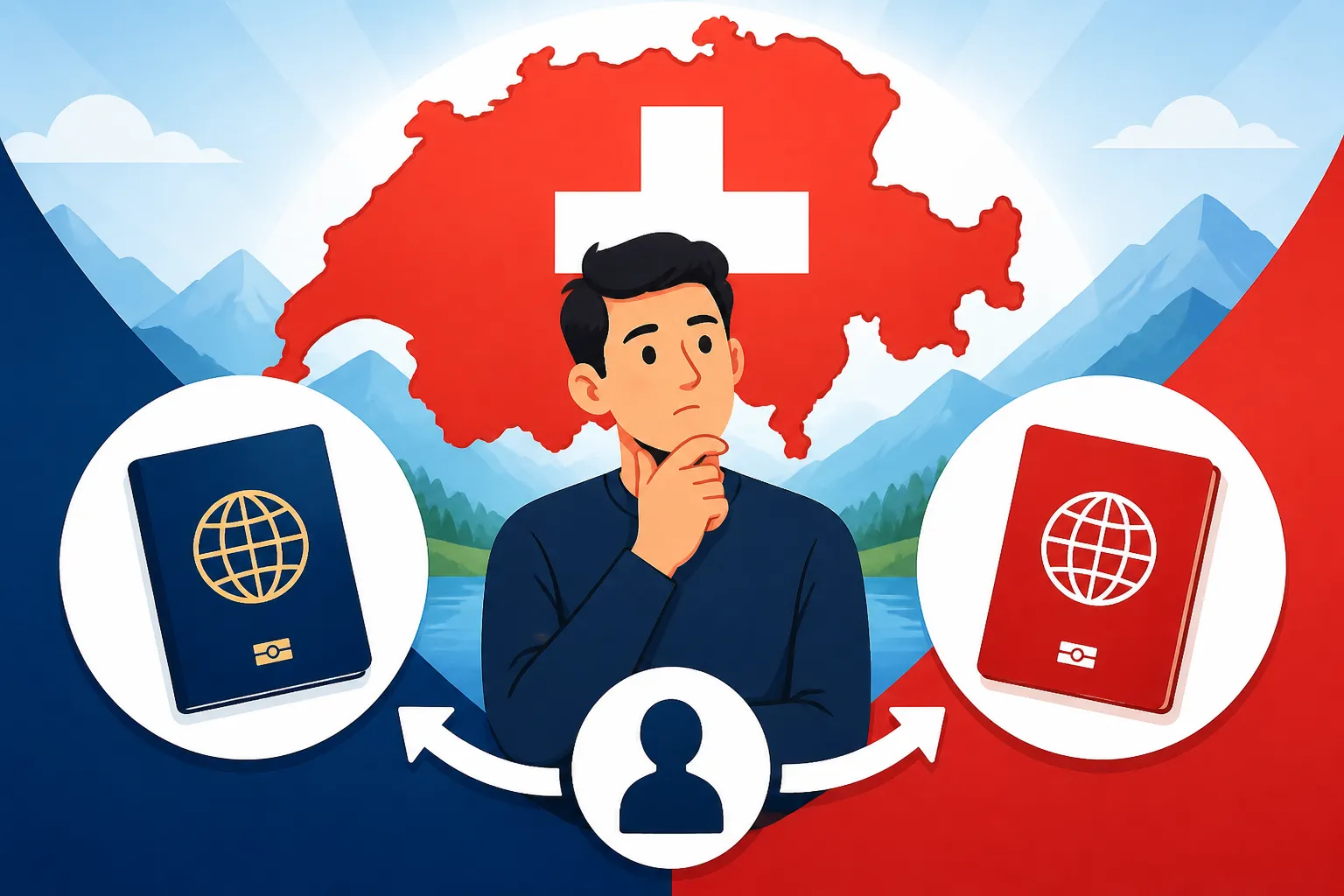
The good news is that Switzerland is actually one of the most liberal countries in the world when it comes to dual citizenship. Since January 1, 1992, Swiss law has permitted its citizens to hold multiple nationalities without any restrictions from the Swiss side. This means that if you fulfill the requirements for Becoming Swiss: Naturalization and Citizenship Process in 2027, the Swiss government will not ask you to renounce your original passport. In their eyes, you can be 100% Swiss and 100% something else simultaneously.
However, the "I've been there" reality is that while Switzerland doesn't care, your home country might. This is where the administrative headache usually begins. The Swiss authorities won't force you to give up your first passport, but the laws of your country of origin might trigger an automatic loss of citizenship the moment you take the Swiss oath. Before you start collecting your stamps and certificates, you must verify the stance of your original embassy.
Understanding the Three Tiered System of Citizenship
When you apply for citizenship, you aren't just applying to Switzerland as a nation; you are applying to a specific Canton and a specific Commune (Gemeinde). This is a quirk of the Swiss system that often confuses newcomers. Because citizenship is "bottom-up," the rules regarding your integration and the acceptance of your dual status are handled at multiple levels.
The Cantonal vs Federal Citizenship: Understanding the Three-Tier Integration Process is vital to grasp because each level has its own veto power. While the federal government sets the baseline for the Swiss Visas and Work Permits: The Complete 2027 Guide for Expats, the local commune is where your "Swissness" is truly tested. During my own process, I found that the local officials were much more interested in whether I knew the names of the local mountains and participated in the village Apéro than in the specifics of my other passport.
If you are married to a Swiss citizen, the path is slightly different. You might be eligible for Facilitated Naturalization: Fast-Track Citizenship for Spouses of Swiss Nationals, which bypasses some of the local communal hurdles but still maintains the same stance on dual nationality. Regardless of the route, the Swiss federal law remains consistent: dual citizenship is fully accepted.
The Problem of Third Country Restrictions
While Switzerland is welcoming, EU/EFTA vs Third-Country Nationals: Immigration Differences in Switzerland often manifest in how citizenship is handled by the "other" side. If you are from a country like the United States, the UK, or most EU nations, dual citizenship is generally a non-issue. You simply end up with two passports and a much shorter line at the airport.
However, for many "Third-Country" nationals, the situation is far more complex. Some countries, such as India or China, do not recognize dual citizenship at all. If you are an Indian citizen, for example, the moment you acquire Swiss nationality, you technically lose your Indian citizenship. You then have to apply for an OCI (Overseas Citizen of India) card to maintain your link to home.
When preparing your dossier, ensure your documents are perfectly translated. I highly recommend using a service like RushTranslate for your birth certificates and marriage licenses, as the Swiss authorities are notoriously picky about official translations. Errors in these documents can set your application back by months, or worse, cause issues with your original embassy when you try to explain your new dual status.
| Aspect | Swiss Resident (C Permit) | Swiss Citizen (Dual) |
|---|---|---|
| Right to Vote | Limited to local level in some cantons | Full rights at Federal, Cantonal, and Local levels |
| Passport | Original Passport + Residence Card | Original Passport + Swiss Passport |
| Consular Protection | From home country only | From both Switzerland and home country |
| Expulsion Risk | Possible for serious crimes | Impossible (Swiss citizens cannot be deported) |
| Military Service | None (unless specified by home country) | Mandatory for Swiss males under certain ages |
| Job Access | Most private sector and some public | Full access, including high-level diplomatic/security roles |
Military Service Obligations for Dual Citizens
This is a topic that catches many young male expats off guard. If you become a Swiss citizen before the age of 24 (and in some cases up to 30), you are subject to mandatory military service. If you are a dual citizen, the question often arises: "Do I have to serve twice?"
Switzerland has bilateral agreements with several countries to prevent "double dipping" in military service. Generally, if you have already performed military service in your other home country, you won't have to do it again in Switzerland. However, you might still be liable for the Military Service Exemption Tax (Wehrpflichtersatzgabe), which is roughly 3% of your taxable income, if you don't serve in the Swiss army.
For more details on how this works in practice, you should look into Does Military Service Exemption Apply to Naturalized Swiss Citizens?. I’ve seen friends navigate this by choosing the "Civilian Service" (Zivildienst) option, which allows them to work in hospitals or forest conservation instead of carrying a rifle, though the duration is 1.5 times longer than military service.
Language and Integration Requirements
You cannot become a dual citizen without proving you have "arrived" in Swiss society. The days of simply living here for ten years and getting a passport are long gone. You now need to prove a specific level of language proficiency and show that you are socially integrated.
Most cantons require at least a B1 level of oral proficiency and an A2 level of written proficiency in the local national language. It is important to know the difference between the Language Tests for C Permit: fide vs Goethe-Zertifikat Compared because some communes specifically prefer the "fide" test, which focuses more on real-life Swiss scenarios like talking to a landlord or a doctor.
Beyond the tests, you will likely face a personal interview. This is the part everyone fears. The Swiss Citizenship Interview Questions: What the Commune Asks You can range from "Who is the current President of the Confederation?" to "What do you do when your neighbor leaves their laundry in the shared machine too long?" These interviews are designed to see if you have adopted Swiss values and etiquette, rather than just memorized a textbook.
Travel and Administrative Logistics as a Dual Citizen
Once you have both passports in hand, the world becomes a bit more complicated administratively, but much easier for travel. One of the biggest perks of Swiss citizenship is the freedom of movement within the EU and EFTA zones, especially if your original passport has heavy visa restrictions.
However, you must be careful about which passport you use and when. A general rule of thumb is to enter and leave a country using that country's passport. If you are a US-Swiss dual citizen, you must enter the USA with your US passport and enter Switzerland with your Swiss passport. Using the "wrong" one can lead to uncomfortable questions at border control or issues with your digital travel authorizations.
If you are moving around during the application process, make sure to read up on Changing Cantons on a B Permit: Notification and Reapplication Processes, as moving to a different canton mid-application can sometimes reset your residency clock, depending on local laws. This is a nightmare scenario I’ve seen happen to people who moved for work without realizing they just killed their three-year application progress.
Health Insurance and Life as a Citizen
Becoming a citizen doesn't exempt you from the standard Swiss requirements like mandatory health insurance. In fact, your obligations remain largely the same as when you held The Swiss C Permit (Permanent Residency): Fast-Track and Standard Routes. You will still need to maintain a high-quality health plan.
For many dual citizens who travel frequently back to their home country or work internationally, having a plan that covers them globally is a huge advantage. This is where providers like Cigna Global come into play, offering the kind of portable coverage that standard Swiss KVG plans might lack once you step outside the Swiss borders for extended periods. Even as a citizen, you want to ensure your medical needs are met without the stress of "out-of-network" surprises in your other home country.
Financial and Tax Implications
Finally, let’s talk about the "hidden" side of dual citizenship: taxes. For most people, becoming a Swiss citizen doesn't change their tax situation much, as Switzerland taxes based on residency, not citizenship. However, if your other citizenship is from the United States, you are in a unique boat. The US is one of the only countries that taxes based on citizenship regardless of where you live.
Holding a Swiss passport while being a US citizen can make opening bank accounts in Switzerland slightly more difficult due to FATCA regulations. Some local cantonal banks are still wary of "US Persons" even if they have a Swiss passport in their pocket. It’s always worth checking with your bank to see how they handle dual citizens with US ties.
Ultimately, the process of gaining Swiss citizenship is a marathon, not a sprint. It requires patience, a decent amount of paperwork, and a genuine commitment to the local culture. But at the end of that marathon, being able to hold two passports is a powerful tool. It gives you a sense of security and belonging in the place you’ve chosen to call home, without asking you to delete the history of where you came from.
Disclaimer
This guide is intended for informational purposes only and does not constitute legal or professional advice. Swiss immigration laws and the laws of your home country are subject to change. Always consult with the Swiss State Secretariat for Migration (SEM) or a qualified immigration lawyer before making decisions regarding your citizenship status. Additionally, ensure you contact your original country’s embassy to confirm their specific rules regarding the acquisition of a foreign nationality.