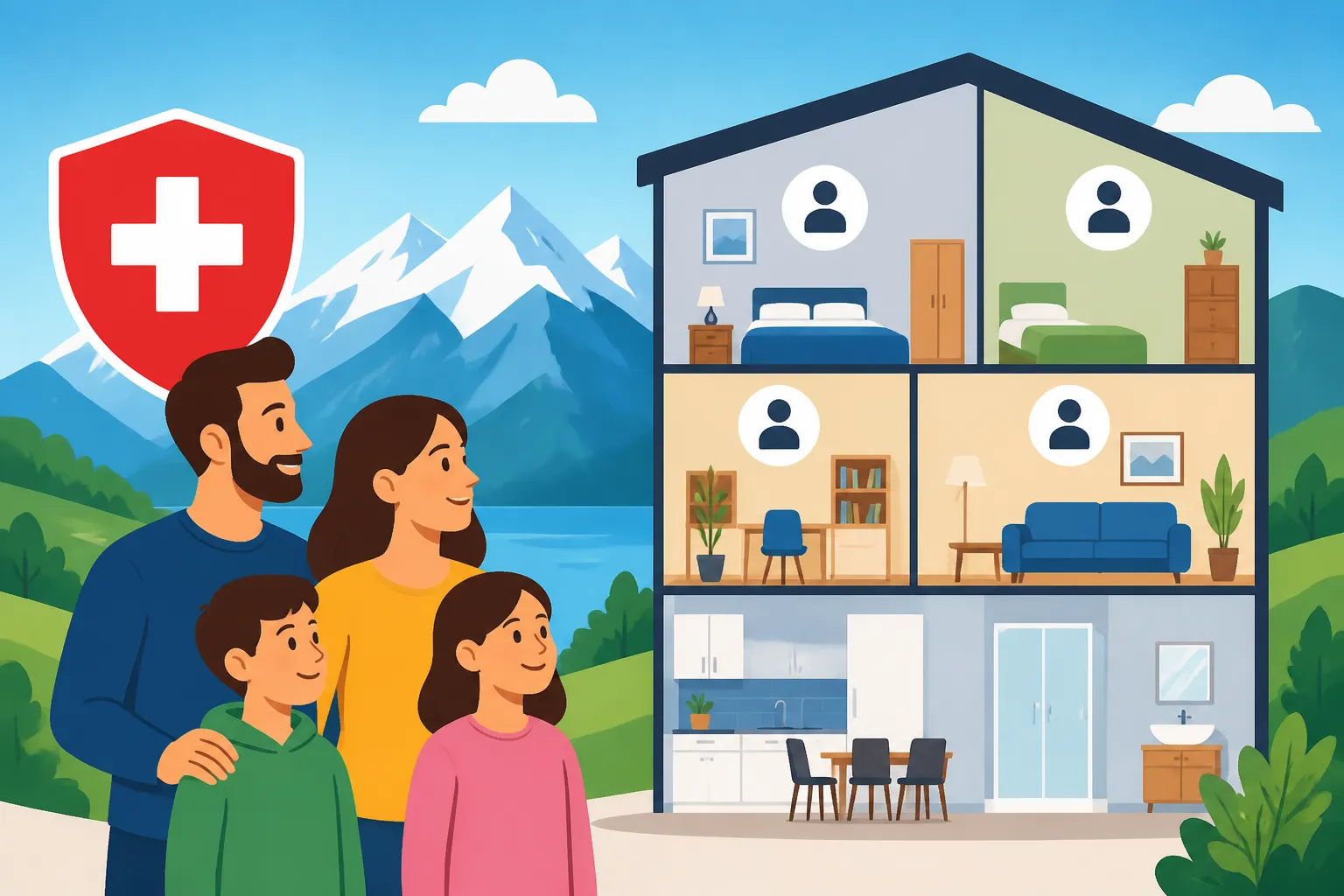
Apartment Size Requirements (Rooms per Person) for Family Visas
Finding out your family reunification permit was denied because your apartment is one room too small is a rite of passage no expat wants to experience. I still remember the sinking feeling in my stomach when a clerk in Zurich told me my charming studio wouldn't legally fit my partner, even though we were perfectly happy sharing the space. This guide solves the confusion around Swiss housing ratios so you can secure your family’s future without the administrative heartbreak.
The Legal Foundation of Adequate Housing in Switzerland
When you apply for Family Reunification: Bringing Your Spouse and Children to Switzerland, the cantonal migration authorities are not just looking at your bank balance or your clean criminal record. They are looking at your four walls. Under Swiss law, specifically the Foreign Nationals and Integration Act (FNIA), anyone bringing dependents into the country must prove they have "adequate housing." But "adequate" is a subjective word that the Swiss have turned into a very objective science.
Why the Migration Office Cares About Your Square Footage
You might wonder why the government feels the need to dictate how many rooms your family needs. From an official perspective, this is about preventing "overcrowding" and ensuring a minimum standard of living that aligns with Swiss social norms. They want to ensure that children have enough space to study and that couples have a degree of privacy. In their eyes, if a family lives in a space that is too small, it places a strain on the local infrastructure and the well-being of the residents.
In practice, this means that before your spouse or children are granted a visa, the migration office will often request a copy of your lease agreement. They will check the number of rooms and the total square meterage. If you are currently living in a 1.5-room bachelor pad and trying to bring over a spouse and two children, your application will likely be rejected before they even look at your Translation and Apostille Requirements for Marriage Certificates. It feels invasive, I know, but it is a non-negotiable hurdle in the immigration process.
The General Rule of Thumb for Rooms versus People
While every canton has its own nuances, the federal guideline generally follows a simple formula: the number of rooms in the apartment should be equal to the number of people living in it, minus one. This is often referred to as the "People minus One" rule. For example, if you are a couple (2 people), a 1.5 or 2-room apartment is usually the bare minimum. If you are a couple with one child (3 people), you will almost certainly be required to have at least a 2.5 or 3-room apartment.
However, "minimum" is the keyword here. Many migration offices, especially in conservative cantons, prefer to see a 1:1 ratio or at least a very spacious version of the "minus one" rule. If you are on a The Swiss B Permit: Eligibility, Renewal, and Restrictions, the authorities have a fair amount of discretion. They will look at the age of the children; a toddler might be allowed to share a room with parents for a time, but a teenager will almost always be legally required to have their own space.
Understanding Room Counting the Swiss Way
If you are new to the country, looking at apartment listings can feel like trying to crack a secret code. Unlike in the US or UK, where we count bedrooms, the Swiss count "rooms." This includes the living room, bedrooms, and sometimes a large dining hall. It does not include bathrooms, hallways, or the kitchen (unless the kitchen is exceptionally large and integrated into a living space).
Decoding Room Designations in Listings
When you see a 3.5-room apartment advertised, it generally means you have two bedrooms and one living room. The ".5" usually refers to a dining area or a large entrance hall that is big enough to serve as a functional space. When navigating the housing market, you should check Decoding Swiss Apartment Ads: What 2.5, 3.5, and 4.5 Rooms Actually Mean to ensure you aren't miscalculating your eligibility. A 2.5-room flat is perfect for a couple, but for a family of three, it might be right on the edge of what a migration officer will accept.
I have seen many expats make the mistake of thinking a "living room" doesn't count toward the total if someone sleeps in it. In the eyes of the law, a room is a room. However, for family visas, the authorities are looking for "closed" rooms. A studio (1 room) where the bed is in the same space as the stove is almost never accepted for more than one person, regardless of how many square meters it occupies.
What Does Not Count as a Room
It is vital to understand that Swiss authorities are very strict about what constitutes a habitable room. A windowless basement room, no matter how nicely finished, will generally not be counted toward your total room count for visa purposes. Rooms must have natural light and ventilation to be considered "habable." Similarly, a mezzanine or a loft area that doesn't have a certain ceiling height might be excluded from the official count.
If you are unsure about whether your current or prospective apartment meets the criteria, you can often find the official room count on the Swiss Apartment Handovers: Protocols and Deposits documentation or the building's official registry entry. If you are using international documents to prove your family status, ensure you use a service like RushTranslate to provide high-quality, certified versions of your previous housing records or family documents, as the migration office has zero patience for "informal" translations.
Specific Requirements for Family Reunification
The rules get significantly tighter when children are involved. The Swiss system prioritizes the "best interests of the child," which in this context means having enough physical space to develop. If you are moving to a major city, you should consult the Zurich Expat Healthcare Guide: Hospitals, Clinics, and Emergency Contacts or similar local guides to understand the general cost of living, as the price of a 4-room apartment can be a shock to the system.
The Room-to-Person Ratio for Children
Generally, once a child reaches the age of school entry (around 4 or 5 in most cantons), the migration office will start looking for an extra room for them. If you have two children of different genders, especially as they approach puberty, the requirement for separate bedrooms becomes almost mandatory. A family of four (parents, one son, one daughter) will often be required to have a 4.5-room apartment to satisfy the "adequate housing" requirement for a long-term permit.
| Number of People | Minimum Rooms (General) | Recommended Rooms (Safe Bet) |
|---|---|---|
| 1 Person | 1.0 – 1.5 Rooms | 1.5 – 2.5 Rooms |
| 2 People (Couple) | 2.0 Rooms | 2.5 – 3.0 Rooms |
| 3 People (Couple + 1 Child) | 2.5 – 3.0 Rooms | 3.5 Rooms |
| 4 People (Couple + 2 Children) | 3.5 – 4.0 Rooms | 4.5 Rooms |
| 5 People (Couple + 3 Children) | 4.5 Rooms | 5.5 Rooms |
Cantonal Variations and Discretion
While federal law sets the baseline, Switzerland is a land of cantonal autonomy. In Geneva, where the housing crisis is legendary, the authorities might be slightly more lenient regarding square meterage if the room count is met. In contrast, in a canton like Appenzell or Zug, they might stick strictly to the letter of the law. If you are currently going through this, it is worth checking The Swiss C Permit: Permanent Residency: Fast-Track and Standard Routes to see how your housing might impact your long-term residency goals.
I always tell people to call the local Einwohnerkontrolle (Residents' Registration Office) before signing a lease if they are unsure. Just tell them your situation: "I am on a B permit, and I want to bring my wife and two kids. Is a 3.5-room, 85-square-meter apartment sufficient?" They are usually surprisingly helpful and will give you a "yes" or "no" that could save you thousands in a lost deposit.
Proving Your Housing Status to Authorities
Once you have found the right place, you need to document it properly. The migration office won't just take your word for it. You will need to submit a signed rental contract that clearly states the number of rooms, the square meterage, and the names of all authorized residents. This is where many expats get tripped up, especially if they are currently subletting.
The Rental Contract and Floor Plans
In some cases, the migration office might even ask for a floor plan (Grundriss). They want to see that the bedrooms are actual rooms and not just alcoves. If you are working with a relocation agent, they can usually provide this. If not, the landlord or the Verwaltung (property management) should have it. Make sure the names on your marriage and birth certificates match the names you intend to put on the lease. If you need those certificates translated quickly for a deadline, RushTranslate is a reliable option for Swiss-compliant documents.
Furthermore, ensure that your Mandatory Registration: How to Sign Up for Health Insurance Within 90 Days process is ready to go for the new family members. The authorities often link the "adequate housing" check with your ability to provide for the family's basic needs, including health insurance. Having a quote from a provider like Cigna Global can sometimes show the authorities that you are fully prepared for the financial and logistical reality of your family's arrival.
Dealing with Temporary Accommodation
Can you bring your family while living in an Airbnb or a serviced apartment? Technically, yes, but it is much harder. The migration office wants to see a long-term solution. A lease that is only valid for three months is often viewed as "inadequate" because it doesn't offer the family stability. If you must use temporary housing, ensure it is a "serviced apartment" that allows for official registration (Wohnsitzbestätigung). If you cannot register your family at the address, the visa will not be issued.
Common Pitfalls and the Financial Link
The "room count" rule is often a proxy for a financial check. If you can afford a 4.5-room apartment in a city like Zurich, the migration office assumes you have the salary to support a family of four. If you find a very cheap, small apartment, they might dig deeper into your Salary and Compensation: Navigating Swiss Pay, Bonuses, and Deductions to see if you are actually earning enough to live a "dignified" life according to Swiss standards.
The Untermiete (Subletting) Trap
Subletting is very common in Switzerland, but it is a minefield for family visas. If you are subletting a room in a larger apartment, you will almost never be allowed to bring a spouse or child to live in that single room. The authorities require that the family has its own "closed" living unit with its own kitchen and bathroom facilities. If you are subletting an entire apartment, you must have written permission from the primary landlord (the Hauptvermieter) stating that they agree to the sub-lease for the specific number of people you are bringing. Without this document, your Residence Permits in Switzerland: L, B, C, and G Permits Explained status won't help you bring your family over.
Impact on Permit Renewals and Upgrades
It is also important to remember that housing requirements don't just disappear once the visa is granted. When it comes time to renew your B permit or apply for a C permit, the authorities may check your housing situation again. If your family has grown—say, you brought a spouse and now have two children—but you are still in the same 2-room apartment, they might issue a warning or even a deadline to find a larger place.
I have seen cases where people were denied an "early" C permit because their living situation was considered "precarious" due to overcrowding. Always keep an eye on your Swiss Everyday Rules: Recycling, Quiet Hours, and Neighborhood Etiquette, because if neighbors complain about noise from a crowded apartment, it can trigger an inspection from the local authorities, which is the last thing you want when your residency is on the line.
Summary Checklist for Your Apartment Search
To make sure your family's move goes smoothly, keep this checklist in your pocket while you are browsing listings on Homegate or Flatfox:
- Does the room count meet the "People minus One" rule at a minimum?
- Are the rooms "closed" with windows and doors (not alcoves)?
- Is the apartment large enough for the children to have separate rooms if they are older or of different genders?
- Can you officially register (Anmeldung) all family members at this specific address?
- Is the rent-to-income ratio sustainable (usually rent should be less than 30% of your gross income)?
- Do you have all your health insurance ducks in a row with a provider like Cigna Global to show you are prepared?
- Are your family documents translated by a professional service like RushTranslate?
By focusing on these details, you turn the "adequate housing" requirement from a scary hurdle into a simple box-ticking exercise. Switzerland is a wonderful place to raise a family, provided you play by their very specific, very organized rules.
Disclaimer
This guide is for informational purposes only and does not constitute legal advice. Housing requirements for family reunification can vary significantly between cantons and are subject to the discretion of the individual migration officer handling your case. Always verify the current regulations with your local Cantonal Migration Office or a qualified immigration lawyer before signing a lease or submitting a visa application. Fees, rules, and procedures are subject to change without notice.