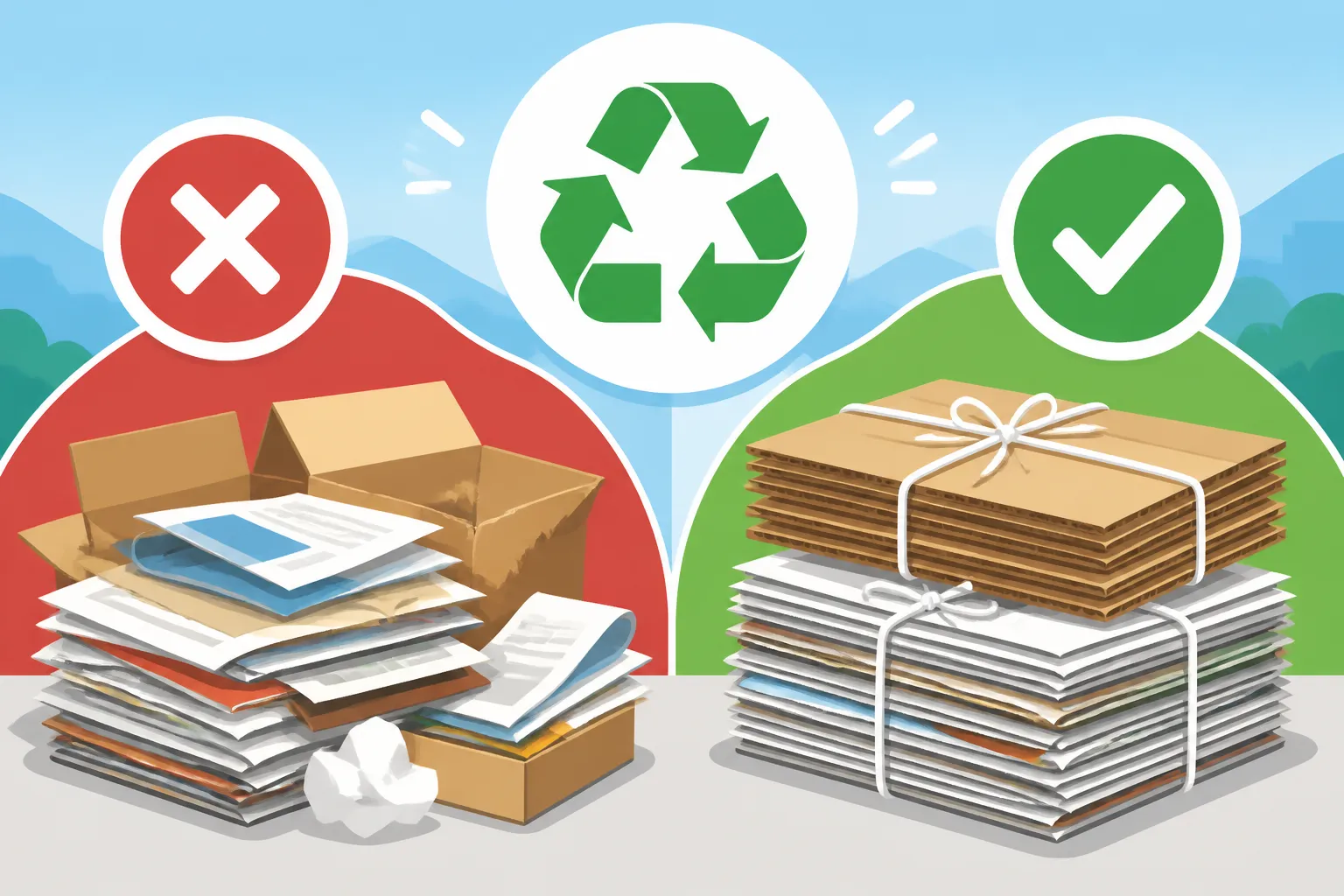
Recycling Paper and Cardboard: Strict Stacking and Tying Rules
There is nothing quite as humbling as waking up to find your neighbor’s recycling gone while your cardboard stack sits on the curb with a bright orange "rejected" sticker. I remember my first month in Zurich, staring at a ball of twine feeling like I was failing a complex craft project. This guide solves the mystery of Swiss paper and cardboard disposal once and for all.
Why Switzerland Takes Paper Recycling So Seriously
To the uninitiated, the Swiss obsession with perfectly bundled paper looks like a national case of obsessive-compulsive disorder. However, once you have lived here for a while, you realize it is the backbone of a highly efficient circular economy. Switzerland has one of the highest recycling rates in the world, and that is only possible because the residents do the "pre-sorting" and "packaging" work for the processing plants. When you bundle your paper correctly, you are ensuring that the local municipality can process it without human intervention at the sorting stage.
The cultural aspect is just as significant. In Switzerland, how you handle your trash is often seen as a reflection of your respect for the community. If you are moving into a new flat you found through HousingAnywhere, you will quickly notice that the communal bin area is the most scrutinized part of the building. Your neighbors might seem like they are judging your stacking technique—and to be honest, they probably are. It is a rite of passage for every expat to master the bundle. If you ignore the rules, you aren't just being "messy"; you are perceived as being indifferent to the local Swiss Everyday Rules: Recycling, Quiet Hours, and Neighborhood Etiquette.
Furthermore, the financial side cannot be ignored. While household trash (the stuff that goes into the expensive Züri-Sack or similar bags) is taxed heavily, paper and cardboard collection is usually "free" at the point of collection, funded by your local taxes. However, that "free" service comes with the condition of labor. You provide the labor of flattening, stacking, and tying, and the city provides the logistics. If you fail to do your part, the collectors are legally allowed to leave your mess on the street, which can lead to fines from the "Abfallpolizei" (trash police).
The Art of the Bundle: Stacking and Tying Rules
The most common mistake foreigners make is assuming that "paper is paper." In Switzerland, there is a very strict distinction between Papier (paper) and Karton (cardboard). Depending on your commune, these may be collected on different days, or they may be collected together but must still be bundled separately. Mixing a few sheets of paper into your cardboard bundle is a surefire way to get a rejection sticker.
Mastering the Paper Bundle (Altpapier)
When we talk about paper, we are talking about newspapers, magazines, office paper, and flyers. The goal is to create a "parcel" of paper that can be easily lifted with one hand by a worker who is running alongside a moving truck. This means the bundle should not be too heavy—usually no more than 10 to 15 kilograms. You must stack the paper neatly, ensuring that the edges are aligned. This prevents the bundle from slipping out of the twine when it is tossed into the truck.
The string you use is non-negotiable. It must be natural twine (hemp or sisal) or paper-based string. You can find this at any Migros or Coop, or you can order bulk rolls from Amazon Germany if you find yourself going through it quickly. Never, under any circumstances, use plastic string, scotch tape, or wire. These materials contaminate the recycling process. The "Swiss Cross" tie is the standard: wrap the string around the length and width of the stack, pull it as tight as humanly possible, and knot it securely in the center. If the stack wobbles when you lift it, it is not tight enough.
The Cardboard Challenge (Altkarton)
Cardboard is the real nemesis of the modern expat, especially if you do a lot of online shopping. Between the boxes from your new furniture and the constant stream of deliveries, you will find yourself drowning in brown paper. Before you even think about tying it, every single piece of plastic tape must be removed. This is a tedious task, but it is mandatory. The collectors will often reject a bundle if they see a single strip of reinforced plastic tape still attached to a box.
Once the tape is gone, you must flatten the boxes completely. Do not simply put smaller boxes inside a larger box. This is known as "nesting," and it is generally hated by collectors because it makes the bundle unstable. Instead, break every box down until it is a flat sheet. If you have very large boxes, fold them or cut them down so they match the size of your other sheets. Just like with paper, use natural twine and the cross-tie method. If you are struggling with the volume of cardboard, remember that managing these details is part of the Cost of Living Realities: Groceries, Telecoms, and Household Expenses in Switzerland.
What Never Goes into the Bundle
It is equally important to know what is excluded. Many people assume that milk cartons or juice boxes (Tetra Paks) are cardboard. They are not. They contain plastic and aluminum liners and must be taken to specific collection points, usually at large supermarkets. Pizza boxes are another common culprit. If a pizza box has even a single drop of grease or a stray piece of cheese stuck to it, it is no longer recyclable as paper. It must go into the regular taxed household trash.
| Item Type | Recycling Category | Preparation Required |
|---|---|---|
| Newspapers & Magazines | Paper (Papier) | Stacked flat and cross-tied with natural twine. |
| Envelopes (with windows) | Paper (Papier) | Usually allowed, but check local rules for plastic windows. |
| Shipping Boxes | Cardboard (Karton) | All tape removed, flattened, and cross-tied. |
| Egg Cartons | Cardboard (Karton) | Flattened and included in cardboard bundle. |
| Pizza Boxes | Regular Trash | Cannot be recycled if grease-stained. |
| Tetra Paks | Supermarket Drop-off | Do not include in paper or cardboard bundles. |
| Glossy Gift Wrap | Regular Trash | Often contains plastic or metallic coatings. |
Navigating the Collection Schedule and Logistics
Every commune in Switzerland has its own "Entsorgunskalender" (waste calendar). This document is your bible. If you put your paper out on a Tuesday but the collection is on Wednesday, you are liable for a fine, and your neighbors will likely have something to say about it. Many cities now have apps that send you a push notification the night before a collection. Since you’ll likely be using Airalo to keep your data costs down while navigating your new city, I highly recommend downloading your local city's waste app immediately.
Understanding the Collection Frequency
In major cities like Zurich, Geneva, or Basel, paper and cardboard are often collected once every two to four weeks. Because the frequency is so low, the volume of paper can build up quickly. This is why it is essential to stay on top of your Renting in Switzerland: The Complete 2027 Guide for Expats journey by finding a storage spot for your recycling that isn't in everyone's way. If you miss a day, you are stuck with those bundles for another month.
If you cannot wait for the collection day, most communes have a "Recyclinghof" (recycling center). You can load your bundles into your car or a cargo bike and drop them off for free. However, check the opening hours carefully. Many of these centers are closed on Sundays and have very specific "Quiet Hours" during the week. Dropping off glass or metal during Quiet Hours (Ruhezeiten): Sunday Rules for Laundry, Mowing, and Noise is a fast way to get a stern lecture from a local official.
The Role of the Janitor (Hauswart)
In larger apartment blocks, the "Hauswart" or "Concierge" manages the waste area. They are often the ones who will pull a poorly tied bundle aside and leave it for the tenant to fix. It is always a good idea to stay on the good side of your Hauswart. They can provide tips on where the specific collection point is for your building, as it isn't always right in front of the door. When you are Registering Your Address at the Kreisbüro Within 14 Days of Moving, you might also receive a physical copy of the waste calendar for your specific zone.
Avoiding Fines and the Infamous Garbage Police
The "Abfallpolizei" is a very real thing in Switzerland. They don't wear capes, but they do wear gloves, and they are not afraid to dig through a bag of trash or a bundle of paper to find a name and address. If you leave a loose pile of cardboard on the street without tying it, and they find a shipping label with your name on it, you will receive a bill in the mail that far exceeds the cost of a roll of twine.
Dealing with Rejected Bundles
If you wake up and see that your paper wasn't taken, do not leave it there hoping the collectors will change their minds. Bring it back inside immediately. Leaving a rejected bundle on the sidewalk is considered illegal dumping. Inspect the bundle: Is it tied with the wrong string? Is it too loose? Does it contain plastic? Fix the issue and wait for the next collection or take it to a central depot. If you are struggling with the rules, joining The ASLOCA / Mieterverband: Why Every Swiss Tenant Must Join can be helpful, as they provide advice on all aspects of tenant life, including disputes over waste disposal.
Social Pressure and Integration
Recycling is one of the few areas of Swiss life where your integration is visible to everyone. If you consistently put out perfect bundles, you are signaling that you understand and respect the local system. It might seem trivial, but it goes a long way in building rapport with your neighbors. This is especially true in older buildings where residents have lived for decades. They take pride in their Swiss Apartment Handovers (Wohnungsübergabe): Protocols and Deposits, and they expect you to take pride in how you maintain the building's exterior during your stay.
Whether you are Furniture Shopping: IKEA, Conforama, Galaxus, and Second-Hand Brockis and generating heaps of cardboard or just clearing out old magazines, the rule remains the same: flatten, stack, and tie. It takes an extra ten minutes, but it saves you the headache of fines and the social stigma of being the "messy neighbor." Once you get the hang of it, you'll find yourself looking at loose cardboard in other countries and feeling a strange, Swiss-induced urge to find some twine and a pair of scissors.
Common Pitfalls for Newcomers
One of the most frustrating experiences is the "hidden" cardboard. Many items come in a cardboard box, but inside, they are wrapped in plastic film or surrounded by Styrofoam. You must separate these. The paper goes in the bundle, and the plastic goes in the regular trash (unless your commune has a specific "Plastik Sammelsack"). If you are Managing the Shared Waschküche: Wash Calendars and Cleaning the Lint Filter, you might also find that detergent boxes are a mix of cardboard and plastic handles. You must rip the plastic handle out before recycling the box.
Another pitfall is the weather. If it is raining heavily on collection day, some communes ask that you keep your paper inside if possible, as wet paper is harder to recycle and the bundles tend to fall apart when lifted. However, most collectors will still take damp bundles as long as they are structurally sound. The key is the tension of the twine. If the string is loose, the wet paper will slide out like a deck of cards, leaving a soggy mess for you to clean up.
Final Thoughts on Swiss Waste Etiquette
Mastering the rules of paper and cardboard recycling is more than just a chore; it is a fundamental part of Swiss civic life. It requires a level of precision that can be jarring at first, but it eventually becomes second nature. By following the stacking and tying rules, you avoid the "orange sticker of shame," steer clear of hefty fines, and demonstrate to your community that you are a responsible and integrated resident. So, grab your hemp twine, sharpen your box cutter, and start bundling.
Disclaimer
This guide is for informational purposes only. Recycling regulations, collection schedules, and fine structures vary significantly between cantons and individual communes in Switzerland. Always consult your local municipality’s official waste calendar (Entsorgunskalender) for the most accurate and up-to-date rules specific to your place of residence.