Altbau vs Neubau: Pros and Cons of Historic Swiss Apartments
Finding yourself caught between the romantic allure of a creaky 19th-century flat in the heart of Zurich and the sterile efficiency of a brand-new "Minergie" apartment in the suburbs is a rite of passage for every newcomer. I remember my own first month, staring at a gorgeous Altbau with original stucco ceilings but a kitchen so small I couldn't open the oven and the fridge at the same time. This guide breaks down the emotional and financial realities of the Altbau versus Neubau debate to help you navigate the Swiss rental market with your eyes wide open.
Defining the Duel: What Characterizes Altbau and Neubau in Switzerland
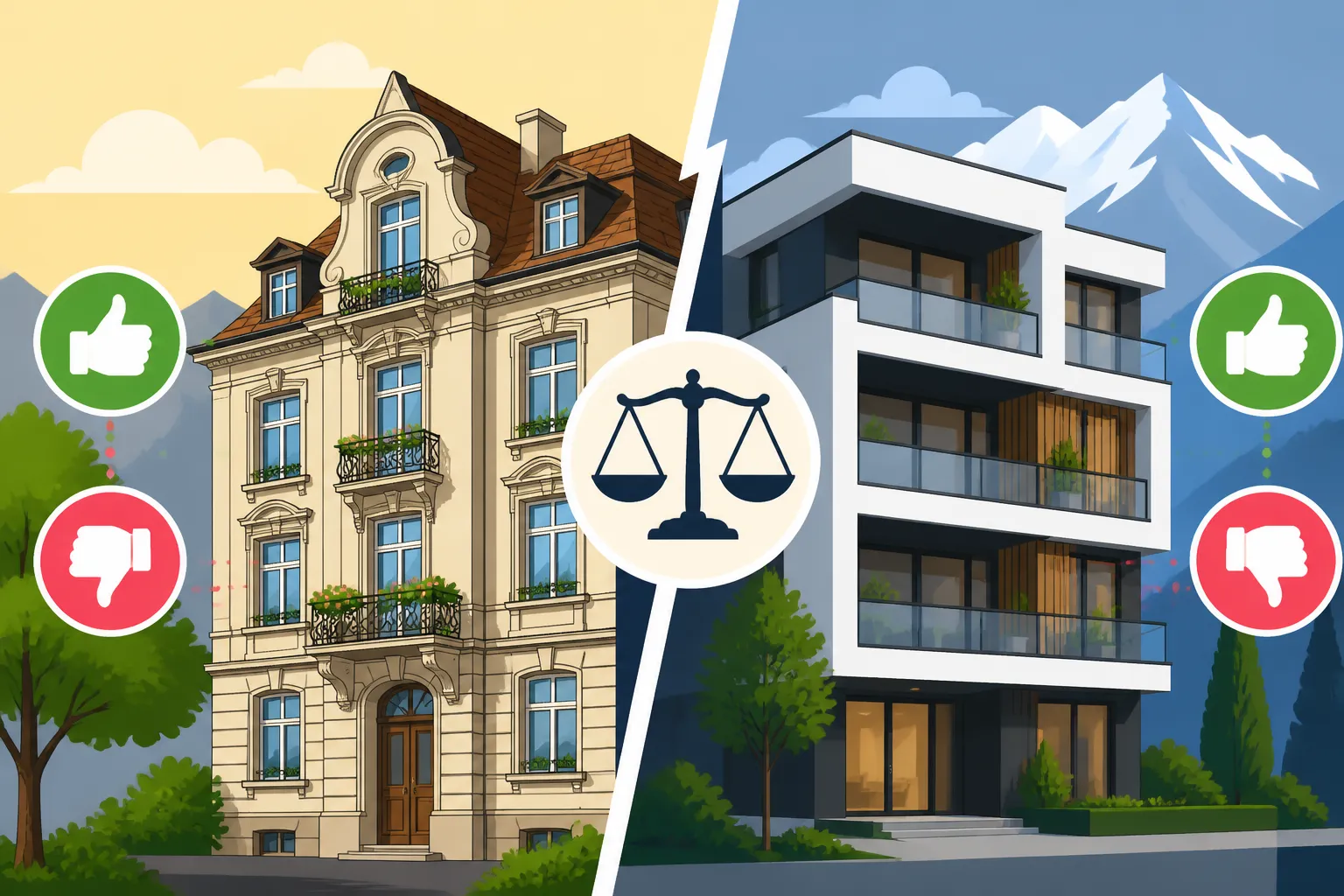
The term Altbau generally refers to buildings constructed before World War II, though in the Swiss context, it often captures everything up until the 1960s that hasn't undergone a total "Sanierung" (gut renovation). These buildings are the soul of cities like Basel, Geneva, and Lausanne. They offer character that mass-produced modern housing simply cannot replicate. However, when you are Decoding Swiss Apartment Ads: What 2.5, 3.5, and 4.5 Rooms Actually Mean, you have to be careful with Altbaus. A "3.5 room" in an old building might include a tiny half-room that was originally meant for a domestic helper, whereas in a Neubau, that half-room is usually a spacious dining nook or a home office.
Altbaus are famous for their high ceilings, often reaching 3 meters or more, which provide a sense of grandeur and light even in smaller square footage. You will often find "Fischgrätparkett" (herringbone parquet floors) that have been polished by generations of tenants. The walls are usually thick masonry, which provides excellent insulation against heat in the summer—a godsend given that air conditioning is almost non-existent in Swiss residential buildings. But there is a catch: the plumbing and electrical systems might be as historic as the facade. If you are a remote worker, you might find that the beautiful thick walls are the ultimate enemy of your Wi-Fi signal.
In contrast, a Neubau represents the Swiss obsession with precision, efficiency, and comfort. These are buildings typically constructed in the last 10 to 15 years. They follow strict building codes, specifically the Minergie standard, which focuses on high-grade airtight envelopes and controlled air ventilation systems. While they might lack the "soul" of an old building, they make up for it with floor-to-ceiling windows, open-plan living areas, and state-of-the-art kitchens equipped with induction stoves and integrated dishwashers. If you are Finding an Apartment in Zurich: Relocation Agents vs Flatfox vs Homegate, you will notice that Neubaus often command a premium, but for many expats, the plug-and-play nature of a modern flat is worth the extra few hundred francs.
The Charm and Quirks of the Altbau
Living in an Altbau is a lifestyle choice that requires a certain level of patience. You aren't just renting an apartment; you are becoming a temporary steward of history. Many of these buildings feature shared balconies or small, enclosed courtyards that foster a close-knit (though sometimes nosy) neighborly environment. The aesthetic appeal is undeniable. There is nothing quite like sipping coffee in a room with crown molding and deep window sills where you can actually sit and watch the world go by. I spent three years in a 1920s flat in Wiedikon, and despite the drafts, the sheer beauty of the space made every cold morning feel like a scene from a movie.
However, the "quirks" can quickly turn into frustrations. For instance, many older buildings do not have elevators. If you are on the 4th floor (the "4. Stock" in Switzerland, which is effectively the 5th floor in the US), carrying groceries or a new IKEA haul up those narrow stairs will become your new cardio routine. Storage is another issue. While you might have a "Keller" (basement storage unit), the actual closet space within the apartment is often non-existent. Historic Swiss residents used massive wardrobes (Schrank) rather than built-in closets. You may find yourself spending a significant amount on Amazon Germany to order modular wardrobe systems that fit the specific dimensions of your high-ceilinged rooms.
Finally, there is the issue of the "Nasszelle" or wet room. In many unrenovated Altbaus, the bathroom and kitchen are the most dated parts of the home. It is not uncommon to find a bathtub with a handheld showerhead but no curtain rod, or a kitchen with only two burner plates. Before you sign a lease, check the water pressure and how long it takes for the hot water to reach the top floor. If these trade-offs sound like too much, you might consider using HousingAnywhere to find a serviced or mid-term apartment first. This allows you to live in an older district without the long-term commitment, giving you time to see if the "old world charm" actually suits your daily routine.
The Sleek Efficiency of the Neubau
The Neubau is the choice of the pragmatic expat. Everything just works. The windows are triple-glazed, meaning that even if you live near a tram line or a busy street, the interior remains pin-drop quiet. Modern Swiss apartments are designed with the "Minergie" philosophy, which means the building manages its own airflow. You rarely need to open windows to "Lüften" (the Swiss German tradition of vigorous airing out) because the ventilation system does it for you. This creates a very stable, allergy-friendly indoor climate that is hard to achieve in older structures.
One of the biggest selling points of a Neubau is the inclusion of "Eigener Waschturm"—your very own washing machine and dryer inside the apartment. In the world of Swiss rentals, this is the ultimate luxury. It frees you from the stress of Managing the Shared Waschküche: Wash Calendars and Cleaning the Lint Filter, which is a common point of contention in older buildings. Additionally, Neubaus almost always come with underground parking (for an extra fee) and large elevators that make moving day a breeze. For families with strollers or individuals with mobility needs, the Neubau is often the only realistic option.
Connectivity is another area where modern buildings shine. They are usually pre-wired with fiber-optic cables, making Setting Up Swiss Home Internet: Swisscom, Sunrise, and Salt Compared a much smoother process. You won't have to worry about whether the copper wires from 1950 can handle your 4K streaming or Zoom calls. In those first few days before your fiber is installed, having a reliable eSIM from Airalo can bridge the gap, but once you are plugged into a Neubau’s infrastructure, the speeds are generally world-class. The downside? These apartments can feel a bit "copy-paste." You might find that your apartment looks identical to every other unit in the building, and the neighborhood might lack the established trees and local cafes found in older quarters.
The Financial and Practical Trade-offs: Beyond the Monthly Rent
In Switzerland, the "Netto" rent you see in the headline is rarely what you actually pay. You must always account for "Nebenkosten" (ancillary costs). This is where the Altbau vs. Neubau debate becomes a matter of cold, hard math. In an older building, the heating system is often an aging oil or gas furnace. With rising energy prices, Receiving the Nebenkostenabrechnung: Why You Might Owe Extra Heating Costs can be a nasty surprise at the end of the year. I once received a bill for 800 CHF in June because the previous winter had been particularly brutal and my Altbau’s windows were about as airtight as a sieve.
Neubaus, on the other hand, often utilize heat pumps or geothermal energy, which are significantly more efficient. While the base rent (Nettomiete) of a Neubau is usually higher, the monthly Nebenkosten are often lower and more predictable. When you are calculating your Cost of Living in Switzerland 2026: Budgeting for Singles and Families, you have to look at the total "Brutto" rent. Sometimes, a 2,200 CHF Neubau ends up costing nearly the same as a 1,900 CHF Altbau once you factor in the high heating costs and the lack of energy-efficient appliances in the older unit.
Energy Efficiency and the Dreaded Nebenkosten
The Swiss take energy efficiency very seriously, and the law allows landlords to pass on most energy-related costs to the tenant. In an Altbau, you are often paying for the inefficiency of the building. If you have those beautiful, original wooden window frames, they might look great, but they allow heat to escape rapidly. Many tenants find themselves draped in wool blankets from October to April. If you do choose an Altbau, ask the landlord for the "Energieausweis" (energy certificate) or ask to see the previous year’s Nebenkosten breakdown. It is your right to know what you are getting into before you commit your Swiss Apartment Handovers (Wohnungsübergabe): Protocols and Deposits funds.
In a Neubau, the floor heating (Bodenheizung) is standard. This provides a consistent, comfortable warmth that radiates from the ground up. It’s a game-changer for those who hate cold feet. However, modern buildings can sometimes be too well-insulated. In the peak of summer, if the building doesn't have external slats or "Lamellenstoren" to block the sun, a Neubau with large glass windows can turn into a greenhouse. Check if the building has automated shading systems; most premium modern Swiss apartments do, but it is always worth verifying during the viewing.
Maintenance, Repairs, and the Swiss Standards of Quality
Swiss landlords are generally very diligent about maintenance, but there is only so much you can do with a 100-year-old pipe. In an Altbau, you might deal with minor annoyances like slow drains, flickering lights, or "singing" radiators. While the landlord is responsible for major repairs, the tenant is often responsible for "Kleiner Unterhalt" (minor maintenance) up to a certain amount—usually around 150 to 200 CHF. Make sure you understand Normal Wear and Tear (Lebensdauer): What Swiss Landlords Cannot Charge For so you don't end up paying for repairs that are actually due to the building's age.
Neubaus generally have a "honeymoon period" where nothing goes wrong. If something does break, it’s usually a faulty sensor or a digital component in the kitchen. The maintenance is streamlined, and most modern buildings are managed by large professional firms (Verwaltung) rather than private landlords. This can make the process more impersonal, but also more efficient. You won't have to wait for "Uncle Hans" to find time to fix your leaky faucet; you simply log a ticket in an app, and a technician appears two days later.
Lifestyle and Community: Finding Your Fit in a Swiss Neighborhood
The choice between old and new also dictates your social experience. Altbaus are typically located in "quartiers" that have been established for centuries. These areas have a high density of local shops, "Bunkis" (second-hand stores), and traditional Swiss restaurants. You are more likely to live next to someone who has been in the building for forty years. This can be wonderful for integration, but it also means you must be very respectful of Quiet Hours (Ruhezeiten): Sunday Rules for Laundry, Mowing, and Noise. In these older communities, the walls may be thick, but the "social surveillance" is even thicker.
Neubaus are often built in clusters, sometimes forming entire new "micro-districts" like Europaallee in Zurich or the Quartier de l'Étang in Geneva. These areas tend to attract a more international, younger demographic. You will find more people who speak English and more families who are in the same boat as you—trying to figure out Swiss Recycling Rules: Cantonal Paid Garbage Bags (Züri-Sack, Bebbi-Sagg) for the first time. The community vibe is often more relaxed, and while the rules still apply, there is generally a higher tolerance for the "noise" of modern life, like children playing or the occasional evening dinner party.
Soundproofing, Social Rules, and the Shared Laundry Reality
One of the biggest shocks for expats moving into an Altbau is the noise transfer. While the external masonry is thick, the internal floors are often wooden joists filled with sand or rubble. You will hear every footstep of the neighbor above you, and they will hear yours. If you have children who like to run, an Altbau might lead to some tense encounters in the hallway. This is why many Swiss people in older buildings live in slippers (Finkli) to dampen the sound.
The shared laundry room in an Altbau is a cultural institution that can either be a great way to meet people or a source of infinite stress. You will likely be assigned a specific day or half-day every week or two. If you miss your slot, you might be out of luck until the next week. In a Neubau, this is rarely an issue as most have in-unit machines. If your heart is set on an Altbau but you can't stand the laundry schedule, check if there is a way to install a small machine in the kitchen or bathroom—though this often requires written permission from the landlord and a professional plumber.
Connectivity and Modern Amenities
If your lifestyle revolves around high-speed internet and smart home features, the Neubau is the clear winner. Many newer buildings come with smart intercom systems that connect to your phone, allowing you to buzz in a delivery driver even if you aren't home. They also feature better electrical layouts, with plenty of outlets in logical places—something that is chronically lacking in older flats where you might find only one outlet for the entire living room.
That said, don't underestimate the power of a well-located Altbau. Being able to walk to the main train station (HB) or the lake in five minutes is a luxury that many Neubaus, often pushed to the city fringes, cannot offer. For those who prioritize location and character over having a perfect dishwasher, the Altbau remains the quintessential Swiss experience. Before you dive into the deep end, ensure your Applying for a Flat: The Bewerbungsmappe (Application Dossier) Essentials is perfectly polished, as competition for both types of housing is incredibly high.
Comparing Altbau vs. Neubau at a Glance
| Feature | Altbau (Historic) | Neubau (Modern) |
|---|---|---|
| Ceiling Height | High (2.8m – 3.5m) | Standard (2.4m – 2.6m) |
| Heating | Radiators (Often Oil/Gas) | Floor Heating (Often Heat Pump) |
| Windows | Often double-glazed, can be drafty | Triple-glazed, soundproof, Minergie |
| Laundry | Usually shared (Waschküche) | Often in-unit (Waschturm) |
| Elevator | Often missing in smaller buildings | Standard, even in low-rise |
| Kitchen/Bath | Can be dated or compact | Modern, high-end appliances |
| Noise | High floor-to-floor transfer | High soundproofing standards |
| Storage | Basement cellar, few built-ins | Modern cellar, built-in closets |
Making Your Choice: A Strategic Checklist for Expat Renters
When deciding between these two, ask yourself the following questions:
- How much do I value "soul"? If white walls and grey floors make you feel like you're living in a laboratory, stick to the Altbau. Just budget for extra sweaters.
- Is in-unit laundry a dealbreaker? If you have a large family, the shared laundry schedule of an old building will be your biggest daily stressor.
- What is my total budget? Don't just look at the rent. Compare the "Bruttomiete" and factor in the potential for high electricity and heating bills in older structures.
- How mobile am I? Carrying a baby or heavy bags up four flights of stairs in a no-elevator Altbau loses its charm after about three days.
- How important is high-speed tech? If you are a hardcore gamer or a heavy data user, the fiber-ready infrastructure of a Neubau will save you hours of technical frustration.
Ultimately, both housing styles offer a unique way to experience life in Switzerland. Whether you choose the creaky charm of the past or the polished efficiency of the future, understanding the trade-offs will help you turn your Swiss apartment into a true home.
Disclaimer
The information provided in this guide is for general informational purposes only and does not constitute legal or professional real estate advice. Rental laws and building standards in Switzerland vary by canton and are subject to change. Always review your specific lease agreement and consult with local authorities or a tenant's association like ASLOCA or Mieterverband before making financial or legal commitments.