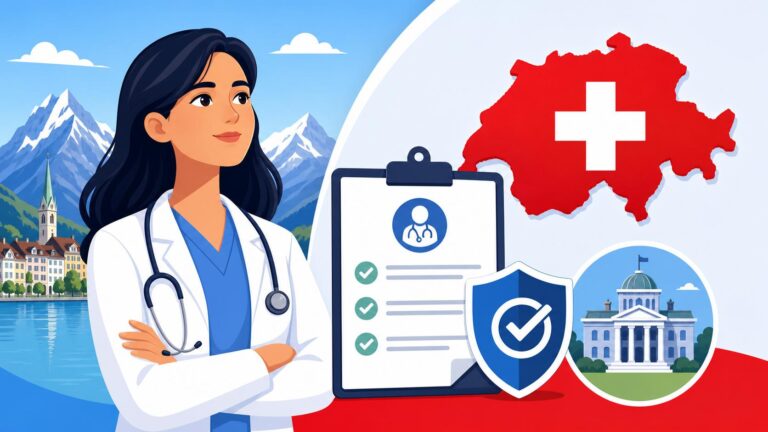
Studying Part-Time at a Swiss University of Applied Sciences
Living in Switzerland often feels like a balancing act between high salaries and high pressure. Many expats dream of upskilling at a Swiss University of Applied Sciences but worry about losing their residency status or income. This guide explains how to navigate part-time study as a professional, covering permit regulations, costs, and the practicalities of the Swiss Fachhochschule system.
Understanding the Fachhochschule System for Professionals
If you come from a traditional academic background in the US, UK, or India, the concept of a University of Applied Sciences (known as a Fachhochschule in German or Haute École in French) might be new to you. Unlike traditional universities that focus on theory and research, the Fachhochschule (FH) is deeply rooted in the practical application of knowledge. For an expat already working in Tech Careers in Switzerland: Software Engineering and Data Science Roles, this is often the most efficient way to gain a Swiss-recognized qualification that employers actually value.
The FH system was designed to bridge the gap between vocational training and academic study. Because of this, the programs are uniquely structured to accommodate people who are already working. In fact, for many part-time Master’s or Bachelor’s programs, having a relevant job in the industry is a mandatory requirement for admission. The school doesn't just "tolerate" your job; they view it as your primary laboratory.
You will find that the lecturers are rarely just career academics. Most of them spend half their week working as senior consultants, engineers, or executives in Swiss companies. This creates a networking environment that is far superior to traditional universities. However, don't mistake "practical" for "easy." The Swiss education system is rigorous, and the ECTS (European Credit Transfer System) requirements are strictly enforced. Whether you study at the Zürcher Hochschule für Angewandte Wissenschaften (ZHAW) or the Haute École d'Ingénierie et de Gestion du Canton de Vaud (HEIG-VD), the standard is exceptionally high.
The Logistics of Workload and Residency Permits
One of the most common frustrations for foreigners is the "permit trap." If you are here on a B or L work permit, your residency is tied to your employment. You cannot simply quit your job to become a full-time student without risking your right to stay in the country. This is where part-time study becomes a strategic necessity.
Most part-time programs at an FH are designed for a "60% to 80% workload" model. This means you work three or four days a week and attend classes on the remaining days or evenings. It is vital to understand What Does '100% Workload' Mean? Understanding the 40-42 Hour Swiss Week before you try to negotiate a reduction with your boss. If you are a non-EU citizen, you must ensure that your primary purpose of residence remains "employment" to keep your work permit valid. If you drop your work percentage too low, the migration office might view you as a student first, which could change your permit status and affect your path to permanent residency.
For those considering the opposite route—arriving on a student visa and hoping to work—the rules are even tighter. You should consult the guide on Student Visas and Part-Time Work: The 15-Hour Weekly Limit Explained to avoid accidentally violating your visa conditions. The beauty of the FH system is that it allows you to maintain your "professional" status while slowly chipping away at a degree. It prevents the financial shock often associated with the Cost of Living in Switzerland 2026: Budgeting for Singles and Families, as you continue to earn a Swiss salary while you study.
Financial Planning and Tax Deductions for Expat Students
While Swiss University Tuition Fees: Domestic vs International Student Rates are generally much lower than in the United States, the ancillary costs of studying in Switzerland can add up quickly. You have to factor in semester fees, specialized software, books, and the "opportunity cost" of reducing your work hours. However, there is a significant silver lining in the Swiss tax code: professional development is often tax-deductible.
If the degree you are pursuing is directly related to your current profession, you can often deduct the tuition fees and even travel expenses from your taxable income. For US citizens, this gets complicated because you are dealing with dual-taxation systems. Using a service like Taxes for Expats is highly recommended to ensure you are compliant with both the Swiss cantonal tax office and the IRS. Navigating the interaction between Swiss education deductions and US tax credits requires specialist knowledge, and Taxes for Expats can help you determine if your Swiss FH qualifies as an "eligible educational institution" for US tax purposes.
Beyond tuition, you should also consider the cost of language preparation. Most part-time Bachelor’s and Master’s programs at an FH are taught in the local language (German, French, or Italian). Even if the brochures say "English-friendly," the administrative reality and group projects often happen in the local tongue. To get your language skills up to the required C1 level, many expats use iTalki to find tutors who specialize in Swiss-specific business terminology. Using iTalki for intensive 1-on-1 sessions can be more effective than a generic group class, especially when you need to pass the specific language exams required for university admission.
| Study Model | Duration | ECTS Credits | Target Audience |
|---|---|---|---|
| CAS (Certificate of Advanced Studies) | 6 months | 10 – 15 | Professionals seeking a specific niche skill. |
| DAS (Diploma of Advanced Studies) | 1 – 2 years | 30 | Mid-career pivoters needing deeper expertise. |
| MAS (Master of Advanced Studies) | 2 – 3 years | 60 | Seniors aiming for leadership or specialized roles. |
| Part-time Bachelor | 4 – 5 years | 180 | Career starters or those without a first degree. |
| Part-time Master (MSc/MA) | 2 – 3 years | 90 – 120 | Academically-minded professionals seeking research-based application. |
Recognition of Foreign Degrees and Admission Hurdles
Before you can even apply, you have to face the administrative hurdle of degree recognition. Switzerland is protective of its educational standards. If you have an engineering degree from outside the Bologna system, you may need to go through the process of Validating a Foreign Engineering Degree in Switzerland (SERI) or the broader process of Getting Your Foreign University Degree Recognized in Switzerland (swissuniversities).
The FH admission offices will look for two things: academic equivalence and practical experience. If you are applying for a part-time Bachelor's and you didn't go through the Swiss apprenticeship system, they may require you to prove at least one year of full-time work experience in a related field. For Master’s programs, they often conduct "sur dossier" admissions, where your professional portfolio is weighed as heavily as your GPA.
If your previous university transcripts are not in a Swiss national language or English, you will need certified translations. This is another area where your language level becomes critical. If you are struggling with the nuances of the application forms or the entrance interview, taking a few targeted sessions on iTalki can help you practice the specific professional vocabulary used in the Swiss academic world. Being able to explain your career trajectory fluently in German or French can sometimes be the deciding factor in a competitive "sur dossier" application.
Balancing the "Swiss Way" of Life and Study
The social reality of part-time study in Switzerland is that it is exhausting. The Swiss work ethic is famous for a reason, and adding 20 hours of study on top of a 30-hour work week is a recipe for burnout if you don't manage your time. You will need to embrace Working 80%: Why 4-Day Work Weeks Are Popular in Switzerland as a lifestyle, not just a schedule.
One thing that surprises many expats is how much the "local rules" affect your study habits. If you plan to spend your Sundays in deep focus at home, you have to remember the Quiet Hours (Ruhezeiten): Sunday Rules for Laundry, Mowing, and Noise. Swiss apartment walls are notoriously thin, and your neighbors will not appreciate you pacing around or using heavy equipment for a project during the sacred Sunday quiet time.
If you live in a major hub like Zurich, you will likely spend a lot of time on the train. The ZHAW, for instance, has campuses in Winterthur and Zurich. Navigating Public Transport in Zurich: ZVV Zones, Tickets, and Night Service becomes part of your daily routine. Many students use the "SBB quiet zones" on the train to get their reading done, making the commute part of their "study hours."
Finally, don't forget the tax implications of your reduced salary. When you move from a 100% to an 80% workload, your "Quellensteuer" (withholding tax) might change, and your pension contributions will definitely decrease. Consulting with Taxes for Expats during this transition is a smart move to ensure you aren't overpaying or under-saving. They can provide a clear picture of how your lower income, combined with your educational deductions, will affect your net take-home pay, allowing you to focus on your studies instead of your bank balance.
Preparing for the Transition to the Local Market
The ultimate goal of a part-time degree at an FH is usually a promotion or a career pivot within Switzerland. The Swiss market is very credential-heavy. Having a degree from a local FH like the Fernfachhochschule Schweiz (FFHS) or the Lucerne University of Applied Sciences and Arts (HSLU) signals to Swiss HR departments that you have "integrated" into their system. It shows you understand the Swiss professional standards and have the discipline to juggle a career and academics in a foreign environment.
As you near graduation, you should start thinking about how to present your new Swiss credentials on your CV. If your goal is to stay long-term, you might also be looking at From Student Visa to Work Permit: The Swiss Step-by-Step Transition if your initial permit was temporary. The networking you do during your FH projects will be your most valuable asset. Your classmates are often the people who will refer you to your next role.
To make the most of these networking opportunities, ensure your "Small Talk" and "Business Lunch" language skills are sharp. Using iTalki to practice professional social scenarios can give you the confidence to engage with your Swiss peers beyond just the technical project work. Integration in Switzerland happens in the "Apéro" after class just as much as it does in the lecture hall.
Disclaimer
This guide is for informational purposes only. Immigration laws, tax regulations, and university admission requirements in Switzerland are subject to frequent changes. Always consult with official cantonal authorities, the Swiss State Secretariat for Migration (SEM), or a qualified professional tax advisor before making significant financial or residency decisions. Enrollment in a University of Applied Sciences does not guarantee the approval or renewal of a residency permit.