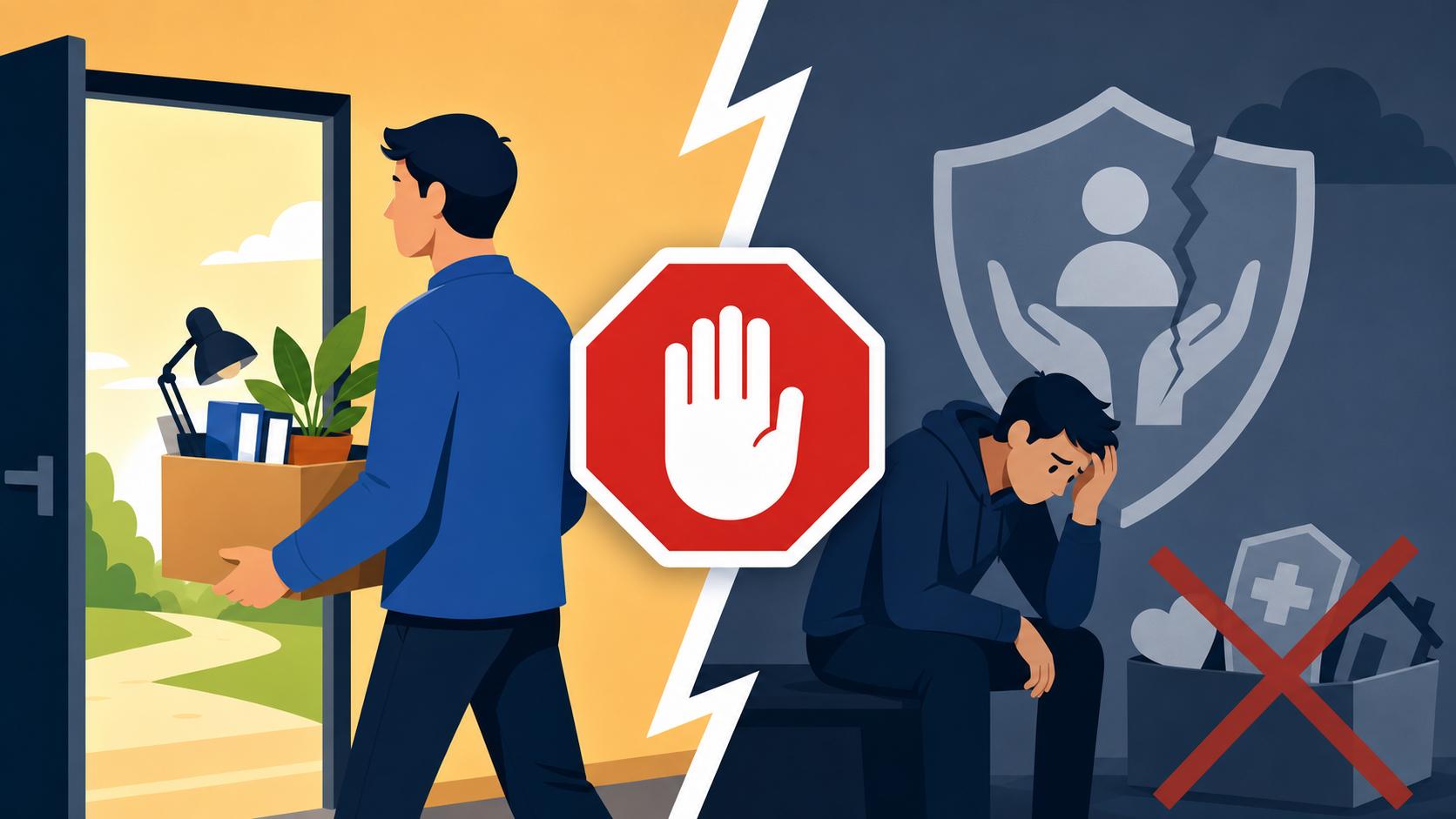
RAV Penalty Days (Einstelltage): Why Quitting Your Job Halts Benefits
Standing in line at the RAV office in Zurich Oerlikon or Geneva Plainpalais is a humbling experience that most expats never plan for. I remember the sinking feeling in my gut when my first advisor told me my benefits would be suspended for several weeks because I had technically "caused" my own unemployment. This guide explains the brutal reality of RAV penalty days, why quitting your job triggers them, and how to survive the financial gap.
Understanding the RAV and the Concept of Self Inflicted Unemployment
The Regional Management Centres, known as RAV in German-speaking cantons, ORP in French, and URC in Italian, are the gatekeepers of your unemployment insurance (ALV) benefits. In Switzerland, unemployment insurance is not a "no-questions-asked" social safety net; it is a highly regulated insurance policy. To receive your Unemployment Pay: Receiving 70% vs 80% of Your Previous Swiss Salary, you must prove that you are unemployed through no fault of your own and that you are doing everything humanly possible to find a new role.
The system relies on a concept called "self-inflicted unemployment" (verschuldete Arbeitslosigkeit). If you walk into your boss's office in Basel or Zug and hand in your resignation without having a signed contract for a new position, the Swiss authorities view this as a choice to become a burden on the state. Unlike some countries where you might wait a week or two for processing, the Swiss system implements "Einstelltage" or penalty days. During these days, you are officially registered as unemployed, and you must still fulfill all your obligations—like attending meetings and applying for jobs—but you receive zero Swiss Francs in compensation.
It is a common misconception among expats that as long as they have paid their mandatory contributions, they are entitled to immediate support. I’ve seen many colleagues move here, get burnt out by the high-pressure corporate culture, and quit thinking they can just "take a few months on the RAV" to reset. This is a dangerous financial gamble. The RAV will scrutinize your Swiss Work Contracts and Labor Law: Notice Periods, Leave, and Rights to ensure you didn't leave prematurely or behave in a way that forced your employer to fire you.
How Many Penalty Days Should You Expect
The number of penalty days isn't arbitrary; it follows a scale based on the "gravity" of your fault. The law allows for a suspension of benefits anywhere from 1 to 60 days. Because the RAV operates on a 5-day working week, 60 penalty days actually equates to nearly three full months without an income. For an expat paying Zurich rents and Swiss health insurance premiums, this can be a total financial catastrophe.
The scale is generally broken down as follows:
- Slight Fault (1 to 15 days): Usually reserved for minor administrative errors, such as missing a single deadline for your job search activity or failing to show up to one meeting without a doctor's note.
- Medium Fault (16 to 30 days): This often applies if you reject a "reasonable" job offer from the RAV or if your job search efforts are deemed insufficient after several warnings.
- Serious Fault (31 to 60 days): This is the "Hero" category for quitting your job without a guaranteed next step. If you resign of your own volition, expect a minimum of 30 days, though 45 to 60 is the standard for most cantons.
| Reason for Penalty | Typical Number of Penalty Days | Financial Impact (Approx. for CHF 100k Salary) |
|---|---|---|
| Quitting without a new job | 30 – 60 Days | CHF 6,000 – CHF 12,000 loss |
| Getting fired for misconduct | 30 – 60 Days | CHF 6,000 – CHF 12,000 loss |
| Missing a RAV meeting | 5 – 10 Days | CHF 1,000 – CHF 2,000 loss |
| Not enough job applications | 3 – 12 Days | CHF 600 – CHF 2,400 loss |
| Rejecting a "suitable" job | 30 – 50 Days | CHF 6,000 – CHF 10,000 loss |
These penalties are cumulative. If you quit your job (serious fault) and then fail to submit your Writing a Swiss CV: Formats, Photos, and Professional Norms to enough employers during your notice period, the RAV can stack those penalty days. Suddenly, you aren't just looking at two months of no pay; you’re looking at four.
Why Language Skills Can Prevent Administrative Penalties
One of the most frequent reasons expats get hit with "slight" or "medium" penalty days is a simple failure to communicate or understand the RAV’s complex instructions. Your advisor is legally required to speak to you in the local national language. While some advisors in international hubs like Geneva or Zurich might be kind enough to use English, you cannot rely on this. If you misunderstand a requirement for How to Register at the RAV Office Before Your Job Ends because of a language barrier, the RAV will still hold you accountable.
This is where proactive integration becomes a financial shield. Improving your local language skills isn't just about making friends; it's about defending your right to benefits. Using resources like GermanPod101 or FrenchPod101 during your commute can help you pick up the specific administrative vocabulary used in RAV brochures and meetings. If you are already facing a job loss, enrolling in an intensive course with Lingoda can show your RAV advisor that you are taking "reasonable measures" to improve your employability.
Advisors have a significant amount of "discretionary power." If they see you are using Lingoda to bridge a language gap and that you are actively studying via GermanPod101 to better understand local job postings, they are often much more lenient. A candidate who struggles with the language but shows a documented effort to learn is far less likely to be penalized for "insufficient integration" than one who insists everyone should speak English to them.
Valid Reasons for Quitting Without Penalties
There are, however, a few "golden" exceptions where you can quit your job and avoid the dreaded Einstelltage. But be warned: the burden of proof is entirely on you, and the RAV’s standard for "unbearable conditions" is incredibly high. You cannot simply quit because your boss is "mean" or the work is "boring."
First, medical reasons are valid. If the job is causing a documented physical or mental health crisis, you must have a Sick Notes (Arztzeugnis): Do You Need One on the First or Third Day? from a Swiss-certified doctor specifically stating that the work environment is damaging your health. Even then, the RAV will ask if you tried to resolve the issue with HR or requested a transfer first.
Second, harassment or "Mobbing" can be a valid reason. However, you must have a paper trail. If you quit due to bullying, the RAV will expect to see emails, HR meeting minutes, and evidence that you tried to mitigate the situation. I always recommend that expats join The ASLOCA / Mieterverband: Why Every Swiss Tenant Must Join for housing, but for work, you should look into legal protection insurance. Having a lawyer help you draft your resignation letter can sometimes convince the RAV that the quit was "forced" by the employer's behavior.
Lastly, major changes to your contract can sometimes qualify. If your employer unilaterally slashes your Salary and Compensation: Navigating Swiss Pay, Bonuses, and Deductions or moves your office from Lausanne to St. Gallen without your consent, you may have a case for quitting without penalty. Before you take this leap, though, read our guide on Employment Probation Periods in Switzerland: What You Need to Know to ensure you aren't in a phase where the employer has more leeway to change terms.
The Job Search Requirement During Your Notice Period
A trap that catches almost everyone is the "Notice Period Search." In Switzerland, your duty to find a new job begins the second you know your current job is ending—even if that's three months away. If you are fired on June 1st with a notice period ending August 31st, you must document 10-12 high-quality job applications for June, July, and August.
If you wait until you are actually "unemployed" in September to start applying, the RAV will hit you with penalty days for every month you were "lazy" during your notice period. They will ask for your job search log the very first time you meet them. They want to see the date of application, the company, the contact person, and the outcome. If you can’t provide this, you are essentially telling the RAV that you chose to be unemployed by not preparing.
To avoid this, you should immediately start looking at Top Expat Job Boards in Switzerland Beyond LinkedIn and Indeed. Even if you aren't fluent, showing that you are looking for English-Speaking Jobs in Switzerland: Top Industries and Cantons will prove your "goodwill." Keep every "thank you for your application" email you receive. These are your currency when negotiating with your RAV advisor to reduce potential penalty days.
Administrative Logistics and the Impact of Penalties
The ripple effect of RAV penalty days extends far beyond your bank account. Because your benefits are tied to your Residence Permits in Switzerland: L, B, C, and G Permits Explained, a long period of "self-inflicted" unemployment can occasionally raise red flags during permit renewals, especially for non-EU "Third Country" nationals. The authorities want to see that you are financially self-sufficient.
Furthermore, if you find yourself unable to pay your bills during these penalty months, you risk a What is a Betreibung? How an Unpaid Bill Ruins Your Swiss Credit Score. A debt register entry is the "kiss of death" for finding a new apartment or getting a car lease in Switzerland. It is far better to stay in a job you dislike for an extra three months while you search for a new one than to quit and face the combined wrath of the RAV and the debt collection office.
If you are a student transitioning to the workforce, be aware of the Swisscare and Academic Care: Cheap Insurance for Non-EU Students rules, as your insurance requirements change the moment you enter the RAV system. You will likely need to move to a standard KVG/LAMal: Mandatory Basic Health Insurance Explained plan, which is much more expensive, adding even more pressure to your budget during penalty days.
If you find yourself in a situation where you are facing a massive number of Einstelltage, you can appeal. You have 30 days to file a "Rekurs" (appeal) against the decision. This is a formal process where you provide additional evidence as to why your unemployment wasn't your fault. However, the success rate is low unless you have new, concrete evidence (like a medical report or HR witness statement) that wasn't included in your initial dossier.
Legal Disclaimer
This article is for informational purposes only and does not constitute legal or financial advice. Swiss unemployment laws and RAV regulations are subject to frequent changes and vary significantly between cantons. Always consult with your local RAV office, a qualified legal expert, or the official portal of the Swiss authorities (ch.ch) before making decisions regarding your employment or resignation. Individual circumstances, such as permit type and specific contract clauses, can drastically alter the outcomes described here.