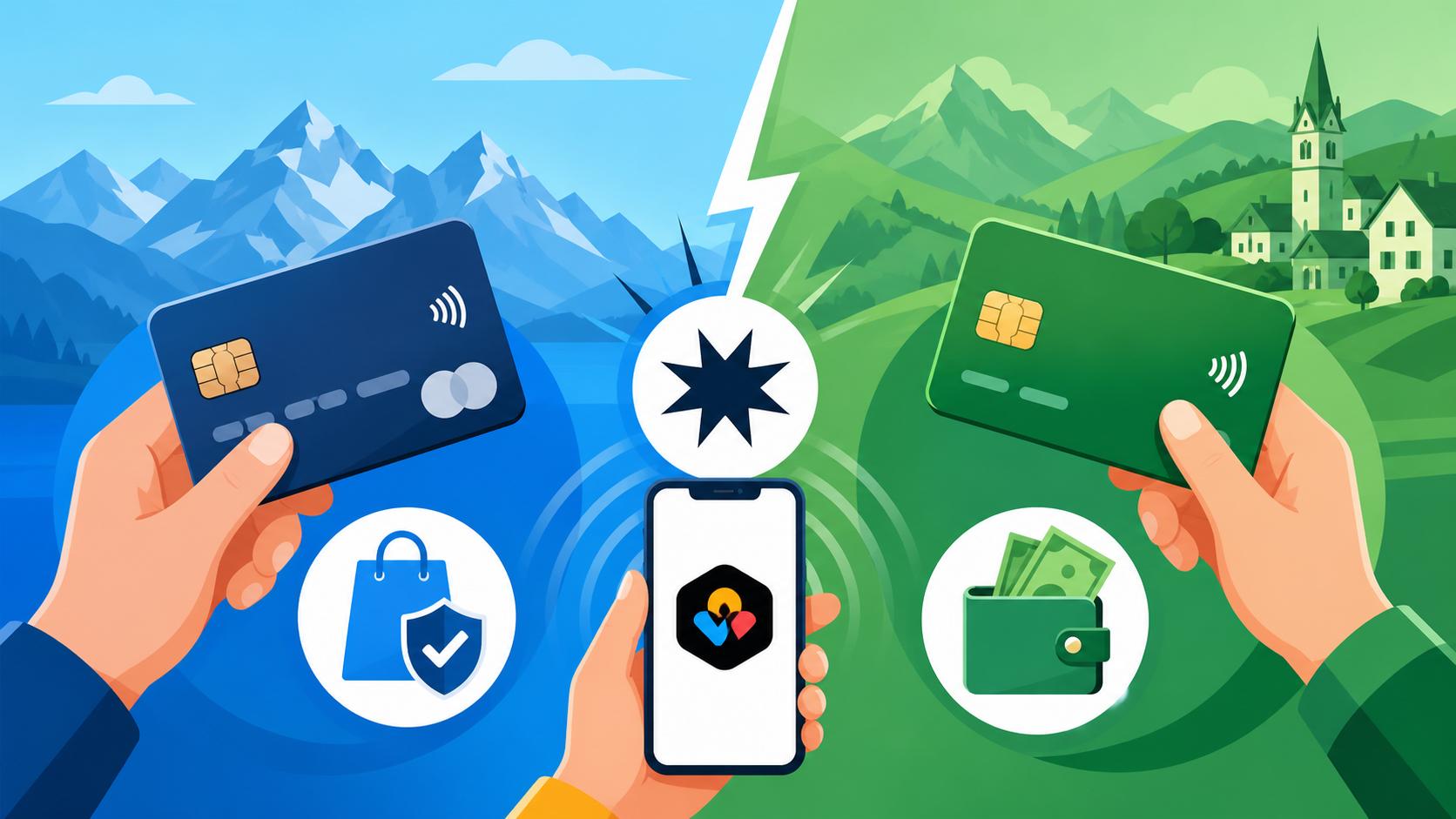
Credit Cards vs Debit Cards: Navigating TWINT and Cashless Payments
Standing in a grocery line at Migros with a week's worth of supplies, only to have your premium foreign credit card rejected while a line of impatient locals stares you down, is a rite of passage every expat dreads. I remember sweating through my shirt during my first month in Zurich because I didn't realize how specific Swiss payment terminals could be. This guide solves the confusion by breaking down exactly which plastic or digital wallets you need to survive and thrive in the Swiss financial ecosystem.
Understanding the Swiss Payment Landscape
Switzerland has undergone a massive digital transformation over the last few years, but it remains a unique beast compared to the US, UK, or even its EU neighbors. While you might be used to a world where a single Visa card covers everything from a stick of gum to a car down payment, the Swiss system is built on layers of legacy banking security and hyper-local solutions. Understanding these layers is the first step toward financial integration.
The Cultural Shift to Cashless
Historically, Switzerland was a cash-heavy society. There was a time not so long ago when carrying a thousand-franc note was perfectly normal. However, the post-pandemic era accelerated a shift toward contactless payments that has become the new standard. Today, even the smallest alpine hut or farm-side "honesty box" often features a QR code for digital payment. This shift hasn't just made life more convenient; it has redefined what it means to be financially prepared. If you are still relying on a fat stack of notes, you’re missing out on the speed and record-keeping benefits of the modern Swiss system.
Despite this digital lean, the "way" the Swiss pay is highly regulated. You will notice that many locals still prefer debit over credit for daily transactions. This stems from a cultural aversion to debt. In the Swiss mindset, if you don't have the money in your account right now, you shouldn't be buying the item. This philosophy is baked into the payment terminals you encounter at retailers like Coop or Denner.
Why Your Foreign Card Might Fail
It is a common frustration for newcomers: your card works at the ATM and the high-end watch shop, but it fails at the local kantine or the post office. This usually happens because of a distinction between "global" credit networks and "local" debit networks. Many smaller Swiss merchants use systems that prioritize the Swiss Debit system (formerly Maestro or V-Pay) because the merchant fees are significantly lower than those charged by Visa or Mastercard Credit.
Furthermore, some terminals are not set up to handle the "Foreign Transaction" protocols of certain overseas banks, or they might trigger a fraud alert because your bank hasn't caught up with your move. To avoid the embarrassment of a declined card, you need to diversify your wallet. Relying on a single source of funds is a recipe for a "Migros meltdown." Instead, you should aim to have a local bank account as soon as possible. Reading about Banking and Finance for Expats in Switzerland: The Complete 2026 Guide will give you a broader view of why this transition is so critical for your long-term stay.
Debit Cards: The Daily Workhorse in Switzerland
In Switzerland, the debit card is king. When you open a local account, this is the first thing you will receive. But not all debit cards are created equal, and the terminology can be confusing for those used to different banking standards. Currently, the market is in a transition phase between the old "Maestro" style cards and the new "Debit Mastercard" or "Visa Debit" options.
Maestro vs. V-Pay vs. New Debit Mastercard
For decades, the "Maestro" card was the gold standard in Switzerland. It was a simple, no-frills card that pulled money directly from your current account. However, these are being phased out in favor of Debit Mastercards and Visa Debits. These new cards are "hybrids" in a sense; they have a 16-digit number and a CVV code, allowing you to use them for online shopping just like a credit card, but they still settle transactions instantly against your bank balance.
When you are Opening a Swiss Bank Account: UBS, ZKB, PostFinance, and Neobanks, pay close attention to which version they issue. The newer Debit Mastercards are far more versatile for expats because they work seamlessly with international websites while still being accepted at the local bakery that only takes "debit." If you are still carrying an old Maestro card, check with your bank about an upgrade, as it will make your digital life significantly easier.
Neobanks and Modern Alternatives
The rise of neobanks has revolutionized how expats manage their daily spending. Many veterans now use a combination of a traditional "big bank" for their salary and rent, while using a neobank card for daily coffee and groceries. This is often because neobanks offer better apps, real-time notifications, and lower fees for currency exchange. If you are frequently crossing the border to Germany or France for shopping, a card from a provider like Wise can save you a fortune in hidden exchange rate markups.
These digital-first banks are particularly popular among the younger expat demographic and tech-savvy locals. They often provide "disposable" virtual cards for online shopping, which adds an extra layer of security. If you are comparing your options, you might want to look into the Best Neobanks in Switzerland: Neon, Yuh, and Zak Compared to see which one fits your spending habits. Using a service like Trade Republic can also be a clever way to earn interest on your "spending cash" while it sits in your account waiting to be used.
The PostFinance Factor
PostFinance is a unique entity in Switzerland. It’s the banking arm of the Swiss Post, and for a long time, it operated on its own proprietary card network. This meant that for years, some shops only took PostFinance cards and refused all other debit or credit cards. While this has largely been standardized now, you will still occasionally find "PostFinance-only" terminals in very rural areas or government-adjacent offices.
For many expats, PostFinance is an attractive first option because they have a mandate to provide basic services to all residents. If you find yourself struggling with the paperwork at a major commercial bank, PostFinance is often more accessible. Their debit card is widely accepted and integrates well with the Swiss ecosystem, making it a solid choice for your Financial Checklist for Your First 30 Days as an Expat in Switzerland.
Credit Cards: Strategic Spending and Rewards
While debit is for the "now," credit cards in Switzerland serve a different purpose. They are rarely used as a way to borrow money—interest rates on credit card balances in Switzerland are notoriously high—but rather as a tool for insurance, travel rewards, and large deposits like car rentals or hotel stays.
Why You Still Need a Credit Card
Even if you prefer the "pay as you go" lifestyle of a debit card, you will eventually hit a wall in Switzerland without a proper credit card. Try booking a car for a weekend trip to the Grisons or a hotel in Geneva; most of these businesses require a "hold" on a credit card that a debit card simply cannot process correctly. Furthermore, many Swiss credit cards come with robust travel insurance and purchase protection that can save you money in the long run.
For high earners, credit cards also act as a status symbol and a way to accumulate "Superpoints" or "Cumulus" points at the major supermarkets. If you are savvy, you can pay for your yearly Serafe Fee 2026: Paying the Mandatory CHF 335 Media Tax or other bills using points earned through your credit card. For a deep dive into which cards offer the best bang for your buck, check out our guide on the Best Swiss Credit Cards for Travel Miles and Cashback in 2026.
Hidden Fees and Currency Conversion
The biggest trap for expats using credit cards in Switzerland is the "Foreign Transaction Fee." Most traditional Swiss credit cards charge between 1.5% and 2.5% every time you buy something in a currency other than CHF. This includes your Netflix subscription if it's billed from abroad or your Amazon.de orders. Over a year, this can add up to hundreds of francs.
To mitigate this, many expats use a multi-currency card for their non-CHF spending. Using Wise for international online purchases while keeping your Swiss credit card for local CHF spending is a common strategy. You should also be wary of "Dynamic Currency Conversion" at ATMs or shops abroad—always choose to pay in the local currency to let your bank (or a service like Wise) handle the conversion at a much fairer rate.
Credit Limits and the "B Permit" Hurdle
Getting a credit card as a fresh expat on a B Permit can be surprisingly difficult. Swiss banks are conservative; they want to see a stable income and a clean debt record. It is not uncommon for a bank to offer a very low limit (like 2,000 CHF) initially, or even ask for a "security deposit" where you freeze an equivalent amount of cash in a savings account to "back" your credit limit.
This is why having your Cost of Living in Switzerland 2026: Budgeting for Singles and Families mapped out is important. If you can show the bank that your income significantly covers your outgoings, they are more likely to increase your limit. Don't be afraid to negotiate with your bank advisor; in Switzerland, personal relationships with your banker still carry a surprising amount of weight.
TWINT: The Essential Swiss Super-App
If there is one thing that defines the modern Swiss payment experience, it is TWINT. You will see the green logo everywhere—at supermarket checkouts, in tiny farm shops, on parking meters, and even on the "bill" at a restaurant when you want to split the cost with friends.
What is TWINT and Why Is It Everywhere?
TWINT is Switzerland's national "mobile wallet." Unlike Apple Pay or Google Pay, which are just digital versions of your physical cards, TWINT is often linked directly to your bank account via a dedicated app provided by your specific bank (e.g., UBS TWINT, ZKB TWINT). It allows you to pay by scanning a QR code or by "beaming" via Bluetooth at certain terminals.
The genius of TWINT is its peer-to-peer (P2P) functionality. If you go out for dinner with five friends, one person pays the bill, and the other four "Twint" their share to that person instantly using just their phone number. It has completely eliminated the "I'll pay you back later" headache. It’s so ubiquitous that "to Twint" has become a verb in all four national languages.
Setting Up TWINT as an Expat
To get the full experience, you really need a Swiss bank account and a Swiss phone number. While there is a "Prepaid TWINT" app for those without a local bank, it is much more cumbersome as you have to manually load funds into it. Once you have your local account, the setup is usually a three-minute process within your banking app.
For a step-by-step walkthrough, refer to How to Set Up and Use the TWINT Payment App as an Expat. One pro-tip: make sure your daily and monthly TWINT limits are set high enough. By default, they can be quite low, which is frustrating when you’re trying to pay for a 300 CHF grocery haul and the app tells you you’ve reached your limit.
Beyond Payments: The Swiss Army Knife of Apps
TWINT isn't just for buying things. It’s an ecosystem. You can use it to pay for parking (and get money back if you leave early!), buy digital vouchers for the Apple Store or Steam, and even make donations to local charities. Many shops also integrate their loyalty cards (like the Coop Supercard) directly into TWINT, so you scan once to pay and collect points simultaneously.
It is also the primary way many people pay for small services. If you buy eggs from a fridge on the side of a mountain road, there will almost certainly be a TWINT QR code taped to the door. This level of trust and convenience is a hallmark of Swiss society, and adopting TWINT is one of the fastest ways to feel like a "local."
Comparing Payment Methods in Switzerland
To help you decide which tool to pull out of your wallet, here is a quick breakdown of how these methods compare in real-world Swiss scenarios.
| Payment Method | Best For | Acceptance | Speed | Expat Pro/Con |
|---|---|---|---|---|
| Local Debit Card | Daily groceries, Post Office, local shops | Universal (100%) | High | Pro: No debt. Con: Hard to use for hotel deposits. |
| Swiss Credit Card | Travel, car rentals, large purchases | Very High (95%+) | High | Pro: Rewards & Insurance. Con: High interest rates. |
| TWINT | Splitting bills, parking, farm shops, small vendors | High (80%+) | Very High | Pro: Instant P2P. Con: Requires Swiss bank/phone number. |
| Foreign Card (e.g., Wise) | Cross-border shopping, travel outside CH | Moderate (70%) | High | Pro: Best FX rates. Con: Sometimes rejected at small local shops. |
| Cash | Flea markets, very old-school cafes | High (90%) | Low | Pro: Privacy. Con: No digital record; coins are heavy. |
Crypto and Emerging Tech
Switzerland, particularly the "Crypto Valley" in Zug, is a global hub for blockchain technology. While you won't be paying for your bread with Bitcoin at the local bakery just yet, the integration of crypto into the financial mainstream is further along here than in most other places.
Paying Taxes and Bills with Crypto
In certain cantons like Zug and Lugano, you can actually pay your taxes using Bitcoin or Ethereum. This is part of a broader government push to remain at the forefront of financial technology. Some major retailers, like the electronics giant Digitec Galaxus, also accept crypto for online purchases. If you are a crypto enthusiast, Switzerland is one of the most welcoming places to live.
However, for the average expat, this is still a niche area. Most people use platforms like Binance or Trade Republic to hold crypto as an investment rather than a daily currency. The tax implications of using crypto for daily spending can also be a bit of a headache, as every transaction could technically be a taxable event.
The Rise of Stablecoins
There is significant talk in the Swiss banking sector about a "Digital Franc" or a regulated stablecoin. This would combine the stability of the CHF with the speed of blockchain. While we aren't there yet, the infrastructure is being built. If you are interested in the intersection of traditional and digital finance, keeping an eye on Cheapest Ways to Transfer CHF Abroad: Wise vs Revolut vs Swiss Banks will help you see how these technologies are slowly lowering the cost of moving money.
For now, if you do hold assets on Binance, keep them for your long-term portfolio. For your day-to-day life in Zurich or Geneva, you’re much better off sticking to the "Holy Trinity" of Swiss finance: a local debit card, a strategic credit card, and a fully-loaded TWINT app.
Practical Tips for Newcomers
Navigating your first month can be expensive if you don't have the right tools. Here is how I would set up my finances if I had to move to Switzerland all over again today.
The 14-Day Financial Sprint
As soon as you have your residence permit (even the temporary one), open your bank account. Don't wait. You need that IBAN for everything—your phone contract, your rent, and your salary. While you wait for your physical cards to arrive in the mail (which usually takes about 5-7 business days), use a card like Wise to avoid the horrific exchange rates your "home" bank will charge you.
Once the cards arrive, immediately download the TWINT app associated with your bank. Link it, verify it, and spend an afternoon "practicing" at a self-checkout in a supermarket. It sounds silly, but knowing how the interface works before you're in a rush will save you a lot of stress.
Managing Daily Expenses and Budgeting
Switzerland is expensive, and it’s easy to lose track of spending when everything is just a "tap" away. Use the categorization features in your banking app to see where your money is going. You might be shocked at how much you’re spending on "Kiosk" snacks or coffee.
By balancing a low-cost neobank for your variable expenses and a traditional bank for your fixed costs, you can create a "firewall" for your budget. This strategy is common among successful expats who want to enjoy the Swiss lifestyle without draining their savings. Remember, the goal isn't just to pay for things—it's to pay for them in the smartest, most "Swiss" way possible.
Disclaimer
The information provided in this guide is for informational purposes only and does not constitute financial, legal, or professional advice. While we strive to keep the details accurate and up-to-date for 2026, the Swiss financial landscape and banking regulations can change. Always consult with a qualified financial advisor or your bank directly before making significant financial decisions or opening accounts. No writer or publisher of this content shall be held liable for any financial losses or damages resulting from the use of this information.