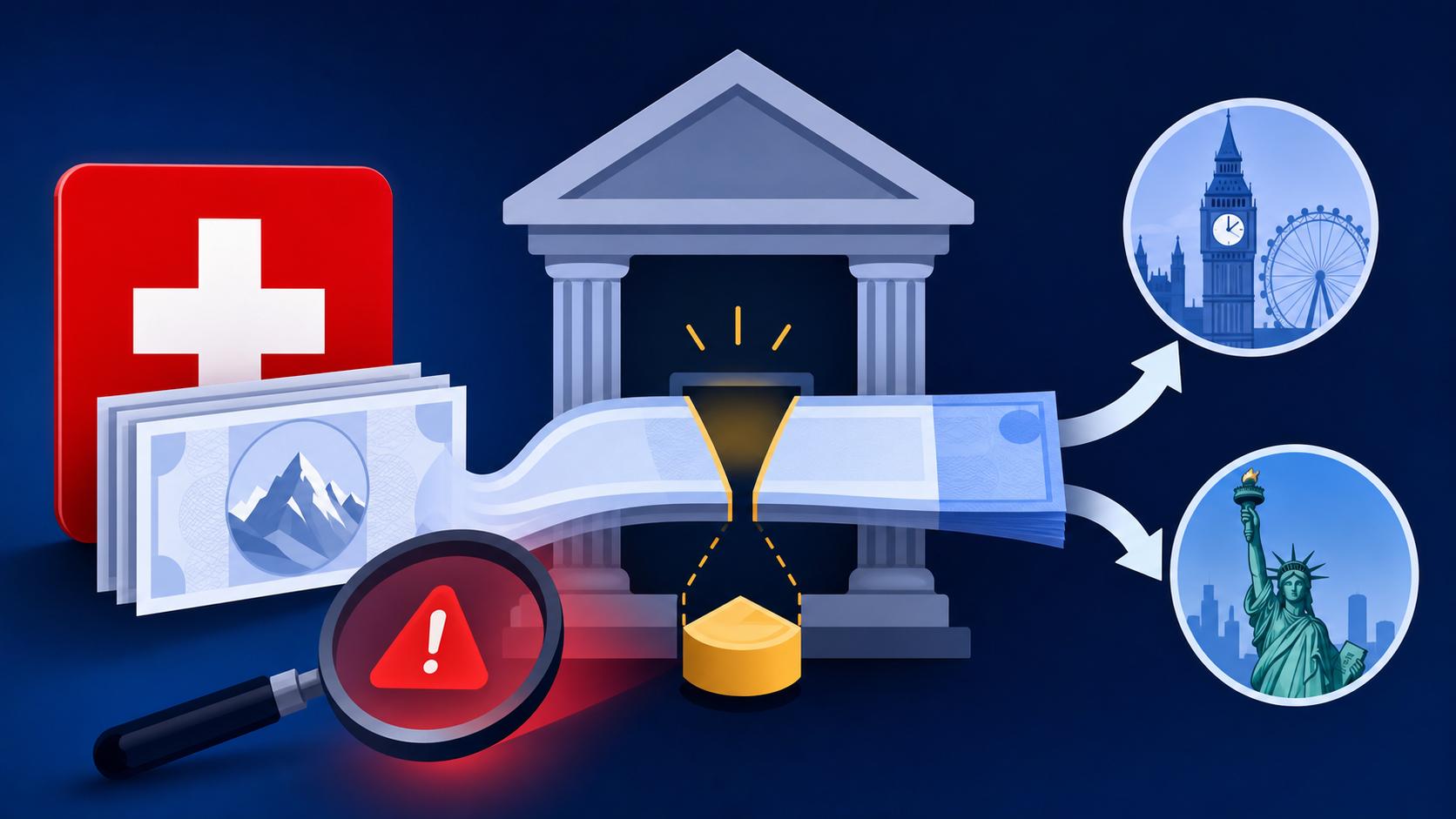
Hidden Bank Margins When Sending Large CHF Amounts to the UK/US
You have just received your first significant bonus in Zurich or perhaps sold a property back home, and now you face the daunting task of moving a large sum of Swiss Francs across borders. I remember the literal physical ache I felt seeing nearly eight hundred francs vanish during my first major transfer because I trusted a standard bank wire. This guide exposes how Swiss financial institutions hide their profit margins and how you can reclaim that lost value.
The Illusion of the Low Cost Swiss Wire Transfer
When you log into your e-banking portal at a major Swiss institution, you are often greeted with a user-friendly interface that promises a flat fee for international transfers, usually ranging between CHF 5 and CHF 25. This transparency is a psychological trap. Most expats focus on this "sticker price," assuming that the administrative fee is the primary cost of the transaction. In reality, the flat fee is the smallest fraction of what the bank is actually taking from you. The real profit for the bank lies in the exchange rate spread, a "hidden" margin that is rarely disclosed in the main transaction window.
The spread is the difference between the mid-market rate—the one you see on Google or XE.com—and the "retail rate" the bank offers you. For example, if the mid-market rate for CHF/USD is 1.15, the bank might offer you a rate of 1.12. While a 0.03 difference seems negligible, on a transfer of CHF 100,000, that gap represents a loss of 3,000 USD. This is money that never leaves the bank's coffers, effectively acting as a massive, undisclosed commission. During my early years here, I was shocked to find that the more money I sent, the more I was being "penalized" by this percentage-based logic, even though the administrative work for the bank remained identical.
To protect your wealth, you must first understand the Banking and Finance for Expats in Switzerland: The Complete 2026 Guide and how it prioritizes institutional profit over individual savings. Banks count on the fact that most expats are too busy navigating the Cost of Living in Switzerland 2026: Budgeting for Singles and Families to perform a manual calculation of the exchange rate against the live market. They provide a "guaranteed" rate for a few minutes, which is almost always heavily skewed in their favor.
Decoding the Mid Market Rate vs the Bank Rate
To truly see the hidden margins, you have to look at the interbank rate. This is the price at which banks trade currency with one another. Retail customers are almost never given this rate. Instead, you are given a "Sell" or "Buy" rate that includes a markup. This markup is the bank's insurance policy against currency volatility, but it is also their primary revenue stream for foreign exchange services. In Switzerland, these margins can be particularly aggressive because the Swiss Franc is a high-value currency.
When you are dealing with large amounts, even a 1% margin is predatory. Unfortunately, many traditional Swiss banks carry margins between 1.5% and 3.5% for retail clients. If you are sending your Salary and Compensation: Navigating Swiss Pay, Bonuses, and Deductions back to the UK to pay off a mortgage or into a US brokerage account, these margins compound over time, potentially stripping away months of your hard-earned savings over a single year. I have sat in meetings with bank advisors where they insisted their "premium" service justified these rates, but for a simple digital transfer, there is no value-add that justifies a four-figure hidden fee.
One of the most effective ways to bypass this is to use a specialist service like Wise. These platforms use the real mid-market rate and charge a transparent, upfront fee. Instead of guessing how much the bank is taking, you see exactly what the exchange costs. When you are performing your Financial Checklist for Your First 30 Days as an Expat in Switzerland, setting up a dedicated transfer rail should be your top priority. Using Wise ensures that you are not subsidizing the marble lobbies of the Paradeplatz banks with your personal savings.
How Much Are You Actually Losing A Comparison Table
To put this into perspective, let's look at the actual numbers for transferring CHF to either GBP or USD. These figures represent typical outcomes in 2026, assuming a mid-market spread of 2.5% for traditional banks versus the transparent fee structures of modern fintech providers.
| Transfer Amount (CHF) | Traditional Bank Margin (Est. 2.5%) | Specialist Service Fee (Est. 0.5%) | Total Savings for Expat |
|---|---|---|---|
| 5,000 | 125 | 25 | 100 |
| 20,000 | 500 | 100 | 400 |
| 50,000 | 1,250 | 250 | 1,000 |
| 100,000 | 2,500 | 500 | 2,000 |
| 250,000 | 6,250 | 1,250 | 5,000 |
The data is sobering. If you are moving the proceeds from a home sale or a significant inheritance, you could be handing over the price of a luxury watch or a high-end family vacation to the bank simply for the "convenience" of clicking a button in your existing app. Understanding the Cheapest Ways to Transfer CHF Abroad: Wise vs Revolut vs Swiss Banks becomes an essential survival skill in this high-cost environment.
The Hidden Danger of Correspondent Bank Fees
Beyond the exchange rate margin, large transfers to the UK or US often fall prey to correspondent bank fees. The international banking system, known as SWIFT, functions like a series of connecting flights. If your Swiss bank does not have a direct relationship with your UK or US bank, they must use an intermediary or "correspondent" bank. Each of these intermediaries can deduct a fee from the principal amount as it passes through their hands.
The frustration here is that these fees are often unpredictable. You might send exactly CHF 50,000, and your recipient receives the equivalent of CHF 49,940, even before the exchange rate is applied. These "routing fees" are often not disclosed by the sending bank because they claim they cannot control what the intermediary banks charge. In my experience, this lack of transparency is used to deflect accountability. When sending large sums, you should always select the "OUR" instruction (where the sender pays all fees) rather than "SHA" (shared) or "BEN" (beneficiary pays), though even then, hidden deductions can occur.
To avoid this, many expats are turning to Best Neobanks in Switzerland: Neon, Yuh, and Zak Compared which often have more modern, direct routing paths or use local accounts in the destination country to circumvent the SWIFT network entirely. If you are still Opening a Swiss Bank Account: UBS, ZKB, PostFinance, and Neobanks, ask specifically about their correspondent network for USD and GBP transfers. If they are vague, it is a sign that you will be hit with unexpected costs.
Strategic Timing and Safe Haven Considerations
The Swiss Franc is unique because of its Understanding Swiss Franc (CHF) Safe Haven Status and Currency Risk. In times of global instability, money pours into Switzerland, driving the value of the Franc up. If you are an expat looking to send money to the US or UK, these moments of "crisis" are actually your best opportunity to transfer funds. A strong Franc means you get more Dollars or Pounds for every unit of Swiss currency.
However, banks often widen their spreads during periods of high volatility. This means that just when the exchange rate is most favorable for you, the bank increases its "hidden" margin to capture that extra value for themselves. I have noticed that during major market shifts, the gap between the mid-market rate and the bank's offered rate can double. To combat this, you need a strategy that allows you to hold funds in a high-interest environment until the rate and the spread are both in your favor.
Using a platform like Trade Republic can be a brilliant middle-ground strategy. In 2026, they often offer competitive interest rates on uninvested cash. You can move your CHF into a versatile account, wait for the perfect market moment when the Franc is peaking against the Pound or Dollar, and then execute your transfer. This turns your "waiting time" into "earning time," rather than letting your money sit in a traditional Swiss current account that likely pays zero or negative interest.
Alternative Rails for the Tech Savvy Expat
For those who are comfortable with digital assets, the emergence of stablecoins has provided another path for large transfers. While not for everyone, using a platform like Binance allows you to convert CHF into a stablecoin pegged to the US Dollar (like USDC or USDT). Once in the digital ecosystem, the "transfer" to a US-based entity can happen in minutes for a fraction of the cost of a bank wire.
However, you must be extremely cautious about Crypto Taxation in Switzerland: Declaring Bitcoin and Staking Rewards. The Swiss tax authorities are very clear that even if you are using crypto simply as a bridge for a transfer, any gains made during that short window must be declared. Furthermore, the UK and US have their own complex reporting requirements for digital assets. While Binance offers incredibly low fees for moving large volumes of value, the administrative overhead of tax compliance can sometimes outweigh the savings on the exchange rate margin.
For the vast majority of expats, the most reliable and least stressful method remains a dedicated currency specialist. Platforms like Wise have spent years building local banking relationships so that when you send money to the UK, it is technically a local transfer from their UK-based account to yours, completely bypassing the expensive and archaic SWIFT system.
The PostFinance Paradox and Public Institutions
Many expats find themselves using PostFinance: The Best Option if Traditional Banks Reject You because of their mandate to provide basic financial services to all residents. While their service is reliable, their foreign exchange margins are often some of the highest in the country for retail customers. There is a common misconception that because PostFinance is "public," it must be the most affordable. This is demonstrably false when it comes to international wire transfers.
If your primary account is with PostFinance or a smaller cantonal bank, you are likely paying a "convenience tax" on every transfer. These institutions often lack the global scale to offer competitive FX rates, so they outsource the actual currency exchange to larger banks and then add their own margin on top. I always advise my fellow expats to treat their local Swiss bank as a "holding tank" for domestic bills and to use a secondary, specialized rail for any amount over CHF 1,000.
With the integration of API banking, there is no longer a reason to be loyal to a single institution. You can have your salary deposited into your traditional bank to satisfy your landlord and your permit requirements, then immediately move the excess to Trade Republic for interest or Wise for international needs. Managing your money as a modular system is the only way to thrive in the Swiss financial landscape.
Final Steps Before Committing to a Large Transfer
Before you click confirm on a transfer of CHF 10,000 or more, take five minutes to do the math. Open a browser window with the live mid-market rate and compare it to the rate offered by your bank. If the difference is more than 0.5%, you are leaving significant money on the table. For amounts over CHF 100,000, you can often call your bank's "FX Desk" directly to negotiate a better rate, but they will only do this if you prove you have an account with a competitor like Wise.
Remember that the bank is not your friend in this transaction; they are a service provider trying to maximize their margin. By being proactive, using modern fintech tools, and understanding the hidden mechanics of the SWIFT network, you can ensure that your Swiss success translates into real wealth back home, rather than just another line item in a bank's annual profit report.
Legal and Financial Disclaimer
The information provided in this guide is for educational and informational purposes only and does not constitute professional financial, investment, or legal advice. Switzerland's financial regulations and tax laws are subject to frequent change, and the specific circumstances of each expat can vary significantly based on canton of residence, permit type, and nationality. Always consult with a qualified tax advisor or financial professional before making significant cross-border transfers or investing in digital assets. While the brands mentioned are reputable, their terms of service and fee structures may change; the author assumes no liability for losses incurred through the use of these services.