Deducting SBB GA or Half-Fare Travelcards on Your Swiss Tax Return
One of the biggest financial shocks when moving to Switzerland is realizing that a first-class Generalabonnement costs more than a used car in most other countries. I still remember staring at my first SBB invoice, wondering if I’d have to live on M-Budget pasta for the rest of the year just to afford my commute. This guide breaks down exactly how to claw some of that money back by deducting your travelcards on your tax return.
The Reality of Commuting Expenses in the Swiss Tax System
When you first land in Switzerland, you are likely focused on the immediate Cost of Living Realities: Groceries, Telecoms, and Household Expenses. However, once the first year passes and the tax office sends you that daunting "Steuererklärung" (tax return) packet, your perspective shifts toward recovery. The Swiss tax system, while complex, is surprisingly fair when it comes to "Berufskosten"—professional expenses. If you need a train pass to reach your place of work, the authorities generally agree that this cost should be deducted from your taxable income.
The fundamental rule is that you can deduct the costs of using public transport between your place of residence and your place of work. However, there is a catch that catches many expats off guard: the "Fahrkostenabzug" (transport cost deduction) is capped. At the federal level, the maximum you can deduct is CHF 3,200. This is a crucial number to remember because a 2nd Class GA currently costs significantly more than that. I’ve seen many newcomers assume they can deduct the full CHF 3,995 (or more for 1st Class), only to be disappointed when the tax software automatically caps the benefit.
Furthermore, the rules change depending on which canton you call home. While the federal cap is fixed, cantons have their own ceilings. For example, in Zurich, the cantonal cap for transport deductions was recently adjusted, and in some cantons like Geneva or Vaud, the calculations can feel like a whole different language. Before you start filling out the forms, it is helpful to understand Understanding Swiss Taxes: Federal, Cantonal, and Municipal Rates to see how your specific location influences your potential refund.
Federal vs. Cantonal Limits
It is vital to distinguish between the two layers of Swiss taxation. Your tax return calculates both your Federal Tax (IFD) and your Cantonal/Municipal Tax. When you enter your GA costs, the software will apply the federal cap of CHF 3,200 to your federal tax calculation. However, for your cantonal taxes, the limit might be higher, lower, or non-existent.
In some progressive cantons, there has been a push to limit these deductions to encourage people to live closer to work, while others remain more generous. If you are living in a high-cost area like Zug or Schwyz, you might find the rules slightly more favorable compared to the dense urban centers. If you are struggling with the overall cost of being here, checking out a Cost of Living in Switzerland 2026: Budgeting for Singles and Families guide can help you see where these tax savings fit into your broader financial plan.
Professional vs. Private Use
The tax office is perfectly aware that you probably use your GA or Half-Fare card for weekend trips to Zermatt or visiting friends in Lugano. However, the law focuses on the "business necessity." If the distance between your home and work justifies the cost of a travelcard, you can deduct it. You do not need to prove that you only use it for work.
If you only have a Half-Fare card, the deduction is even simpler. Since the cost is relatively low (CHF 190 for a one-year renewal), it almost always falls well under the caps, meaning you get to deduct the full amount. In many cases, if your commute involves just a few zones in a local network like ZVV (Zurich) or Unireso (Geneva), the cost of your annual local pass is fully deductible.
How to Deduct the SBB Generalabonnement (GA)
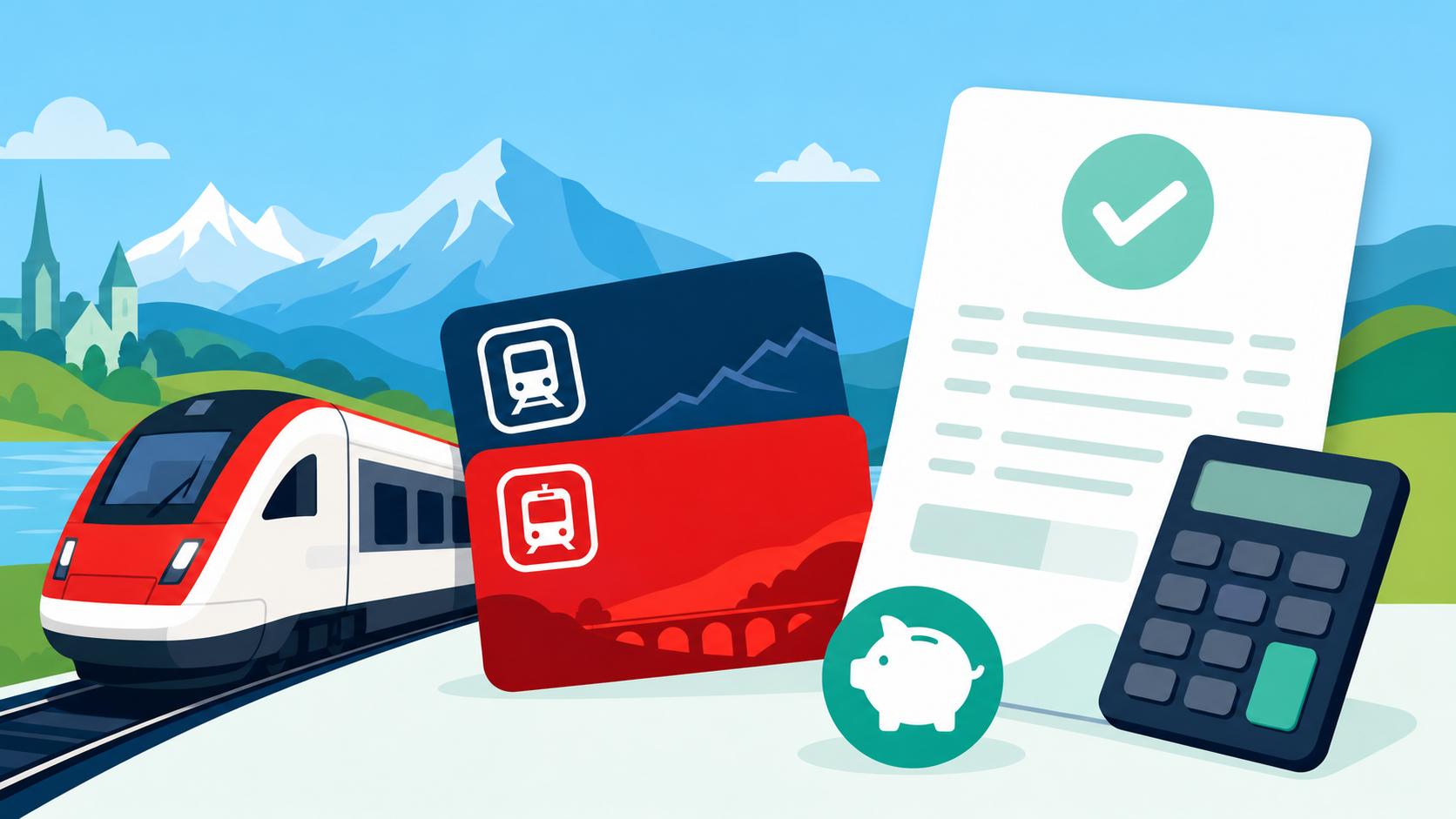
The GA is the "holy grail" of Swiss transport. It gives you unlimited travel on SBB trains, most private railways, postbuses, boats, and trams. Because it is a significant investment, the tax deduction is a major talking point for expats. When you fill out your tax return, you will find a section for professional expenses. Under "Fahrtkosten zwischen Wohn- und Arbeitsstätte" (Travel costs between home and work), you will list your GA.
If your employer provides the GA as a perk, you need to be very careful. Check your "Lohnausweis" (salary certificate). If there is a cross in "Field F," it means your transport is already paid for or subsidized by your employer. In this case, you generally cannot claim the deduction, or you must declare the GA as a benefit-in-kind. I’ve seen expats get into trouble by "double-dipping"—trying to claim a deduction for a pass their company provided for free. For more on this, read Understanding Your Swiss Salary Certificate (Lohnausweis) for Tax Season to ensure you aren't making a costly error.
The Math of the GA Deduction
Let's look at a hypothetical scenario. You live in Winterthur and work in Zurich. An annual ZVV pass for these zones might cost around CHF 2,500. However, you decide to buy a GA for CHF 3,995 because you love hiking on weekends.
- Federal Tax: You enter CHF 3,995. The system automatically reduces this to the CHF 3,200 federal cap.
- Cantonal Tax (Zurich): In Zurich, the limit for the cantonal tax deduction is currently CHF 5,000. This means you can deduct the full CHF 3,995 from your cantonal taxable income.
This distinction is why you shouldn't just look at the federal rules. The cantonal deduction is often where the real savings are. If you are managing your finances through modern tools, you might be using Wise to handle your international transfers or Trade Republic to invest your monthly savings; knowing your exact tax liability helps you move the right amount of money into these platforms at the end of the year.
Documentation Requirements
Do you need to keep the physical receipt? In the age of the Swisspass, the tax office has become much more digitally savvy. You can usually download a "Tax Receipt" directly from the SBB website or the SBB Mobile app. Log into your account, go to your orders, and look for "Rechnung für Steuererklärung." This PDF is your gold standard if the tax auditor asks for proof.
If you are a B-permit holder paying withholding tax, you don't automatically file a full tax return unless you earn over CHF 120,000. However, you can still benefit from these deductions by filing a "Säule 3a" claim or a voluntary tax recalculation. This is known as Tax Corrections (Tarifkorrektur): Claiming Deductions on Withholding Tax, and it is one of the most effective ways for expats to lower their tax bill.
Deducting the Half-Fare Travelcard and Local Passes
Not everyone needs a GA. For many expats, the combination of a The Half-Fare Travelcard (Halbtax): The Must-Have Pass for Swiss Residents and point-to-point tickets or a local zone pass is the most economical choice. The good news is that these are also fully deductible, provided they are used for your commute.
The "Halbtax" is almost a mandatory purchase for anyone living in Switzerland. At CHF 190, it pays for itself in just a few trips. When it comes to taxes, you can add the cost of the Half-Fare card to the total cost of the tickets you purchased for work. If you buy "Streckenabos" (point-to-point monthly passes), keep a record of these. Most tax software will ask for the "effective costs" or allow you to choose a flat rate based on the distance.
| Travelcard Type | Approx. Annual Cost (2nd Class) | Federal Tax Deduction | Cantonal Tax Deduction (e.g., ZH) |
|---|---|---|---|
| SBB GA | CHF 3,995 | Capped at CHF 3,200 | Up to CHF 5,000 |
| Half-Fare (Halbtax) | CHF 190 | Fully Deductible | Fully Deductible |
| Local Zone Pass (e.g., ZVV) | CHF 800 – 2,500 | Fully Deductible | Fully Deductible |
| Point-to-Point Pass | Varies by distance | Capped at CHF 3,200 | Up to CHF 5,000 |
The New Halbtax Plus System
As SBB has pushed the "Halbtax Plus" system, which functions like a prepaid credit account with a bonus. If you deposit CHF 2,000, SBB might give you a bonus of CHF 400. From a tax perspective, you should only deduct the amount you actually paid (the CHF 2,000), not the total credit value. Using the bonus as a deduction could be seen as tax evasion if audited.
If you find yourself with extra cash after these deductions, you might consider diversifying your portfolio. Some expats use the savings to explore the crypto market via Binance, though you must remember that Swiss wealth tax applies to crypto holdings just as much as it does to your bank account. Always ensure your "Wertschriftenverzeichnis" (list of assets) is accurate.
Negotiating Transport in Your Contract
When you are first Working in Switzerland as an Expat: Jobs, Culture, and Employment Laws, it is worth discussing transport subsidies. Some companies offer a "Reka" card or a discounted GA. If you manage to get a Commuter Deductions: Negotiating a Half-Fare Card in Your Contract deal, it can be more valuable than a small salary bump because of the tax implications. A subsidized pass reduces your out-of-pocket costs while often still allowing for some level of deduction if you pay for a portion of it yourself.
Special Cases: Bikes, Cars, and Home Office
The Swiss tax office loves public transport, but they are less enthusiastic about cars. If you choose to drive to work, you can generally only deduct the cost of a train ticket for that same distance—unless you can prove that using public transport is "unreasonable." "Unreasonable" usually means that public transport would take more than an hour longer than driving, or you have a physical disability.
If you are a cyclist, you can often claim a small flat-rate deduction (usually around CHF 700 per year) for the maintenance of your bike. This is a nice "hidden" deduction that many expats miss. However, you cannot claim both a GA and a bike deduction for the same commute. You have to choose the primary method of transport.
The Home Office Impact
Since the shift toward hybrid work, many of us are working from home 2 or 3 days a week. Does this affect your GA deduction? Strictly speaking, if you have a GA, you can still deduct it because the cost is fixed regardless of how many days you travel. However, some cantons have started to look more closely at "Professional Expenses" and might reduce your "Meal Deduction" (Verpflegungskosten) for the days you work from home.
If you are only going into the office 40% of the time, it might be more tax-efficient to buy individual tickets rather than a GA, but then you lose the weekend travel benefits. It’s a math game that requires looking at your total yearly spend. For those on a B-permit, understanding Withholding Tax (Quellensteuer) vs Standard Taxation for Foreigners is the first step in deciding if it’s even worth filing the extra paperwork for these deductions.
Final Practical Advice for Filing
When you sit down to use the "ZHprivateTax" or "VaudTax" software, the transport section is usually very straightforward. It will ask for your place of work and the type of pass you use.
- Select Public Transport: Even if you drive, unless you have a very specific exemption.
- Enter the Full Amount: Let the software handle the capping.
- Check your Lohnausweis: Ensure you aren't claiming something your employer already paid for.
- Save the SBB PDF: Keep it in a folder for five years.
Managing your Swiss life is about these small wins. Whether it is saving CHF 500 on your tax bill or finding the best way to Filing a Swiss Tax Return (C Permit or High Earners on B Permit), every bit of local knowledge helps. Once you get that refund, you can use Wise to send a gift home, or perhaps top up your Trade Republic account to let that "tax money" start working for you.
Disclaimer regarding Tax Advice
This article is for informational purposes only and does not constitute professional tax or legal advice. Swiss tax laws are subject to frequent changes at federal, cantonal, and municipal levels. Always consult with a qualified Swiss tax advisor or your local cantonal tax office (Steueramt) to discuss your specific financial situation before filing your return. The rules for 2026 may vary slightly by canton.