Cross-Border Taxation for Frontaliers: France vs Germany vs Italy
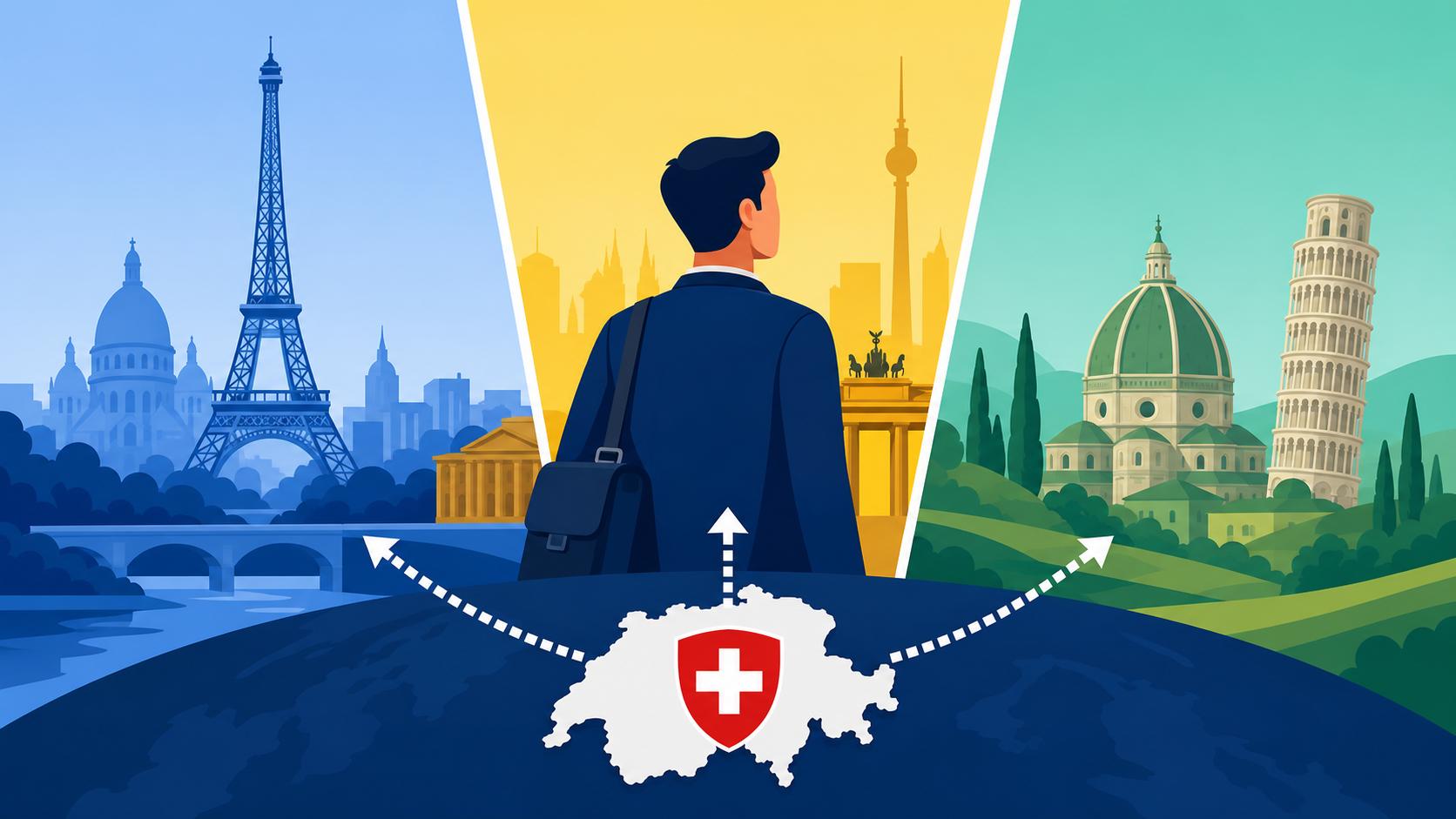
Navigating the double-headache of Swiss salary deductions and home-country tax filings is the ultimate "Welcome to the Frontalier Life" moment for thousands of workers. I spent years navigating the G-permit maze, wondering why my French neighbors paid differently than my German colleagues despite working the same shifts in Basel. This guide breaks down the complex tax treaties between Switzerland and its neighbors to save you from expensive cross-border errors.
The Foundation of the G Permit and Tax Residence
To understand your tax bill, you first have to understand the legal definition of a cross-border commuter, or a "Frontalier." In the eyes of the Swiss authorities, holding a G-permit means you live in a neighboring country and return to your primary residence at least once a week. However, for tax purposes, the rules are much stricter and depend heavily on which canton you work in and which country you sleep in.
A common point of confusion I often see is the difference between tax residence and the place of work. Generally, you are taxed where you live, but Switzerland has a "Right of Taxation" at the source for work performed on its soil. To prevent you from being taxed twice on the same Franc, Switzerland has signed bilateral agreements with France, Germany, and Italy. These agreements are not identical, which is why a worker in Geneva faces a completely different financial reality than one in Lugano or Basel.
Beyond just the income tax, you have to consider social security. Most frontaliers are subject to the Swiss social security system because that is where they are employed. This includes deductions for the AHV (Old Age and Survivors' Insurance) and the BVG (Occupational Pension). If you are new to the system, I highly recommend reading up on Understanding Swiss Payslips: Deductions for AHV, ALV, and NBU to see exactly what is disappearing from your gross salary before it even hits your bank account.
The 45 Day Non Return Rule for Cross Border Commuter Taxes
One of the most technical hurdles you’ll face is the "non-return" rule. For tax purposes, many treaties specify that you must return home daily to maintain your frontalier status. If you stay overnight in Switzerland for work-related reasons—perhaps a late project or a snowy commute—you are limited in how many nights you can do this.
Specifically, The 45-Day Non-Return Rule for Cross-Border Commuter Taxes dictates that if you exceed 45 nights of staying in Switzerland (or working in third countries), you might lose your frontalier tax status. If this happens, your home country may no longer recognize the simplified tax treaty, and you could find yourself being taxed as a standard Swiss resident, which often complicates your filings in France or Germany significantly. I have seen expats lose thousands because they didn't track these nights meticulously in a calendar.
Social Security and the 25 Percent Remote Work Threshold
Since the pandemic, remote work has become a staple of Swiss corporate life. However, for a frontalier, working from your home office in Mulhouse or Freiburg is a legal minefield. According to EU/EFTA coordination rules, if you work more than 25% of your time in your country of residence (teleworking), you must be insured under your home country’s social security system, not the Swiss one.
This is a nightmare for Swiss employers, as they would have to register and pay contributions into the French, German, or Italian systems. For you, it means your Working Models: Part-Time Percentages (e.g., 80% Workload) Explained needs to be carefully balanced. Most frontaliers try to keep their home-office days to one day per week to stay safely under that 25% threshold. If you're using a digital-first bank like Wise to manage your multi-currency needs, you’ll want to ensure your salary is consistently landing in the right account regardless of where you are physically sitting that day.
Frontaliers in France: The Cantonal Divide
France has the most complex relationship with Swiss taxation because the rules change depending on which Swiss canton you work in. There are essentially two regimes: the "Frontalier" regime for cantons like Vaud, Neuchâtel, and Jura, and the "Geneva" regime.
In the cantons of Vaud, Valais, Neuchâtel, Jura, Bern, Solothurn, Basel-Stadt, and Basel-Landschaft, a special agreement exists. You pay your income tax entirely in France. You receive your full Swiss gross salary (minus social security), and then you declare and pay tax to the French authorities. Switzerland then receives a "compensation" payment from France (4.5% of the total gross salary) to cover the infrastructure you use while working in Switzerland.
G Permit France: Taxation Rules for Frontaliers in Geneva
Geneva is the big exception. If you work in Geneva but live in France, you are taxed at the source by the Geneva authorities. This means your employer deducts the tax directly from your monthly paycheck. You still have to declare this income in France, but you receive a tax credit equal to the French tax to prevent double taxation.
For many, G Permit France: Taxation Rules for Frontaliers in Geneva is the most favorable setup because Swiss tax rates are often lower than French ones, especially for high earners. However, the administrative burden of the "Déclaration des revenus encaissés à l'étranger" is something you’ll have to get used to every May. When you're moving large amounts of CHF to EUR to pay French bills, using a service like Wise can save you a fortune compared to the predatory exchange rates at traditional banks.
Tax Credits and Avoidance of Double Taxation
The key to surviving the French-Swiss tax system is understanding the "Credit d’impôt." Since you are a French tax resident, France technically has the right to tax your worldwide income. To stop them from taking a second bite out of your Swiss salary, the treaty allows you to claim a credit.
In your French tax return (Form 2047 and 2042), you report your Swiss income. The French tax office calculates what you would have paid in France, and then applies a credit. If you worked in a canton where you were taxed at the source, that credit effectively cancels out the French tax on that specific income. If you didn't pay at the source (like in Vaud), you'll simply owe the French tax. It’s vital to keep your Understanding Your Swiss Salary Certificate (Lohnausweis) for Tax Season safe, as the French authorities will demand it as proof of your earnings.
Frontaliers in Germany: The 4.5 Percent Rule
For those living in Germany and working in cantons like Basel or Zurich, the system is quite streamlined but very strict. Unlike the French "Vaud" model where you pay everything at home, Germany and Switzerland have a "shared" approach for daily commuters.
If you return home to Germany daily, Switzerland withholds a limited tax at the source, currently capped at 4.5% of your gross salary. This is a "withholding tax" that acts as a down payment. You then report your income to the German Finanzamt, and the 4.5% you already paid in Switzerland is deducted from your German tax bill.
G Permit Germany: Withholding Tax Rules for Cross-Border Commuters in Basel
The 4.5% rule applies only if you meet the strict criteria of a "Frontalier." This is where G Permit Germany: Withholding Tax Rules for Cross-Border Commuters in Basel becomes essential reading. If you are a high-level executive or someone who cannot return home more than 60 days a year due to professional reasons, you might lose this status.
In that case, you fall under the "Non-Returner" (Nichtrückkehrer) rule. You would then be taxed in Switzerland as a regular resident (Quellensteuer), and Germany would give you a tax credit. For most "daily" commuters, however, the 4.5% Swiss tax followed by a German assessment is the norm. To manage the high German tax burden, many commuters look for smart investment vehicles. Using a platform like Trade Republic can be a great way to manage your Euro-denominated savings and investments while benefiting from the higher Swiss salary.
Navigating German Income Tax vs Swiss Withholding
German tax rates are notoriously higher than Swiss ones, especially when you factor in the "Solidaritätszuschlag" and potentially church tax. When the Finanzamt calculates your bill, they look at your total Swiss gross salary and then apply German tax deductions (like commuting costs or insurance premiums).
Because your Swiss salary is paid in CHF and your German taxes are in EUR, the exchange rate used by the Finanzamt can significantly impact your final bill. They usually use an average annual rate, but you can sometimes argue for a specific rate if the Franc fluctuated wildly. Many of my colleagues in Lörrach use Wise to hold balances in both currencies, allowing them to pay their German tax prepayments (Vorauszahlungen) without getting hti by bad bank conversion spreads.
| Feature | France (Vaud/Jura) | France (Geneva) | Germany | Italy (New Treaty) |
|---|---|---|---|---|
| Taxed at Source? | No | Yes | Yes (4.5%) | Yes (80% of total tax) |
| Primary Tax Body | France | Switzerland | Germany | Switzerland & Italy |
| Social Security | Switzerland | Switzerland | Switzerland | Switzerland |
| Reporting Req. | Annual in FR | Annual in FR | Annual in DE | Annual in IT |
Frontaliers in Italy: The 2023 and 2026 Treaty Shift
The landscape for Italian frontaliers changed dramatically with the new treaty that entered into force in July 2023, with major implementation phases reaching into 2026. This was a massive shift from the old 1974 agreement which allowed Italian frontaliers in "border communes" to be taxed only in Switzerland.
Under the new rules, "new" frontaliers (those who started working in Switzerland after July 17, 2023) are subject to a concurrent taxation system. Switzerland taxes the income at the source (up to 80% of the regular withholding tax), and Italy then taxes the income as well, providing a tax credit for the amount paid in Switzerland. This significantly increases the tax burden for new workers in Ticino compared to the "old" generation.
G Permit Italy: 2026 Tax Treaty Updates for Ticino Commuters
If you were already working in Ticino, Graubünden, or Valais before the cutoff, you are considered an "old" frontalier. You remain taxed exclusively in Switzerland until your retirement. However, for anyone else, the G Permit Italy: 2026 Tax Treaty Updates for Ticino Commuters is the new reality.
Italy has also introduced a higher "tax-free" threshold (Franchigia) for frontalier income, which helps slightly, but the net take-home pay for an Italian worker is now much closer to that of a local Italian worker than it used to be. Given the volatile nature of these changes, many Italian frontaliers have started diversifying their wealth into digital assets. Using a platform like Binance can be a way to manage a portion of your portfolio outside the traditional Italian banking system, though you must still remain compliant with Italian "RW" reporting requirements for foreign assets.
The New vs Old Frontalier Status
The distinction between "Old" and "New" is the most important factor for an Italian commuter. To be an "Old" frontalier, you must have worked in a border canton and lived in a border commune between 2018 and July 2023. If you move from a border commune to a non-border commune in Italy, you lose this protected status and fall under the new, more expensive rules.
This "commune" rule is incredibly specific. If your village is 500 meters outside the defined border zone, you are taxed differently. If you find yourself in this situation, you really need to look at How to Read a Swiss Medical Bill (Rückforderungsbeleg) and Claim Refunds and other ways to optimize your Swiss deductions, as every Franc saved in Switzerland helps offset the Italian tax bill.
Financial Management for the Cross Border Life
Living in one currency and earning in another is a balancing act that requires better tools than a standard savings account. As a frontalier, your biggest "hidden" cost isn't taxes—it's the exchange rate.
Most Swiss banks will charge you 1.5% to 3% on the "margin" when you convert your salary to pay your mortgage in France or Germany. Over a 30-year career, that is a six-figure loss. This is where neobanks and transfer services become your best friends. I personally recommend setting up a system where your salary lands in a CHF account, and you use Wise to convert only what you need into EUR at the mid-market rate.
Currency Exchange Strategies
The "set and forget" approach is dangerous for frontaliers. I’ve seen people lose hundreds of Euros in a single month because the SNB made a surprise announcement and they didn't have a limit order in place. By using Wise, you can set "auto-conversions" that only trigger when the CHF/EUR rate hits a certain target.
Furthermore, you should consider where you keep your emergency fund. If your expenses are in EUR, your emergency fund should be in EUR. However, keeping some "dry powder" in CHF is a great hedge against Eurozone inflation. For long-term wealth building, platforms like Trade Republic allow you to earn interest on your EUR cash balances, which is often much higher than what you’d get at a traditional Crédit Agricole or Sparkasse branch.
Investing Across Borders
Investing as a frontalier is tricky because of the tax reporting. If you live in Germany but buy stocks through a Swiss broker, you have to manually report every dividend to the Finanzamt. It is often much easier to use a broker located in your country of residence.
Trade Republic is particularly popular among the Basel-based expat community because they provide the specific tax documents needed for the German return. If you're more into the crypto space, Binance offers a wide range of assets, but remember that as a resident of France, Germany, or Italy, you are subject to strict "wealth" and "capital gains" reporting. Switzerland might not have a capital gains tax for private investors, but your home country certainly does. For more on the Swiss side of this, check out Capital Gains Tax in Switzerland: The Tax-Free Stock Market Rule.
Common Pitfalls and Compliance
The most common mistake I see frontaliers make is forgetting to notify their home country of their Swiss pension (Pillar 2) and Pillar 3a holdings. While these are "tax-deferred" in Switzerland, some countries (like France) have very specific rules about how they are treated if you withdraw them.
If you are contributing to a Pillar 3a, make sure you understand the Pillar 3a in 2026: Tax Deductions, Limits, and Investment Options. While these contributions reduce your Swiss taxable income (which is great if you work in Geneva), they might not be deductible from your French or German tax bill. Always check with a cross-border tax specialist before making large voluntary contributions to your pension.
Health Insurance for Frontaliers
This is the second-biggest financial decision you'll make after your housing. As a frontalier, you have the "Option Right" (Droit d'option). You can choose to be insured in the Swiss system (KVG) or your home country's system (like CMU in France).
If you choose the French system, your premiums are calculated as a percentage of your salary. If you choose the Swiss system, you pay a flat monthly fee. For high earners, the Swiss system is almost always cheaper. For more detail, read French Cross-Border Commuters: Choosing Between CMU and Swiss KVG. Once you make this choice, it is generally irrevocable unless your professional or family situation changes significantly, so choose wisely.
The 13th Month Salary and Bonuses
Many Swiss contracts include a "13th month" salary, usually paid in December. While this feels like a bonus, it is actually part of your annual gross salary. From a tax perspective, this can sometimes push you into a higher tax bracket in your home country.
When you receive this extra payment, don't forget that it will also attract higher social security deductions that month. If you are planning to use that extra cash for a big purchase or an investment on Trade Republic or Binance, make sure you have calculated the "net" amount correctly. You can find a breakdown of how this works in our guide on The 13th Month Salary: How It Works and When It’s Paid.
Disclaimer
This guide is for informational purposes only and does not constitute professional tax or legal advice. Tax treaties and national laws regarding cross-border workers are subject to frequent changes, and individual circumstances can significantly alter your tax liability. Always consult with a qualified cross-border tax advisor (Steuerberater, Fiduciaire, or Commercialista) who specializes in Swiss-Neighboring country relations before making financial decisions or filing your tax returns. Stay updated by checking official government portals such as the Swiss Federal Tax Administration (ESTV) or your local tax office.