Swiss Taxes Explained: Federal, Cantonal, and Municipal Rates
Opening that gray envelope from the Steueramt for the first time is a rite of passage every expat in Switzerland dreads. I remember sitting in my tiny Zurich apartment, staring at a bill that seemed to have an extra zero, feeling utterly lost in a sea of German bureaucratic jargon. This guide will demystify the three-tier system, explain why your neighbor might pay less than you, and show you how to navigate the tax landscape without losing your sanity.
The Three Tiered Tax Nightmare: Federal, Cantonal, and Municipal
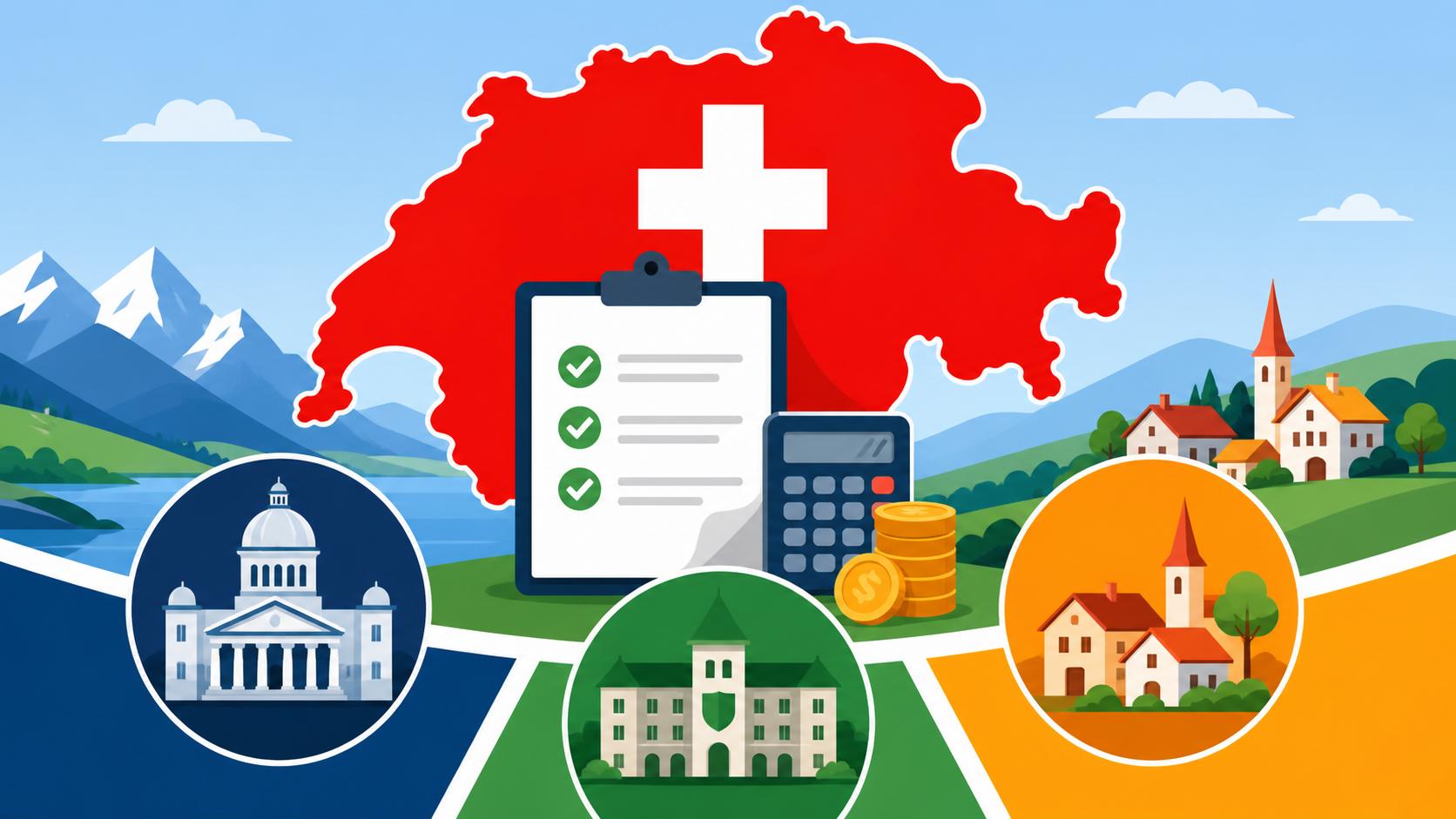
The most confusing part of the Swiss system for any newcomer is the fact that you aren't just paying "the government." You are actually paying three different entities simultaneously. In most countries, you have a national income tax and perhaps a local one. In Switzerland, the sovereignty of the cantons means they hold the real power over your wallet. Understanding how these layers stack up is the first step toward managing your finances effectively.
Federal Taxes: The Big Picture
The Direct Federal Tax (Direkte Bundessteuer) is the only part of the system that is uniform across the entire country. Regardless of whether you live in a low-tax paradise like Zug or a high-tax cultural hub like Geneva, the federal rates remain the same. This tax is progressive, meaning the more you earn, the higher the percentage you pay. For many middle-class expats, the federal rate is actually quite low compared to the cantonal portion, but for high earners, it becomes a significant line item.
I often tell people to view the federal tax as the "baseline." It funds national infrastructure, the military, and federal administration. In 2026, the tax-free threshold remains relatively generous, meaning if you are a student or working part-time, you might not owe the federal government a single rappen. However, once you cross the threshold, the brackets climb steadily. It is essential to keep a copy of your Understanding Your Swiss Salary Certificate (Lohnausweis) for Tax Season to ensure the federal authorities have your correct income figures, as errors here can trickle down to every other level of taxation.
The federal tax is also where the "marriage penalty" often becomes most visible. Because married couples are taxed jointly in Switzerland, their combined income can push them into a much higher bracket than if they were living together unmarried. While there are ongoing political discussions in 2026 to reform this, it remains a reality for now. If you are planning to tie the knot, it is worth calculating how your federal tax burden might shift once your incomes are pooled.
Cantonal Taxes: Why Location is Everything
This is where the Swiss system gets truly unique—and frustrating. Each of the 26 cantons has its own tax law and its own rates. This creates a massive disparity in take-home pay. For example, a software engineer earning CHF 150,000 in Zurich will pay significantly less in cantonal tax than that same engineer living in Lausanne or Neuchâtel. The cantons compete with each other to attract residents and businesses, which is why you’ll often see expats flocking to specific areas just for the fiscal benefits.
When I first moved here, I didn't realize that moving just two train stops away—across a cantonal border—could save me thousands of francs a year. The cantonal tax usually makes up the largest chunk of your total tax bill. It covers things like education, hospitals, and cantonal roads. Most cantons use a "tax multiplier" system, where they set a base rate and then apply a percentage based on the current year’s budget needs. This means your tax rate can actually change slightly from year to year even if your salary stays exactly the same.
For those looking to optimize their finances, Wealth Tax in Switzerland: How Global Assets Are Assessed is a crucial topic at the cantonal level. Unlike many other countries, Swiss cantons tax your total net worth, not just your income. This includes your bank accounts, stocks, and even property held abroad. If you have significant savings in a platform like Trade Republic, you must declare the year-end balance. While the wealth tax rates are generally low (often between 0.1% and 0.5%), they are a recurring annual cost that catches many expats off guard.
Municipal Taxes: Supporting Your Local Commune
The final layer is the municipal tax (Gemeindesteuer). Every town or village (commune) within a canton has its own tax rate, usually expressed as a percentage of the cantonal tax. If your canton has a base tax of CHF 5,000 and your commune's rate is 110%, you pay CHF 5,500 to the town. This is why living in the city center of Zurich is more expensive tax-wise than living in a smaller neighboring village like Kilchberg or Rüschlikon.
Municipal taxes fund your very local services: the primary school down the street, the local trash collection, the public swimming pool, and the library. When you are looking for an apartment, I highly recommend checking the "Steuerfuss" (tax foot/rate) of the municipality. You can find this information on the cantonal tax office website. It is one of the hidden costs of housing that people often forget until that first bill arrives.
I’ve had friends who moved to a beautiful farmhouse in a remote area of Canton Bern, only to find that the local municipal tax was so high it wiped out the savings they made on rent. It’s a delicate balance. Many municipalities are adjusting their rates to cope with infrastructure demands, so it pays to stay informed about local votes and budget approvals. Your The Three-Pillar Pension System: AHV, BVG, and Private Savings contributions can help lower this local burden, as they are often deductible at all three levels of taxation.
Taxation at Source vs. Regular Filing
For the majority of expats arriving on a B Permit, your first encounter with the tax system won't be a bill at the end of the year, but a deduction on your monthly payslip. This is known as Quellensteuer, or withholding tax. It is designed to be a "pay-as-you-go" system for foreign residents who don't yet have a C Permit or aren't married to a Swiss citizen. While it seems simpler, it can sometimes lead to you overpaying if you don't know how to ask for your money back.
Who Pays at the Source?
If you are a foreign national without a permanent residence permit (C Permit) and you are not married to a Swiss national or a C Permit holder, your employer is legally required to deduct your taxes directly from your salary. This rate is calculated based on an average of the municipal and cantonal rates in your canton of residence. It’s a convenient system because it prevents you from getting a massive bill at the end of the year that you haven't saved for.
However, the "convenience" comes with a catch: the standard Quellensteuer rate assumes you have a certain level of expenses and doesn't account for your specific situation. For example, if you are contributing heavily to your pension or have high medical costs, the standard deduction might be too high. You can read more about this in our guide on Withholding Tax (Quellensteuer) vs Standard Taxation for Foreigners. I remember being relieved that I didn't have to file a return my first year, only to realize later that I had missed out on nearly CHF 2,000 in potential deductions because I didn't bother to check the math.
The rules for source tax have become even more digitized. Most employers now use integrated software that updates your tax rate in real-time if you move to a different canton or if your family status changes. It is vital to notify your HR department immediately if you get married, have a child, or separate, as these life events change your "Tax Tariff" (e.g., from Tariff A for singles to Tariff B for married couples), which can drastically change your monthly take-home pay.
The CHF 120,000 Threshold and Mandatory Filing
There is a magic number in the Swiss tax world: CHF 120,000. If your gross annual salary exceeds this amount, you are no longer allowed to just pay source tax and walk away. You are mandatory-qualified for a "Nachträgliche Ordentliche Veranlagung" (NOV), which is a fancy way of saying you must file a full tax return, even if you are on a B Permit. This threshold applies to the household income if you are married, so if you earn CHF 70,000 and your spouse earns CHF 60,000, you have crossed the line.
Once you cross this threshold, the tax office will send you a login for their online filing system (like EasyTax in Zurich or VaudTax in Lausanne). At this point, the source tax your employer deducted is treated as a "down payment." After you file your return, the tax office will calculate exactly what you owe. If your actual tax liability is lower than what was withheld, you get a refund. If it's higher—which often happens if you have significant side income or investments—you will get a bill for the difference.
For those earning over this amount, it becomes essential to track your investments carefully. If you use Binance for crypto trading or hold international stocks, these must all be declared. Even if you are paying source tax, the tax office will look at your global assets once you enter the mandatory filing category. This is often where expats get into trouble, assuming that only their Swiss salary matters. In reality, the Swiss tax man wants to see the whole picture.
Transitioning to Standard Taxation
Even if you earn less than CHF 120,000, you can voluntarily opt into the regular filing system. Why would you do this? Because the standard source tax only allows for very basic deductions. If you have high "actual" expenses—such as expensive weekly commutes to another canton, significant charitable donations, or large contributions to your Pillar 3a in 2026: Tax Deductions, Limits, and Investment Options—filing a regular return might save you thousands.
But be careful: once you opt into regular filing, you cannot go back to source tax. You are "in the system" for good until you leave Switzerland. This means every year, you will have to deal with the paperwork. For many, the effort is worth the savings. I decided to switch in my third year after I realized that my training courses and professional development were all tax-deductible. If you're unsure, it's worth sitting down with a tax consultant for one hour to run the numbers.
Another reason people transition is upon receiving their C Permit. The moment you get that "Permis C," you are treated exactly like a Swiss citizen for tax purposes. No more deductions from your salary. Instead, you receive "provisional" bills throughout the year based on your estimated income. You must be disciplined about saving for these bills. I recommend using a separate "tax pot" in your bank account or a service like Wise to keep these funds separate from your daily spending. There is nothing worse than getting a CHF 10,000 tax bill in April and realizing you spent that money on a ski holiday in February.
Wealth Tax: Because Having Money is Taxable Too
For many expats coming from the US, UK, or other parts of Europe, the concept of a Wealth Tax (Vermögenssteuer) is the biggest shock. In Switzerland, you don't just pay tax on the money you earn; you pay a small percentage on everything you own. This is a cantonal and municipal tax, and while the rates seem tiny, they apply to your global assets. If you've spent years building a nest egg back home, the Swiss government expects you to report it.
How Global Assets Are Assessed
When you fill out your tax return, you must list your worldwide assets as of December 31st. This includes bank accounts, brokerage accounts, real estate, cars, and even expensive jewelry or art if the value is significant. If you have a house in Spain or a 401k in the US, you must declare it. While Switzerland generally doesn't tax the foreign real estate itself (to avoid double taxation), they use the value of that property to determine your "tax rate" for your Swiss assets. This is called "progression-determining" value.
Let's say you have CHF 100,000 in a Swiss bank and a house worth CHF 500,000 in the UK. You won't pay Swiss tax on the UK house, but instead of paying the wealth tax rate for a "100k person," you will pay the rate for a "600k person" on your Swiss 100k. It sounds complicated, and it is. This is why many expats choose to use specialized software to help with Wealth Tax in Switzerland: How Global Assets Are Assessed.
The valuation of these assets can also be tricky. For bank accounts, you use the year-end balance. For stocks, you use the official "Kursliste" provided by the Federal Tax Administration, which lists the taxable value of almost every ticker symbol on earth. If you are holding crypto on Binance, you must use the year-end price in CHF provided by the tax office. Even your car has a "tax value" that decreases each year according to a standard table.
Wealth Tax Rates by Canton
The wealth tax is the ultimate example of cantonal competition. In Canton Zug, the wealth tax is incredibly low, making it a magnet for millionaires. In contrast, cantons like Geneva or Vaud have much higher rates and lower tax-free thresholds. If you are a high-net-worth individual, where you choose to live in Switzerland could be the most important financial decision you make.
| City | Tax-Free Threshold (Single) | Approx. Wealth Tax on 1M CHF |
|---|---|---|
| Zug | CHF 100,000 | ~CHF 1,200 |
| Zurich | CHF 77,000 | ~CHF 2,100 |
| Basel | CHF 75,000 | ~CHF 4,500 |
| Geneva | CHF 83,398 | ~CHF 6,000 |
| Lausanne | CHF 52,000 | ~CHF 6,500 |
As you can see from the table, the difference between Zug and Lausanne for a millionaire is over CHF 5,000 per year just in wealth tax. For most of us with "normal" savings, the tax is manageable, but it’s the principle of declaring everything that usually grinds people’s gears. The tax authorities are increasingly good at spotting undeclared foreign accounts through international data sharing agreements, so "forgetting" about that savings account in London is a very bad idea in 2026.
Exemptions and Deductions for Net Wealth
The good news is that you don't pay tax on your gross wealth, but your net wealth. This means you can subtract all your debts. The most common deduction is your mortgage. If you own a home in Switzerland, your massive mortgage debt will likely wipe out a significant portion of your taxable wealth. You can also deduct any personal loans, credit card balances (as of Dec 31st), and even the tax you owe for the current year.
There are also specific exemptions for household goods. You don't have to list your IKEA sofa, your TV, or your clothes. These are considered "necessary for living" and are generally tax-free up to a very high limit. However, if you have a collection of Rolex watches or gold bars hidden in a safe deposit box, those are legally considered taxable wealth.
Another significant "deduction" is your pension fund. Money held in the 1st Pillar (AHV) and 2nd Pillar (LPP/BVG) is completely exempt from wealth tax while it is in the fund. This is one of the many reasons why the Swiss system encourages long-term pension savings. Even your 3a account is wealth-tax-free until you withdraw it. If you’re looking to reduce your wealth tax burden, moving cash from a standard savings account into a 3a provider like Trade Republic (which offers 3a options in 2026) or a traditional bank is a smart move.
Deductions: The Expat’s Best Friend
If the three-tier system is the "bad news," deductions are the "good news." The Swiss tax system is surprisingly generous when it comes to what you can subtract from your taxable income. If you are filing a regular return, you need to become an expert at finding these. Every franc you deduct is a franc you aren't being taxed on at your highest marginal rate.
Professional Expenses: Commuting and Meals
The most basic deduction is the cost of earning your salary. If you commute to work, you can deduct the cost of your public transport. Usually, this is capped at the price of a local annual pass or, at the federal level, up to CHF 3,000. If you must drive because public transport isn't feasible (a hard argument to win in Switzerland!), you can deduct a per-kilometer rate.
Meals are another common deduction. If you cannot return home for lunch, you can take a standard deduction for "away-from-home meals." In 2026, this is generally around CHF 15 per day, or CHF 3,200 per year, provided your employer doesn't offer a subsidized canteen. If your employer pays for half your lunch, your deduction is halved. It’s these tiny details that fill up the tax forms. I always keep my "Lunch-Check" or canteen card statements just in case the auditor asks.
You can also deduct "other professional expenses" like work clothes, books, and home office costs. Since the remote work revolution, many cantons have established clear rules for deducting a portion of your rent and electricity if you are required to work from home and your employer doesn't provide a desk. Check out Tax Allowances and Deductions: Commuting, Meals, and Childcare for the specific 2026 rates in your canton.
The Power of Pillar 3a
If there is one thing you take away from this guide, let it be this: Max out your Pillar 3a. It is the single most effective way for an expat to lower their tax bill. For 2026, the maximum contribution for someone with a pension fund is CHF 7,258. Every cent of that is 100% deductible from your taxable income.
If you are in a 30% tax bracket, contributing the maximum to your 3a effectively "saves" you over CHF 2,100 in taxes that you would have otherwise paid. It’s essentially a 30% instant return on your investment, plus the growth within the fund. I didn't do this my first year, and it’s my biggest financial regret. Now, I have an automated transfer to my 3a account every January.
You can find more details in our guide on Exactly How to Claim the CHF 7,258 Pillar 3a Tax Deduction for 2026. In 2026, there are more digital providers than ever, allowing you to invest your 3a in low-cost ETFs. This is much better than the old-fashioned "insurance-based" 3a products that many banks will try to sell you when you first arrive. Stay away from those; they are inflexible and expensive.
Health Insurance and Medical Deductions
Health insurance in Switzerland is mandatory and expensive. While the premiums themselves aren't usually fully deductible (most cantons give you a small "standard" deduction for insurance), your out-of-pocket medical costs are. If you have a high deductible (Franchise) and you've spent a lot on dental work or specialists, you can deduct these costs once they exceed a certain percentage of your income (usually 5%).
This is particularly important for expats because dental care isn't covered by basic insurance. If you had a CHF 5,000 root canal and crown in Zurich, that might push you over the 5% threshold. Keep all your receipts! Even the cost of glasses or contact lenses can sometimes be included.
Furthermore, if you support family members abroad who are unable to support themselves, you may be able to claim a "support deduction." This is heavily scrutinized by the tax office and requires extensive documentation (proof of relationship, proof of their poverty, and proof of your bank transfers), but it can be a significant help for those sending money home. Using a transparent service like Wise to send these funds is helpful because it provides clear, downloadable transaction reports for the tax office.
Investing and Capital Gains: The Good News
Finally, some truly good news: Switzerland is one of the few developed countries without a general capital gains tax for private investors. If you buy a stock for CHF 100 and sell it for CHF 200, that CHF 100 profit is generally tax-free. This is why Switzerland is an incredible place to build long-term wealth in the stock market. However, there are nuances you must understand to avoid being reclassified.
Why Switzerland is a Haven for Private Investors
For the average expat buying ETFs on Trade Republic or holding a few blue-chip stocks, the "tax-free capital gains" rule is a massive advantage. While you still pay income tax on the dividends those stocks pay out, the growth of the stock price itself is yours to keep. This is a fundamental pillar of the Swiss financial system and one of the reasons the country has such high private wealth.
To qualify for this, you must be classified as a "private investor" rather than a "professional trader." The tax office uses a set of five criteria to decide. Generally, if you hold stocks for more than six months, don't use leverage (borrowed money) to buy them, and the capital gains aren't your primary source of income, you are safe. If you start day-trading or using complex derivatives on Binance every morning, you are courting trouble.
You can read a deeper dive into this in Capital Gains Tax in Switzerland: The Tax-Free Stock Market Rule. For 2026, the authorities have become more sophisticated in tracking high-frequency traders. If your trading volume is more than five times your total wealth at the start of the year, you might get a tap on the shoulder from the tax office asking for more details.
The Professional Investor Trap
What happens if you are classified as a professional investor? Your capital gains are suddenly treated as self-employment income. This means they are subject to income tax and social security contributions (AHV). This can eat up 40% or more of your profits.
Most expats don't need to worry about this, but it’s a risk for those who are retired and living solely off their stock portfolio. The tax office might argue that you are "professionally managing" your wealth. To stay safe, avoid "churning" your portfolio (selling and buying the same stocks frequently) and keep your debt-to-equity ratio low. If you're using Trade Republic's savings plans to slowly buy ETFs, you are the definition of a private investor.
Reporting Crypto and Foreign Dividends
Crypto is the one area where I see the most confusion. In Switzerland, Bitcoin and other cryptocurrencies are treated like any other currency or stock. You don't pay tax on the capital gains (the price increase), but you must report the value in your wealth tax section. If you are staking your crypto on Binance and earning "interest" or "rewards," those rewards are treated as taxable income, just like bank interest or dividends.
Foreign dividends are also a bit tricky because of "withholding taxes" from other countries. For example, if you own US stocks, the US government takes 15% (if you’ve filled out the W-8BEN form) before the money even reaches you. Switzerland has double taxation agreements to ensure you aren't taxed twice. You can often claim a "credit" on your Swiss taxes for the tax you already paid in the US.
This requires filling out an extra form (the DA-1) with your tax return. It’s a bit of a pain, but if you have a large US-centric portfolio, it prevents you from losing a huge chunk of your income to the IRS and the Swiss Steueramt simultaneously. Filing this correctly is a key part of Filing a Swiss Tax Return (C Permit or High Earners on B Permit).
Church Tax and Other Hidden Fees
Just when you think you’ve finished, a few more items pop up. Switzerland still has a close relationship between the state and the church in many cantons, and this manifests in your tax bill. There is also the matter of the mandatory media fee, which isn't technically a "tax" but feels very much like one.
Opting Out of Kirchensteuer
When you first registered at the Gemeinde, you were likely asked your religion. If you checked "Roman Catholic" or "Protestant," you are automatically enrolled in the Church Tax (Kirchensteuer). This is usually around 1% to 2% of your income tax. For a high earner, this can be CHF 1,000 or more per year.
If you are not a practicing member or don't wish to pay, you must formally "exit" the church. Simply checking "no religion" on your next tax return isn't enough. You must send a physical, signed letter (often registered) to the local parish office. Once they process it, they will send you a confirmation, which you then provide to the tax office.
I know many expats who paid this for years without realizing they could opt out. If you want to save that money for your next Alpine hike, check out our guide on How to Officially Leave the Church in Switzerland to Stop Kirchensteuer. Note that in some cantons like Geneva or Neuchâtel, there is no mandatory church tax, so this only applies if you live in the German-speaking or other French-speaking cantons.
The Serafe Media Fee
The Serafe fee is the Swiss mandatory radio and TV license. In 2026, the fee is CHF 335 per household. It doesn't matter if you don't own a TV or only watch Netflix; if you have an internet connection or a smartphone, you are liable. Serafe gets your data directly from the resident's registry, so they will find you.
The bill usually arrives once a year, and you can pay it via eBill or bank transfer. If you live in a shared apartment (WG), only one person pays for the whole household. It’s a common point of contention among roommates, so make sure you decide who is paying and split the cost early. You can find more on this in The Serafe Fee 2026: Paying the Mandatory CHF 335 Media Tax.
Dog Taxes and Local Levies
If you brought your furry friend to Switzerland, get ready for the "Hundesteuer." Most municipalities charge an annual fee for dog ownership, which funds things like those little green "Robidog" bag dispensers you see everywhere. You must register your dog at the local town hall and pay the fee, which is usually between CHF 100 and CHF 200 per year.
There are also occasional "fire brigade" taxes (Feuerwehrpflichtersatz) in some cantons for those who don't serve in the local voluntary fire department. This usually applies to men and women between the ages of 20 and 50. It’s a relatively small amount, but it’s another example of the "community-based" taxation system that defines Swiss life.
Step by Step Guide to Filing Your First Return
Now that you understand the theory, it's time for the practice. Filing your first Swiss tax return is a daunting task, but if you stay organized, it’s a manageable one-day job. Most cantons allow you to do everything online now, which has simplified the process significantly compared to the old paper-shuffling days.
Gathering Your Documents
Don't wait until the deadline to start looking for your Lohnausweis. You should receive this from your employer in January or early February. You also need:
- Year-end bank statements for every account you own (Swiss and foreign).
- Tax certificates from your investment platforms (Trade Republic, etc.).
- Statements from your 3a provider and your 2nd Pillar pension.
- Receipts for any large medical expenses or charitable donations.
- The "Wohnungsübergabeprotokoll" if you moved, as moving costs for work are sometimes deductible.
If you’re moving money around to prepare for tax payments, using a service like Wise ensures you get a clean statement showing the exact exchange rates used, which is helpful if the tax office questions your foreign account balances.
Using Local Tax Software
Every canton has its own software. In Zurich, it’s called Private Tax; in Bern, it’s TaxMe. These programs are generally excellent. They walk you through each section, and many now allow you to "import" last year's data, making subsequent years a 15-minute task. Most are available in the local language (German/French/Italian), though some cantons are finally introducing English versions.
If your local software is only in German, use a translation app on your phone to scan the screen. The terms are very repetitive. Once you understand that "Abzüge" means deductions and "Vermögen" means wealth, you’re halfway there. For a deep dive into the specific forms, see our guide on Filing a Swiss Tax Return (C Permit or High Earners on B Permit).
Deadlines and Extension Requests
The standard deadline for filing is March 31st. However, almost no one actually files by then. Most cantons allow you to request an extension online for free until September or even November. I highly recommend doing this the moment you get your tax login in the mail. It takes 30 seconds and gives you peace of mind.
If you miss the deadline without an extension, you’ll get a reminder (Mahnung) which comes with a small fee. If you continue to ignore it, the tax office will eventually perform an "assessment by estimation" (Ermessenseinschätzung). Trust me, you don't want this. They will guess your income and wealth—usually on the high side—and send you a bill that is very difficult to contest later.
Disclaimer
The information provided in this article is for informational purposes only and does not constitute professional tax, legal, or financial advice. Tax laws in Switzerland are subject to frequent changes and vary significantly by canton and municipality. We recommend consulting with a qualified Swiss tax advisor to discuss your specific situation before making any financial decisions or filing your tax return.