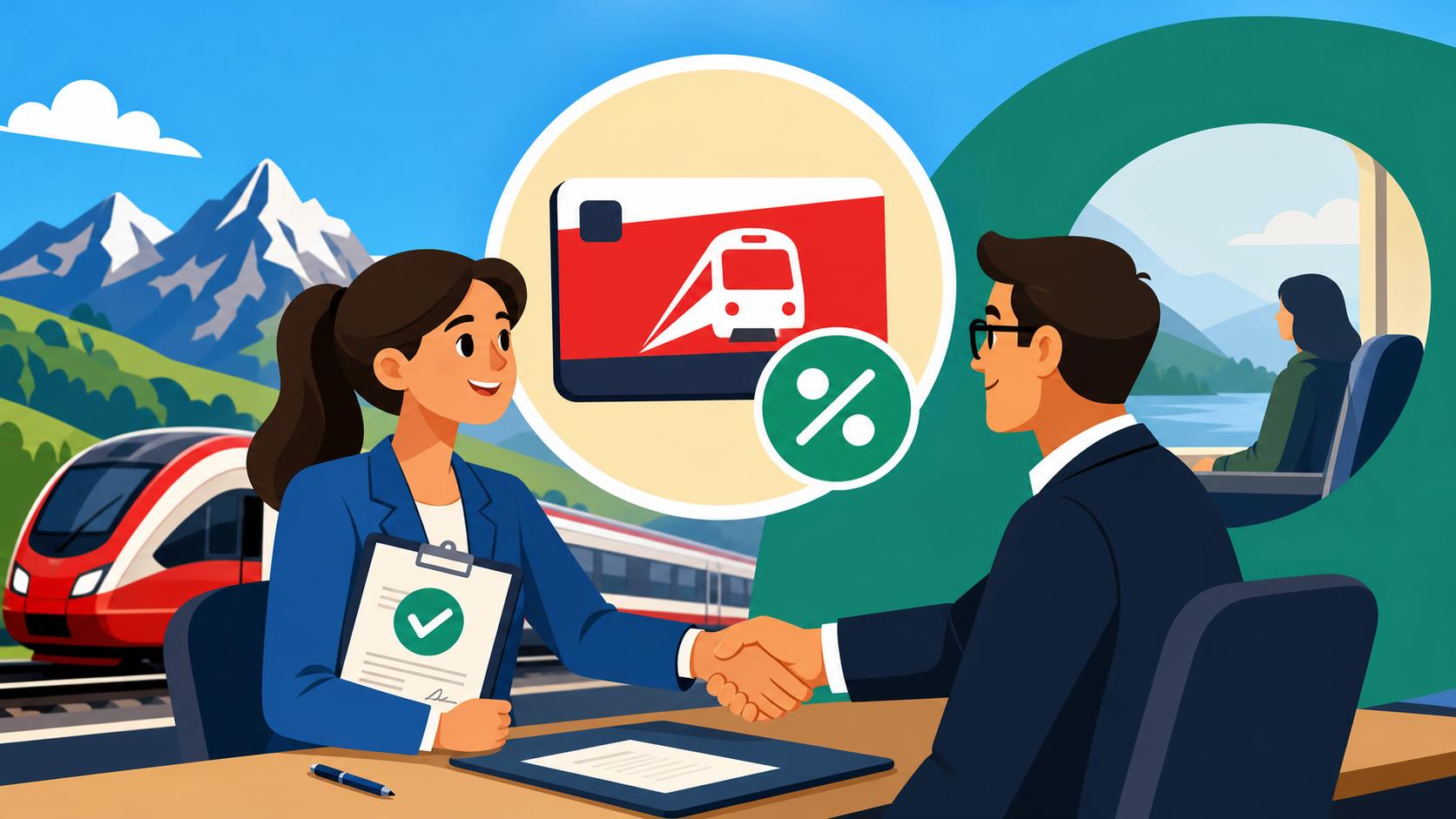
Commuter Deductions: Negotiating a Half-Fare Card in Your Contract
Moving to Switzerland often feels like a sequence of steep learning curves, from the complexity of recycling to the shock of seeing your first monthly insurance bill. I remember my first month in Zurich, standing at the SBB ticket office and realizing my commute would cost me nearly three thousand francs a year if I didn't get my strategy right. This guide will walk you through the essential steps of negotiating a Half-Fare card into your employment contract and how to maximize your commuter tax deductions to protect your bottom line.
Understanding the Swiss Commuter Financial Landscape
Public transportation in Switzerland is world-class, but that efficiency comes at a premium that can catch new arrivals off guard. Whether you are living in the suburbs of Basel or commuting from Vaud to Geneva, your travel expenses will likely be one of your top three monthly costs after rent and health insurance. Most expats quickly realize that a standard point-to-point ticket is the least economical way to travel. Instead, the focus shifts to annual passes and discount cards that allow for more flexibility.
When you first begin Working in Switzerland as an Expat: Jobs, Culture, and Employment Laws, the headline salary figure can be distracting. However, savvy veterans know that the "fringe benefits" or "Lohnnebenleistungen" are where the real value is hidden. A Half-Fare card (Halbtax) is the absolute baseline for any resident. It reduces the cost of almost all train, bus, boat, and tram travel by 50%. While it costs 185 CHF for the first year (and 165 CHF for renewals), many employers are willing to cover this as a standard "thank you" for your commitment, yet they rarely offer it unless you ask during the final stages of your contract negotiation.
For those with longer commutes, the conversation often shifts toward the Generalabonnement (GA). This is the "magic carpet" of Swiss travel, offering unlimited rides on the entire network. However, with the price tag now exceeding 3,900 CHF for second class, getting an employer to cover this requires a more sophisticated negotiation approach. Understanding Transport in Switzerland: SBB, GA, Half-Fare Cards, and Commuting is vital before you sit down with HR, as you need to know exactly which zone-based or national passes apply to your specific route.
The Rise of the Halbtax Plus
Recently, SBB introduced the Halbtax Plus, a credit-based system where you pay a lump sum upfront and receive a bonus amount of travel credit. This has changed the negotiation landscape slightly. Instead of asking for a physical card, some expats are now negotiating for a "travel credit" allocated to their Swisspass. This is often an easier "sell" to a manager because it is a fixed cost that can be easily accounted for in a departmental budget.
If your employer is hesitant to provide a full GA, the Halbtax Plus is an excellent middle ground. You can explain that this credit will be used exclusively for your commute and business-related travel, effectively reducing the company’s administrative burden of reimbursing individual tickets. To understand how this works in practice, you should look into Halbtax Plus: How the New Prepaid Discount System Works for SBB to see which credit tier aligns with your expected annual mileage.
Why Every Expat Needs a Half Fare Card
Even if you plan to drive, The Half-Fare Travelcard (Halbtax): The Must-Have Pass for Swiss Residents is essential. You will inevitably find yourself taking the train for a night out in another city or a weekend trip to the mountains. In my experience, the card pays for itself in just two or three trips from Zurich to Geneva or Lugano. If you don't have it, you are essentially paying a "tourist tax" on every single journey you take within the country.
When I first arrived, I made the mistake of thinking I could wait a few months to see if I really needed it. I ended up spending more in three weeks on full-price tickets than the annual card would have cost. Do not make this mistake. If your employer refuses to include it in the contract, buy it yourself on day one. It is the single most important "access key" to life in Switzerland, and having it sorted from the start makes the administrative transition much smoother.
How to Negotiate the Half Fare Card into Your Employment Contract
The best time to negotiate for travel benefits is after you have received a verbal offer but before you have signed the physical contract. In Switzerland, once a contract is signed, it is culturally and administratively difficult to add "small" perks later on. You want to frame the Half-Fare card as a tool for professional efficiency rather than a personal gift. If your job involves visiting clients or traveling between different office branches, the Half-Fare card is a logical business expense for the company.
When discussing Salary and Compensation: Navigating Swiss Pay, Bonuses, and Deductions, you should mention that you are committed to using public transport for your daily commute to align with the company’s sustainability goals. Most major Swiss firms have "Green" initiatives and are more than happy to support employees who choose trains over cars. You can say something like, "I am very excited about the role. To ensure I can travel efficiently between our locations and manage my commute sustainably, would the company be open to providing an annual Half-Fare card as part of the benefits package?"
If you are dealing with a smaller company or a startup, they might not have a formal policy. In this case, you can offer to have the cost deducted from your gross salary if they aren't willing to pay for it on top. While this doesn't save the company money, it saves you money because the cost is taken out before you are taxed. This is a common tactic used for many benefits in the Swiss system, though it requires a bit more paperwork for their accounting department.
Framing the Request for High Workloads
If you are working a high-percentage workload—what the Swiss call 100%—your time is your most valuable asset. Explain that by having a train pass, you can utilize your commute time to catch up on emails or prepare for meetings. This is a great time to mention that you are also investing in your own professional development. For instance, you might mention you are using your commute to improve your local language skills with resources like Lingoda to better integrate with the local team.
Employers love to hear that you are proactive about integration. If you are moving to the German-speaking part, telling them you spend your train time with GermanPod101 shows a level of commitment to the culture that goes beyond just doing your job. In the Romandie region, the same applies to using FrenchPod101. Framing the Half-Fare card as a "mobile office" or a "study center" makes the 185 CHF seem like a very small price for the company to pay for a more capable and integrated employee.
Comparing the Half Fare to the GA in Negotiations
If your commute is longer than 30 minutes each way, you should push for more than just a Half-Fare card. Many companies, especially in the pharma hub of Basel or the tech sector in Zurich, offer "Job Tickets" or heavily subsidized GA passes. Before you go into the meeting, calculate the cost of your specific commute. If a point-to-point annual pass costs 2,500 CHF, and a GA costs 3,900 CHF, ask the employer to cover the 2,500 CHF and tell them you will pay the difference to upgrade to a GA yourself.
This "split-cost" model is very popular in Switzerland because it demonstrates that you are willing to invest in your own mobility while the company covers the "necessary" portion of the expense. You should check SBB Travelcards: Is the Generalabonnement (GA) Worth the CHF 4000+ Cost? to see if the math works out for your specific cantonal route. Often, the flexibility of the GA far outweighs the small extra cost when you factor in your weekend leisure travel.
| Benefit Type | Typical Cost (Annual) | Who Usually Pays? | Tax Deductibility |
|---|---|---|---|
| Half-Fare (Halbtax) | 185 CHF | Often Employer | Fully deductible if paid by you |
| Point-to-Point Pass | 1,000 – 3,000 CHF | Employee / Subsidized | Deductible up to caps |
| Generalabonnement (GA) | 3,995 CHF (2nd Class) | Large Corporates | Deductible up to 3,200 CHF (Federal) |
| Halbtax Plus | Variable Credit | Employee | Based on actual spend |
Navigating the Tax Deductions for Your Annual Travel Costs
Even if you fail to negotiate a travel pass into your contract, the Swiss tax system offers a "consolation prize" in the form of commuter deductions (Fahrkosten). When you fill out your tax return, you are allowed to deduct the cost of traveling from your home to your place of work. However, there is a catch: the government generally expects you to take the most economical route, which is almost always public transport.
The rules for Swiss Taxes Explained: Federal, Cantonal, and Municipal Rates can be confusing because there are different limits at different levels. At the federal level, the maximum you can deduct for your commute is 3,200 CHF per year (as of 2026). However, each canton has its own ceiling. For example, in Zurich, the limit might be higher or lower than in Geneva or Zug. If your employer pays for your Half-Fare card or GA, you must declare this as a benefit-in-kind on your "Lohnausweis" (salary certificate), and you cannot then deduct the cost again on your tax return.
This is a crucial point that many expats miss. If your company pays for your GA, you essentially have "zero" transport costs to deduct, which might actually increase your taxable income. However, the value of the free travel almost always exceeds the tax savings you would have gotten from a deduction. To get a clear picture of how these variables interact, you should review Tax Allowances and Deductions: Commuting, Meals, and Childcare to ensure you aren't leaving money on the table.
Proving Your Commute to the Tax Office
The Swiss tax authorities are famously meticulous. If you live within walking distance of your office, you cannot claim a full GA deduction. They use SBB's own time and distance calculators to determine what is "reasonable." If you claim you need to drive because the train takes too long, you must prove that the public transport route takes significantly longer (usually more than an hour extra per day) or is physically impossible due to shift work.
For most of us, the tax office will simply allow a deduction equal to the cost of an annual public transport pass for your specific route. If you have a Half-Fare card and buy individual tickets, keep your receipts or use the SBB app's annual summary feature. Most people find it much easier to simply buy the annual pass, as the physical or digital receipt for that single purchase is usually enough to satisfy the tax auditor. You can find more specific advice on this in Deducting SBB GA or Half-Fare Travelcards on Your Swiss Tax Return, which breaks down the filing process step-by-step.
The Impact of Working from Home
With the rise of hybrid work, the tax office has become more strict about commuter deductions. If you work from home two days a week, technically you are only commuting 60% of the time. However, if you have an annual pass (like a GA or a regional ZVV pass), you can usually still deduct the full cost because the pass was a necessary "fixed" expense to enable your commute at all.
This is where your Salary and Compensation: Navigating Swiss Pay, Bonuses, and Deductions certificate becomes vital. Your employer will mark the percentage of days you worked from home. If that percentage is very high, the tax office might challenge a large car-based deduction but will typically still allow a public transport pass deduction. It is always worth discussing with a local tax advisor if you are unsure, as the "home office" deduction and the "commuter" deduction often act as a see-saw—when one goes up, the other might go down.
Maximizing Your Commute Time and Additional Savings
Once you have your Half-Fare card or GA secured and your tax strategy in place, the final step is to make that commute work for you. The average Swiss commute is about 30 to 45 minutes. Over a year, that is hundreds of hours spent on a train. Instead of scrolling through social media, many successful expats use this time for "integrated learning."
If you are using Lingoda for structured classes, the quiet zones (Ruhezone) on the InterCity trains are perfect for reading through your lesson materials. If you prefer a more casual approach, listening to FrenchPod101 or GermanPod101 while watching the Swiss Alps roll by is a quintessentially "expat" experience. Not only does this help you in your daily life, but it also prepares you for the eventual language requirements if you ever decide to apply for a C Permit or citizenship.
Beyond the commute, your Half-Fare card opens up significant "hidden" savings. Many mountain railways (Bergbahnen) and even some ski lifts offer discounts to Half-Fare holders. When you are planning weekend trips, always check if your pass gives you a discount. These small savings add up over a year, often covering the cost of the card multiple times over.
Using the SBB App for Financial Tracking
The SBB app is one of the most powerful tools in a Swiss resident's pocket. It doesn't just show you timetables; it acts as a digital wallet for your Swisspass. You can link your credit card and use "EasyRide," which tracks your movement and automatically bills you the cheapest possible ticket for your journey. If you have a Half-Fare card saved in your profile, EasyRide automatically applies the 50% discount.
At the end of the year, you can export a list of all your trips for your tax records. This is particularly useful if you are a freelancer or have a complex commuting schedule. Managing your travel digitally is the standard in Switzerland, and it significantly reduces the "admin fatigue" that many expats face during their first year.
Final Thoughts on Negotiation
Remember, everything in a Swiss contract is a conversation. While the Swiss are known for being rule-followers, they are also highly pragmatic. If you can show that a Half-Fare card or a travel subsidy makes you a more reliable, focused, and integrated employee, most managers will see it as a very cheap investment. Don't be afraid to bring it up—it is a standard part of the professional culture here, and asking for it shows that you have done your homework on how life in Switzerland actually works.
Disclaimer
This guide is for informational purposes only and does not constitute legal, financial, or tax advice. Swiss tax laws and cantonal regulations are subject to frequent changes. Always consult with a qualified Swiss tax professional or your local cantonal tax office (Steueramt) to verify your specific situation before filing a return or signing a legal contract. For the most up-to-date information on public transport prices and regulations, please refer to the official SBB/CFF website.