What is a GAV (Gesamtarbeitsvertrag) and How Does It Protect You?
Navigating the Swiss job market often feels like decoding a secret language where the most important rules aren't even written in your contract. I remember my first month in Zurich, panicking because my individual agreement seemed suspiciously thin on details regarding overtime and sick pay. This guide explains the GAV (Gesamtarbeitsvertrag), the collective labor agreements that actually dictate your workplace rights and provide a safety net beyond basic federal law.
Decoding the GAV: Why Collective Bargaining is the Secret Backbone of Swiss Employment
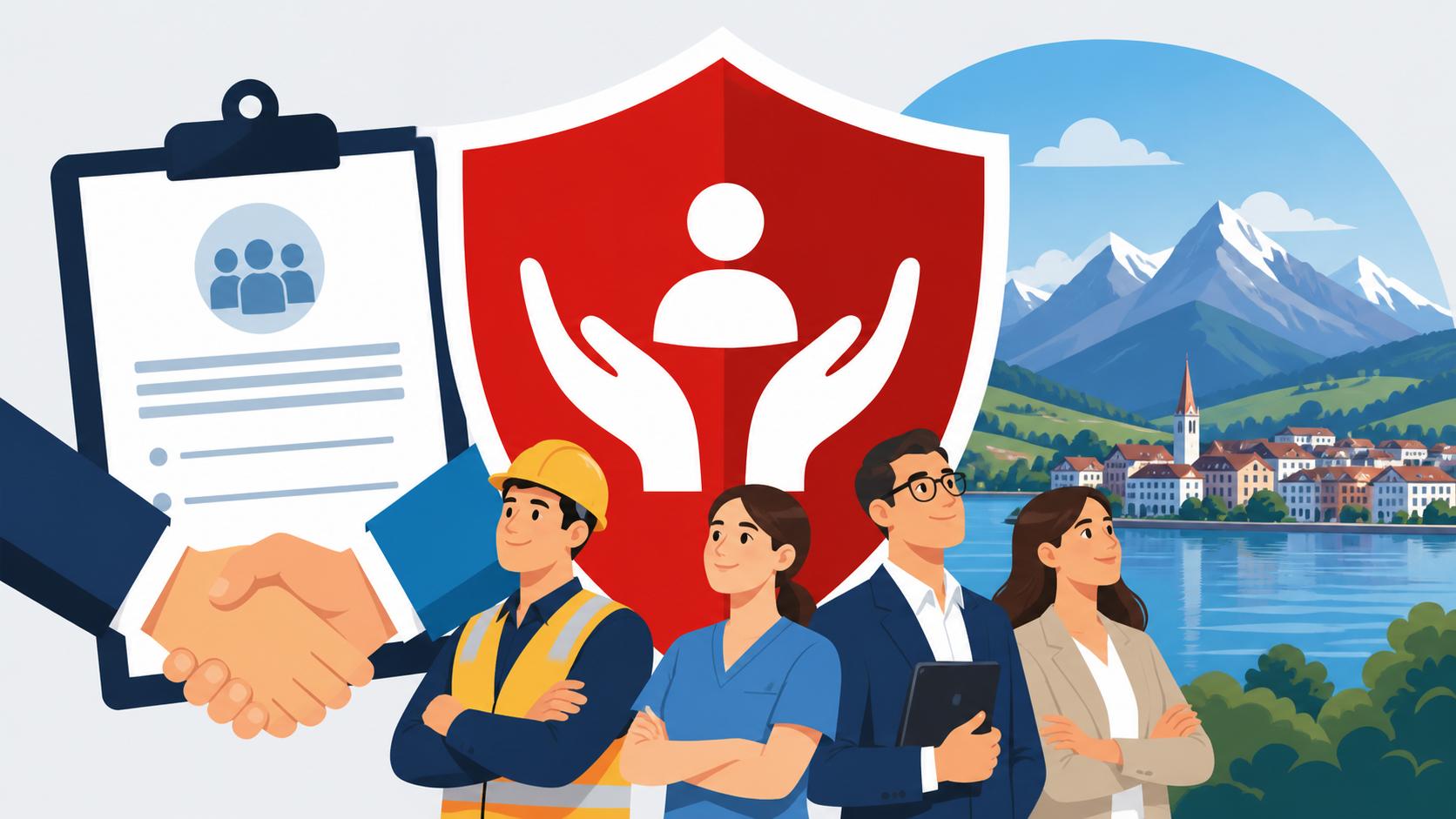
In many countries, labor rights are dictated almost entirely by a central government "Labor Code." Switzerland does things differently. While the Swiss Code of Obligations (OR/CO) provides a baseline, it is remarkably flexible—often too flexible for a worker's comfort. This is where the Gesamtarbeitsvertrag, or GAV, steps in. Think of it as a master agreement negotiated between employer associations and trade unions within a specific industry. It acts as a "shield" that sits between you and the more general federal laws.
If you are Working in Switzerland as an Expat: Jobs, Culture, and Employment Laws, you will quickly realize that the Swiss value social partnership. Instead of the government setting every rule, the people actually doing the work and the people running the companies sit down to agree on what is fair. For an expat, this can be confusing. You might find that your friend working in a watch factory in Jura has completely different vacation rights than you do in a Zurich marketing firm, even if you both have similar experience levels.
The beauty of a GAV is that it usually offers much better terms than the legal minimum. For example, while Swiss law technically only requires four weeks of vacation, many GAVs mandate five or even six weeks for older employees. If your industry is covered by one, those terms are legally binding. Your employer cannot give you a contract that is worse than what the GAV stipulates. If they try, the GAV provision automatically overrides your individual contract. This is a massive relief for foreigners who might not feel they have the "leverage" to negotiate for more than the basics during their first Employment Probation Periods in Switzerland: What You Need to Know.
Key Protections Offered by a GAV: Moving Beyond the Basics
The real meat of a GAV lies in the specific protections that the Code of Obligations ignores. Let's look at the areas where these agreements make the biggest difference in your daily life.
Minimum Wage and Salary Grids
Switzerland notoriously lacks a federal minimum wage. While some cantons like Geneva and Zurich have introduced local minimums, many parts of the country have no "floor" for pay. GAVs solve this by establishing industry-specific minimum wages. They often use "salary grids" based on your age, years of experience, and level of education. If you are trying to understand Salary and Compensation: Navigating Swiss Pay, Bonuses, and Deductions, checking if a GAV applies to you is the first step. It prevents "wage dumping" and ensures that as an expat, you aren't being paid significantly less than a local peer just because you didn't know the market rate.
Working Hours and Overtime
While the federal maximum for office workers is 45 hours per week, many GAVs bring this down to 40 or 42 hours. More importantly, they define exactly how overtime should be compensated. In some agreements, you must be paid a 25% premium for every hour of overtime, while others might mandate time-off-in-lieu at a rate of 1.25 hours for every hour worked. Understanding What Does '100% Workload' Mean? Understanding the 40-42 Hour Swiss Week is much easier when you have a GAV document as a reference.
Enhanced Sick Leave and Maternity Benefits
This is where the GAV truly protects your bank account. Under the standard Code of Obligations, an employer only has to pay your salary for a "limited time" when you are sick—which can be as short as three weeks in your first year of service. Most GAVs require the employer to take out Loss of Earnings insurance (KTG), which pays 80% of your salary for up to 720 days. When you are researching Sick Leave in Switzerland: Doctor’s Notes and Salary Continuation (KTG), the presence of a GAV usually means you have much higher security. Similarly, while federal law mandates 14 weeks of maternity leave, many GAVs extend this to 16 weeks or provide 100% salary instead of the federal 80% cap. This is vital for families looking into Maternity and Paternity Leave: Federal Mandates and Company Perks.
| Feature | Swiss Code of Obligations (Minimum) | Typical GAV Protection (Enhanced) |
|---|---|---|
| Annual Vacation | 4 Weeks (20 days) | 5 to 6 Weeks |
| Minimum Wage | None (Federal) | Industry-specific minimums |
| Sick Pay | 3 weeks in the 1st year | 80% for 720 days (via KTG) |
| Notice Period | 1 month (1st year) | Often longer or more regulated |
| Maternity Leave | 14 weeks at 80% pay | Often 16 weeks at 80-100% pay |
| 13th Month Salary | Not legally required | Usually mandatory |
How to Know if You Are Covered by a GAV
One of the most frustrating things about being an expat in Switzerland is the "information asymmetry." Your HR department might not explicitly tell you that a GAV applies to you unless you ask.
Industry-Wide vs. Company-Specific Agreements
There are two main types of GAVs. The first is an industry-wide agreement, like the one for the hospitality sector (L-GAV) or the construction industry. The second is a company-specific GAV, which large employers like Swisscom, SBB, or Migros have negotiated directly with unions for their own staff. When reviewing Swiss Work Contracts and Labor Law: Notice Periods, Leave, and Rights, look for a clause that mentions "Collective Labour Agreement" or "Gesamtarbeitsvertrag." Even if your contract doesn't mention it, you might still be covered if the Federal Council has declared a GAV "generally applicable" (allgemeinverbindlich) for your entire sector.
The Role of the Declaration of General Applicability
In certain industries where workers are at high risk—like cleaning, security, or hairdressing—the government mandates that every single company in that sector must follow the GAV, regardless of whether they "signed" it. This is a crucial protection for expats who might be working for smaller, less-regulated firms. It ensures you aren't exploited. If you are unsure, you can check the official database of the State Secretariat for Economic Affairs (SECO) or consult with a local trade union like Unia or Syna.
Navigating the Language Barrier
Most GAV documents are massive, dense PDFs written in German, French, or Italian. They are rarely translated into English by official bodies. This is where your integration efforts pay off. Using resources like GermanPod101 or FrenchPod101 to pick up industry-specific vocabulary is a lifesaver. If you're working in Zurich and your GAV is 60 pages of "Beamtendeutsch" (bureaucratic German), having reached a B2 level through Lingoda will be the difference between knowing your rights and being taken advantage of. I spent many nights with a dictionary and my GAV, realizing that my employer owed me a "cleaning allowance" for my uniform that they hadn't mentioned.
Dealing with Disputes and Enforcement: Your Rights as an Expat
What happens if your employer isn't following the GAV? Unlike standard contracts where you might have to sue your boss in a civil court (which is expensive and terrifying), GAVs often have their own enforcement mechanisms.
The Parity Commission (Paritätische Kommission)
Most GAVs are overseen by a "Parity Commission." This is a board made up of an equal number of employer and employee representatives. Their job is to monitor the industry and ensure everyone plays by the rules. If you suspect you are being underpaid or denied vacation, you can often contact the commission directly. They have the power to audit companies and issue heavy fines. For an expat, this is a much "friendlier" first step than hiring a lawyer. It’s a specialized form of protection that helps when dealing with Workplace Bullying (Mobbing): How to Document and Report It to HR.
The Role of Trade Unions
In Switzerland, you don't have to be a member of a union to be protected by a GAV, but being a member helps immensely if things go wrong. Unions like Unia offer free legal advice and will represent you in front of the Parity Commission. They can help you decode the nuances of High German vs Swiss German in the Workplace: What You Must Learn when it comes to the specific "Mundart" terms used in local workshops or construction sites. Even if you aren't a member, you usually pay a small "solidarity contribution" (Vollzugskostenbeitrag) deducted directly from your payslip to fund the enforcement of the GAV.
Legal Support and Insurance
Even with a GAV, disputes can escalate. Because the Swiss legal system is complex and expensive, many veteran expats swear by legal protection insurance. If you are wondering, Do I Need Legal Expenses Insurance (Rechtsschutzversicherung) in Switzerland?, the answer is almost always "yes" if you work in an industry with a complex GAV. If your employer disputes a GAV provision—for instance, whether a specific task counts as "hazardous work" requiring a bonus—having an insurance lawyer to fight your corner is invaluable.
Understanding the Subtle Obligations of a GAV
It is important to remember that a GAV isn't just a list of "freebies" for the employee; it's a peace treaty. In Switzerland, this is known as the "Friedenspflicht" or peace obligation.
As long as a GAV is in effect, the unions agree not to strike, and the employers agree not to lock out workers. This stability is why the Swiss economy is so robust, but it means you are expected to follow the grievance procedures laid out in the agreement rather than taking "wildcat" actions. If you're used to more confrontational labor markets, the Swiss "consensus" model can feel slow, but it provides a level of predictability that is actually quite comforting once you settle in.
Furthermore, some GAVs include mandatory contributions to professional training funds. While this looks like another deduction on your payslip, it often means you can get your language courses at Lingoda or specialized technical certifications subsidized or even fully paid for by the industry fund. I once got a 1,000 CHF "training voucher" simply because I was covered by a GAV and bothered to read the fine print in the "Weiterbildung" (further education) section. Always look for the word "Parifonds" on your payslip; if you see it, you likely have access to training money.
Practical Steps for New Expats Regarding GAVs
If you are just starting your journey or moving to a new industry, follow these steps to ensure you are fully protected:
- Ask during the interview: It is perfectly acceptable to ask, "Is this position subject to a Gesamtarbeitsvertrag?" It shows you are informed and serious about the local standards.
- Request the PDF: If a GAV applies, ask for the "GAV-Reglement." Even if it’s in German, you can use translation tools or your GermanPod101 knowledge to scan for keywords like "Ferien" (vacation), "Lohn" (wage), and "Kündigungsfrist" (notice period).
- Check your payslip: Look for deductions labeled "GAV-Beitrag" or "Vollzugskosten." If you are paying into the system, you are definitely covered by it.
- Join the relevant association: Whether it's a professional guild or a union, having a point of contact outside of your company's HR department is vital.
Switzerland's employment landscape is built on these collective handshakes. While the lack of a national minimum wage might seem "pro-employer" at first glance, the reality of the GAV system creates a highly regulated, high-floor environment that protects the dignity of the worker. By taking the time to understand which GAV covers your role, you move from being a "guest worker" to a protected member of the Swiss labor force, with all the stability and benefits that entails.
Disclaimer
The information provided in this article is for general informational purposes only and does not constitute legal or professional advice. While we strive to keep the details accurate and up-to-date for 2026, Swiss labor laws and collective agreements (GAVs) are subject to change and vary significantly by industry and canton. Always consult with a qualified legal professional, your trade union representative, or the relevant Parity Commission regarding your specific employment situation.