Validating a Foreign Engineering Degree in Switzerland (SERI)
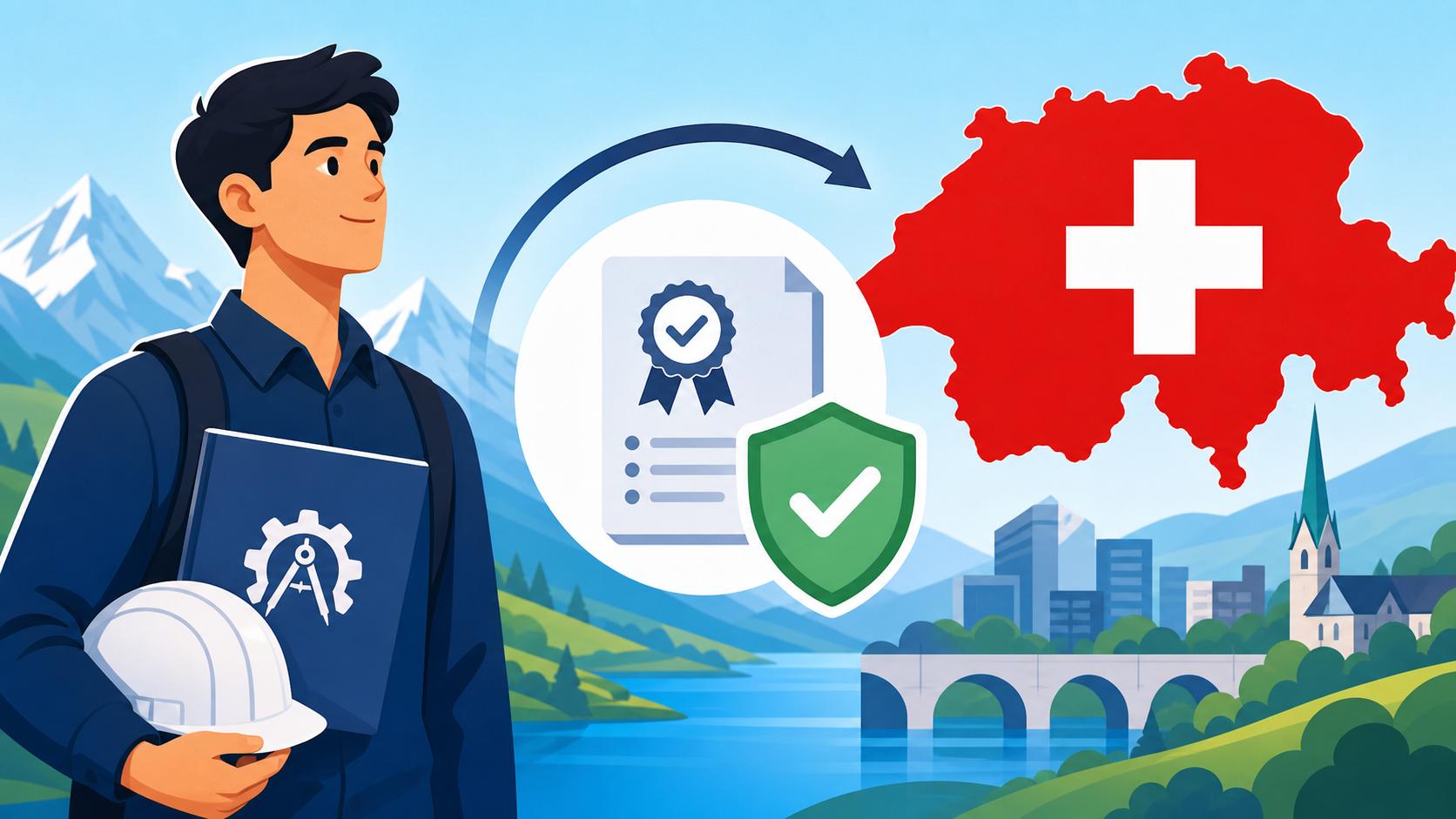
Arriving in Switzerland with a prestigious engineering degree from your home country feels like a golden ticket until you realize that local HR managers often look at your diploma with a mix of confusion and skepticism. I remember the sinking feeling of sitting in a glass-walled office in Oerlikon, realizing my years of study weren't immediately "real" to the person across the desk. This guide breaks down exactly how to navigate the State Secretariat for Education, Research and Innovation (SERI) to validate your credentials and reclaim your professional standing.
Understanding the Protected Title System in Switzerland
Switzerland is a country that runs on precision, and that precision extends to professional titles. Unlike in many other countries where "engineer" is a broad job description, in Switzerland, certain titles are legally protected. If you want to call yourself an "Ingenieur FH" or "Ingenieur ETH," you must have the specific Swiss qualification or a formal recognition of your foreign equivalent. Without this, you might find yourself stuck in a "Junior" or "Technician" bracket despite having a decade of experience back home.
In my first few months here, I was surprised to learn that the Swiss labor market is divided into regulated and non-regulated professions. Engineering sits in a bit of a gray area. While you can technically work as an engineer in the private sector without formal recognition, having that SERI-stamped document is often the only way to get past the automated filters of major Swiss firms. It provides a level of "Swiss-ness" to your profile that is hard to replicate otherwise.
Furthermore, if you are looking for English-Speaking Jobs in Switzerland: Top Industries and Cantons, you will find that international companies are more flexible, but the moment you eye a role in a local Swiss SME (KMU), they will demand to see how your degree compares to the Swiss system. This is where the SERI validation becomes your most powerful tool in salary negotiations. It moves you from being an "unknown quantity" to a "certified professional" who fits into the local salary benchmarks.
The Role of SERI in Your Professional Journey
The State Secretariat for Education, Research and Innovation (SERI) is the ultimate gatekeeper for foreign qualifications. Their job is to compare your foreign curriculum, credit hours, and thesis depth against the Swiss standards. This isn't just a rubber-stamp exercise; it is a meticulous audit of your education. They want to see if your "Bachelor of Science in Mechanical Engineering" actually matches the rigors of a Swiss "Maschineningenieur" degree.
For those of us coming from outside the EU/EFTA, the process is notably more complex. If you have an EU degree, the Bologna Process makes things smoother because of the ECTS credit system. However, if you are a third-country national, SERI will look at your individual modules. I’ve seen friends get frustrated because their "Engineering Management" degree was categorized as a business degree rather than a technical one, simply because they lacked enough high-level mathematics credits according to Swiss standards.
It is also vital to understand the difference between "recognition" and "leveling." Recognition means your degree is legally equivalent to a Swiss one, allowing you to use protected titles. Leveling is a softer "certificate of equivalence" that simply tells an employer what your degree corresponds to in the Swiss education landscape. For most engineering roles, especially if you plan on Working in Basel: The Pharma Hub and Expat Opportunities, a formal recognition is the gold standard you should aim for to ensure your long-term career growth.
Navigating the Application Process Step by Step
The first thing you need to do is a "Pre-check." SERI offers an online tool where you can upload a few basic documents to see if they are even the right body to handle your request. Do not skip this. There is nothing worse than waiting three months only to be told you should have applied through a different cantonal authority. Once you get the green light, the real paperwork begins, and in Switzerland, paperwork is an Olympic sport.
You will need your original diploma, your complete transcript of records (showing every single class and the hours spent), and a detailed CV. I cannot emphasize enough how important the "Diploma Supplement" is. If your university provides one, it will save you weeks of back-and-forth. This document explains the grading system of your home country and the level of your qualification in a way that is internationally understood. If you don't have one, you might need to provide course descriptions for every major subject you took.
Once your dossier is submitted, be prepared for the "Swiss Wait." While the official timeline is often cited as three to four months, in the current 2026 climate of high immigration, it can take longer. During this time, SERI might ask for "compensatory measures." This is a polite Swiss way of saying your degree has a gap. They might ask you to take an exam at a Swiss university or complete a period of supervised practice. It sounds daunting, but it is a path to full recognition that is better than a flat-out rejection.
Costs and Financial Considerations
Validating your degree is not a cheap endeavor. The fees for a SERI recognition typically range from CHF 500 to over CHF 1,000, depending on the complexity of the case. And that is just the administrative fee. You also need to factor in the cost of Translation and Apostille Requirements for Marriage Certificates and other legal documents, which must be done by Swiss-recognized translators.
I remember being shocked at the price of a single page of certified translation in Zurich. If you have a ten-page transcript, you are looking at a significant investment. However, look at this as a career investment. If a validated degree helps you secure a higher-tier role, you will make that money back in your first paycheck. For instance, knowing the Average Salary for Software Engineers in Zurich (2026 Benchmarks) can give you the confidence to realize that a CHF 1,000 fee is a small price to pay for a CHF 10,000+ annual salary bump.
Some employers might even be willing to cover these costs as part of your relocation package. It never hurts to ask during the interview process. If you can prove that you are already in the process of SERI validation, it shows a level of commitment to the Swiss market that local HR departments find very attractive. It signals that you aren't just here for a "short stint" but are serious about integrating into the professional fabric of the country.
Language Proficiency and the Engineering Workplace
You can be the most brilliant structural engineer in the world, but if you cannot explain a blueprint in the local language, SERI might hesitate, and employers certainly will. While the "working language" in many tech hubs is English, the legal and safety standards you will be working with are written in German, French, or Italian. Most SERI recognitions for regulated aspects of engineering require a minimum of B2 level proficiency in a national language.
This is where many expats stumble. We get comfortable in our English-speaking bubbles and forget that the "soul" of Swiss engineering is deeply rooted in local precision. To bridge this gap, I found that using tools like GermanPod101 or FrenchPod101 helped me pick up the technical vocabulary that standard textbooks miss. Being able to discuss "Spannbeton" (prestressed concrete) or "Lastverteilung" (load distribution) in German will set you apart from every other expat candidate.
If you need a more structured approach, especially to pass the formal language exams required by some cantons, Lingoda offers intensive courses that can fit around a full-time job. I spent many evenings after work on these platforms, and the payoff was immediate. When I finally received my SERI recognition, it wasn't just about the piece of paper; it was about the fact that I could actually function in a Swiss office environment, respecting The Swiss Corporate Culture: Meetings, Hierarchy, and Professional Etiquette.
| Document Category | Requirement Level | Estimated Cost (CHF) | Tips for Expats |
|---|---|---|---|
| Original Diploma | Mandatory | N/A | Keep the original safe; only send certified copies. |
| Full Transcripts | Mandatory | 150 – 400 | Must show ECTS credits or total hours per subject. |
| Certified Translation | Mandatory | 50 – 100 per page | Use a translator based in Switzerland to avoid rejection. |
| CV / Resume | Mandatory | N/A | Follow the Writing a Swiss CV: Formats, Photos, and Professional Norms guide. |
| Language Certificate | Recommended | 200 – 400 | Aim for B2 level to be taken seriously in local SMEs. |
| SERI Base Fee | Mandatory | 500 – 800 | This is the non-refundable starting fee. |
The Impact of Validation on Your Swiss Career
Once you have that SERI recognition in your hand, your status in the Swiss job market changes overnight. You are no longer "someone who studied engineering abroad"; you are an "Engineer recognized by the Swiss Confederation." This has practical implications for Employment Probation Periods in Switzerland: What You Need to Know, as employers are often more willing to commit to a long-term contract when the "qualification risk" is removed.
It also changes how you are viewed within the company hierarchy. In Switzerland, there is a deep respect for "Fachkompetenz" (professional competence). Having a validated degree means your colleagues will trust your sign-off on technical documents and project plans. It also opens the door to joining professional associations like SIA (Swiss Society of Engineers and Architects), which is the premier networking body in the country.
Finally, don't overlook the psychological boost. Moving to a new country and starting from scratch is exhausting. Getting my degree validated was the first time I felt like I truly "belonged" in the Swiss professional world. It validated my past hard work and made my future in Switzerland feel secure. It allows you to navigate complex workplace dynamics, like Decoding 'Zufriedenheit' vs 'Stets zur vollen Zufriedenheit' in Reference Letters, with the confidence of someone who knows their worth in the local context.
Common Pitfalls to Avoid During Validation
One of the biggest mistakes I see is people providing "summary" transcripts. SERI needs the "raw" data. If your university combined three different physics modules into one line on your transcript, you need to get an official letter breaking them down. Swiss authorities hate ambiguity. If they can't see the exact number of hours spent on "Fluid Mechanics," they might assume you didn't cover it sufficiently.
Another pitfall is the "translation trap." Do not try to save money by using a cheap online translation service from outside Switzerland. SERI often requires translations to be done by members of the Swiss Association of Sworn Translators. If your translation isn't properly notarized or apostilled according to Swiss standards, it will be sent back, and you will have to start the process—and the payment—all over again.
Lastly, don't wait until you are unemployed to start this process. Because it takes months, you should ideally begin the moment you have a Swiss address (or even slightly before). Having the "recognition pending" status on your CV is much better than having nothing at all. It shows prospective employers that you are proactive and understand the local requirements, which is a key trait of successful integration in the Swiss work culture.
Important Disclaimer
This article is intended for informational purposes only and is based on personal experiences and general research. Requirements for degree validation in Switzerland can change frequently, and specific cantonal rules may apply. Always consult the official SERI website or seek legal counsel before making significant career or financial decisions. The author is a lifestyle blogger, not a licensed immigration or legal professional.