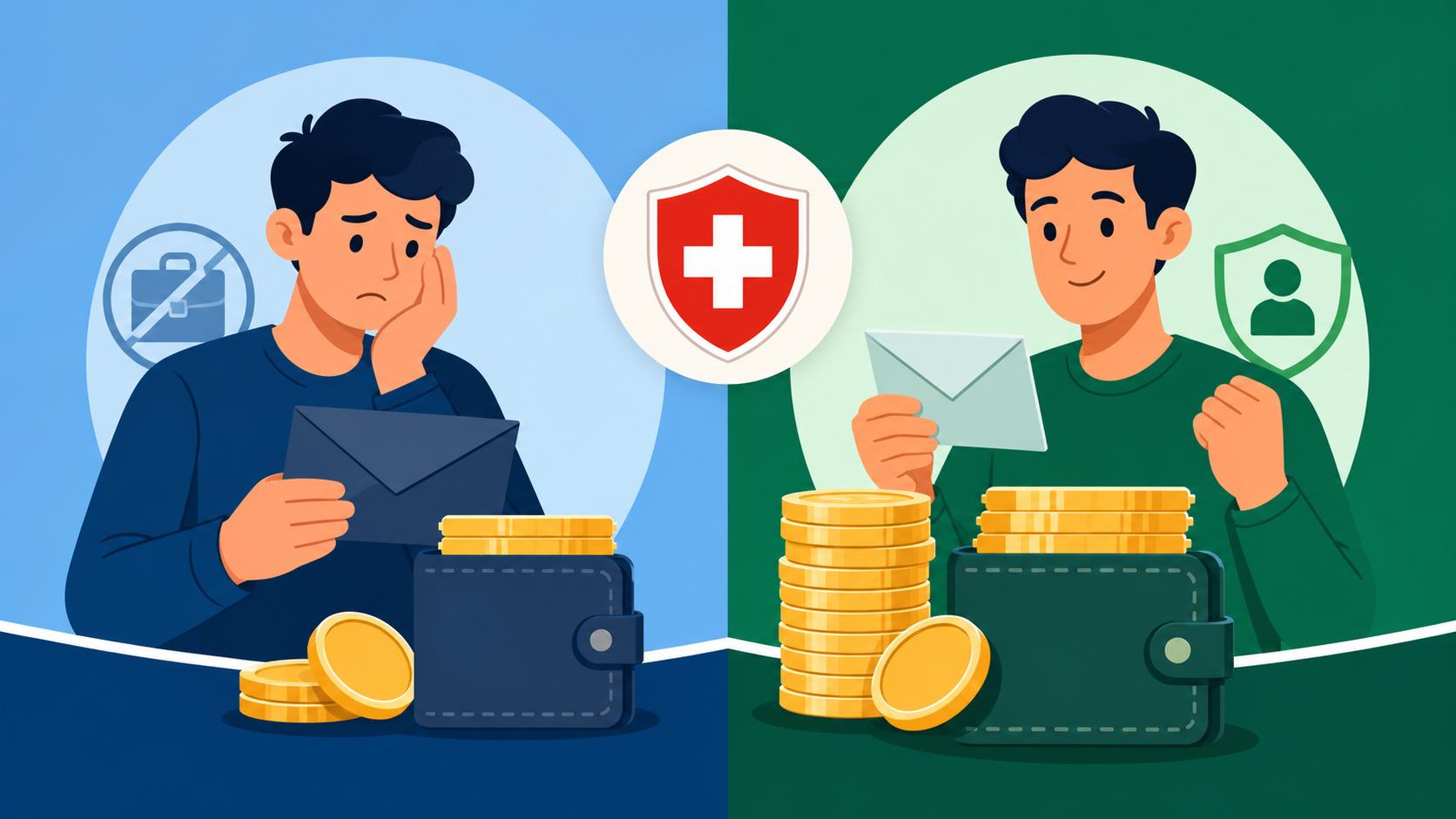
Unemployment Pay: Receiving 70% vs 80% of Your Previous Swiss Salary
Losing a job in Switzerland is an uniquely terrifying experience because the cost of living here doesn't care that your income just stopped. When I received my first notice period letter in Zurich, I spent the entire night staring at my rent and health insurance bills, wondering how I would survive in the world's most expensive country. This guide settles the confusion around your payout, explaining exactly why you will receive either 70% or 80% of your previous salary and how to navigate the RAV system successfully.
Understanding the Swiss Unemployment Insurance ALV
When you look at your Swiss payslip, you will see a deduction for ALV (Arbeitslosenversicherung). This is the mandatory insurance that every employee in Switzerland pays into, and it is the safety net that catches you if your contract is terminated. However, unlike some countries where unemployment is a flat rate, the Swiss system is based strictly on your "insured salary."
The first thing you need to realize is that you are not just a passive recipient of funds; you are entering into a contract with the Regional Employment Center, commonly known as the RAV (or ORP in French-speaking cantons). My first meeting with a RAV advisor was intimidating. I walked into the office feeling like I had failed, but my advisor quickly reminded me that I had been paying for this "insurance" for years. It is a right, not a handout. However, that right comes with a massive list of obligations.
To qualify for these payments, you generally must have worked and contributed to the ALV for at least 12 months within the last two years. There are exceptions for those who were unable to work due to education, illness, or maternity, but for most expats, the 12-month rule is the golden gate. If you haven't hit that mark, the financial situation becomes much more complex, often involving cantonal social assistance, which can have significant implications for your residency status.
The Calculation Why Some Get 70 Percent and Others 80 Percent
The most common question expats ask when they get their first "Abrechnung" (statement) is why they aren't getting the full 80% they heard about. The system is designed to provide more support to those with higher financial burdens or lower earning potential. It isn't a random choice made by your advisor; it is hard-coded into the federal law.
The 80 Percent Eligibility Criteria
You will receive 80% of your insured salary if you meet any of the following three conditions. First, and most commonly, if you have dependent children. In Switzerland, a child is generally considered a dependent if they are under 18, or under 25 if they are still in education (like university or an apprenticeship). You will need to provide birth certificates and proof of education to the unemployment office to trigger this higher rate.
Second, you get 80% if your monthly insured salary is relatively low. As of 2026, if your gross monthly salary was below CHF 3,797, the system automatically bumps you to the 80% bracket to ensure you stay above the poverty line. Finally, if you have a disability pension (IV/AI) with a degree of disability of at least 40%, you also qualify for the 80% rate. I've seen many expats overlook the child dependency rule because their children were living back in their home country. If you can prove you are providing financial support for those children, you can often still claim the 80%, though the paperwork is significantly more taxing.
The 70 Percent Standard Rate
If you are a single person without children, or a couple without children, and you were earning a typical expat salary (above the CHF 3,797 threshold), you will receive 70% of your previous gross income. While 70% sounds like a lot compared to unemployment benefits in the US or UK, remember that you are now responsible for 100% of your health insurance premiums, and you no longer have a company-subsidized pension contribution.
The 70% rate is the "default" for most professionals. It is designed to be enough to live on while providing a strong incentive to find a new role quickly. It is also important to understand Working Models: Part-Time Percentages (e.g., 80% Workload) Explained because if you were working part-time before, your 70% is calculated based on that part-time salary, not a theoretical full-time one.
| Criterion | Payout Percentage | Notes |
|---|---|---|
| Dependent children under 25 | 80% | Requires proof of support/education |
| Monthly salary < CHF 3,797 | 80% | Automatic floor for low earners |
| Disability (IV) > 40% | 80% | Based on federal disability assessment |
| No children / Standard salary | 70% | The default for most expat professionals |
The Insured Salary and the Maximum Cap
One of the biggest shocks for high-earning expats in the finance or tech sectors is the "cap." Swiss unemployment insurance does not cover an infinite salary. There is a maximum "insured salary" which is currently set at CHF 148,200 per year (or CHF 12,350 per month).
If you were lucky enough to be earning CHF 200,000, the RAV does not care about the extra CHF 51,800. They will calculate your 70% or 80% based solely on the CHF 148,200 limit. This can lead to a massive "lifestyle gap" if you have a high-rent apartment and expensive car leases. When I was navigating this, I realized that many people don't factor in The 13th Month Salary: How It Works and When It’s Paid into their initial math. The RAV actually includes your 13th-month pro-rata into your insured salary calculation, which is a small but welcome relief.
It is also vital to check your Swiss Work Contracts and Labor Law: Notice Periods, Leave, and Rights before you finish your job. If you negotiate a severance package, the RAV may view this as "extended salary" and refuse to pay you until the severance amount has been "used up" according to their timeline. This is a common trap for expats who take a voluntary redundancy package and then find themselves with a three-month "black hole" where neither the company nor the RAV is paying them.
Wait Days and the Penalty System
Just because you are eligible for 70% or 80% doesn't mean you get the money on day one. Switzerland uses a "Waiting Day" system (Allgemeine Wartetage). The number of days you have to wait before your first payment depends on your income and whether you have children.
If you were a high earner (over CHF 125,000), you might have to wait up to 20 working days—essentially a full month—before your eligibility even starts. This is why having an emergency fund is non-negotiable in Switzerland. Furthermore, you need to be extremely careful about RAV Penalty Days (Einstelltage): Why Quitting Your Job Halts Benefits. If the RAV decides that you lost your job through your own fault—for example, if you resigned without another job lined up or if you were fired for "just cause"—they can "suspend" your benefits for up to 60 days. In the eyes of the RAV, quitting a job is a "self-inflicted" insured event, and they will punish your bank account for it.
During your notice period, you are also required to start looking for work immediately. I made the mistake of thinking I could take a "mental health month" after being let go. When I showed up to my first RAV meeting with only two job applications for the previous month, my advisor immediately docked me five days of pay. They expect roughly 10 to 12 high-quality applications per month, even while you are still technically employed during your notice period.
Language Requirements and Employability
Perhaps the most stressful part of being an expat on the RAV is the language pressure. The RAV's goal is to get you back into the workforce as fast as possible. If you are in a field like English-speaking IT, you might think you are safe. However, the RAV can insist that you learn the local language to increase your "employability" in the broader Swiss market.
They often provide vouchers for language schools, but the quality can vary. I found that while the RAV-funded courses were "free," they were often slow and crowded. To stay competitive, many expats I know supplement their learning with more flexible options. Using a platform like Lingoda can be a game-changer because it allows you to hit the intensive learning requirements the RAV demands while choosing your own schedule. If you are in Zurich or Bern, you’ll be focusing on German, and starting with something like GermanPod101 can help you get over the initial "Mundart" (dialect) shock you'll encounter in local offices. For those in Geneva or Lausanne, FrenchPod101 is an excellent tool to quickly build the professional vocabulary needed to pass the mandatory language assessments the RAV will eventually put you through.
Remember that if you don't show progress in your language skills, the RAV can technically claim you are "unplaceable" and start reducing your benefits or forcing you into "employment programs" that might involve manual labor or basic administrative work far below your skill level. It sounds harsh, but the system is designed to be a springboard, not a hammock.
Navigating the Practical Steps to Your First Payment
To ensure you actually receive your 70% or 80% without delays, you need to be meticulous with your documentation. The moment you receive your notice of termination, you should look into How to Register at the RAV Office Before Your Job Ends. Do not wait until your last day of work.
You will need to provide the "Arbeitsbescheinigung" (employer's certificate) from every employer you've had in the last two years. This is often the part that slows down the process, especially if a former employer is slow to respond. You also need to keep a meticulous log of every job search activity. The RAV provides a specific form for this (the "Nachweis der persönlichen Arbeitsbemühungen"), and if you submit it even one day late, you risk losing money.
For those in niche industries, finding work can take time. You should proactively research English-Speaking Jobs in Switzerland: Top Industries and Cantons to show your advisor that you have a strategic plan. If you show up with a list of target companies and a clear understanding of the market, your advisor is much more likely to support you and perhaps even fund advanced certifications or specialized training that goes beyond simple language courses.
Managing Your Finances During Unemployment
Living on 70% of your salary requires an immediate and brutal audit of your expenses. While you are on the RAV, you are still required to pay for your mandatory KVG insurance. You should review Understanding KVG/LAMal: Mandatory Basic Health Insurance Explained to see if you can switch to a higher deductible to lower your monthly outgoings, though this is a risk if you have ongoing medical needs.
You also need to stay on top of your taxes. Unemployment benefits are taxable income in Switzerland. If you are on a B Permit, the "Quellensteuer" (withholding tax) will be deducted directly from your RAV payout. If you have a C Permit, you will need to set aside money for your year-end tax bill, as 70% of your salary doesn't leave much room for a surprise CHF 10,000 tax demand.
Finally, be aware of the "stigma" and the social side. Many expats feel isolated when they lose their job. Joining local "Vereine" (clubs) or expat networking groups isn't just good for your mental health; it's also "networking," which you can legitimately log on your RAV job search forms. The Swiss system is rigid, but it is also predictable. If you follow the rules to the letter, provide the documentation they ask for, and show a genuine "will" to work, the 70% or 80% payout provides a very stable platform to rebuild your career in the Alps.
Disclaimer
The information provided in this article is for general informational purposes only and does not constitute legal, financial, or professional advice. Swiss laws and RAV regulations are subject to frequent changes and can vary significantly between cantons. Always consult with the official Regional Employment Center (RAV/ORP) or a qualified legal professional regarding your specific situation.