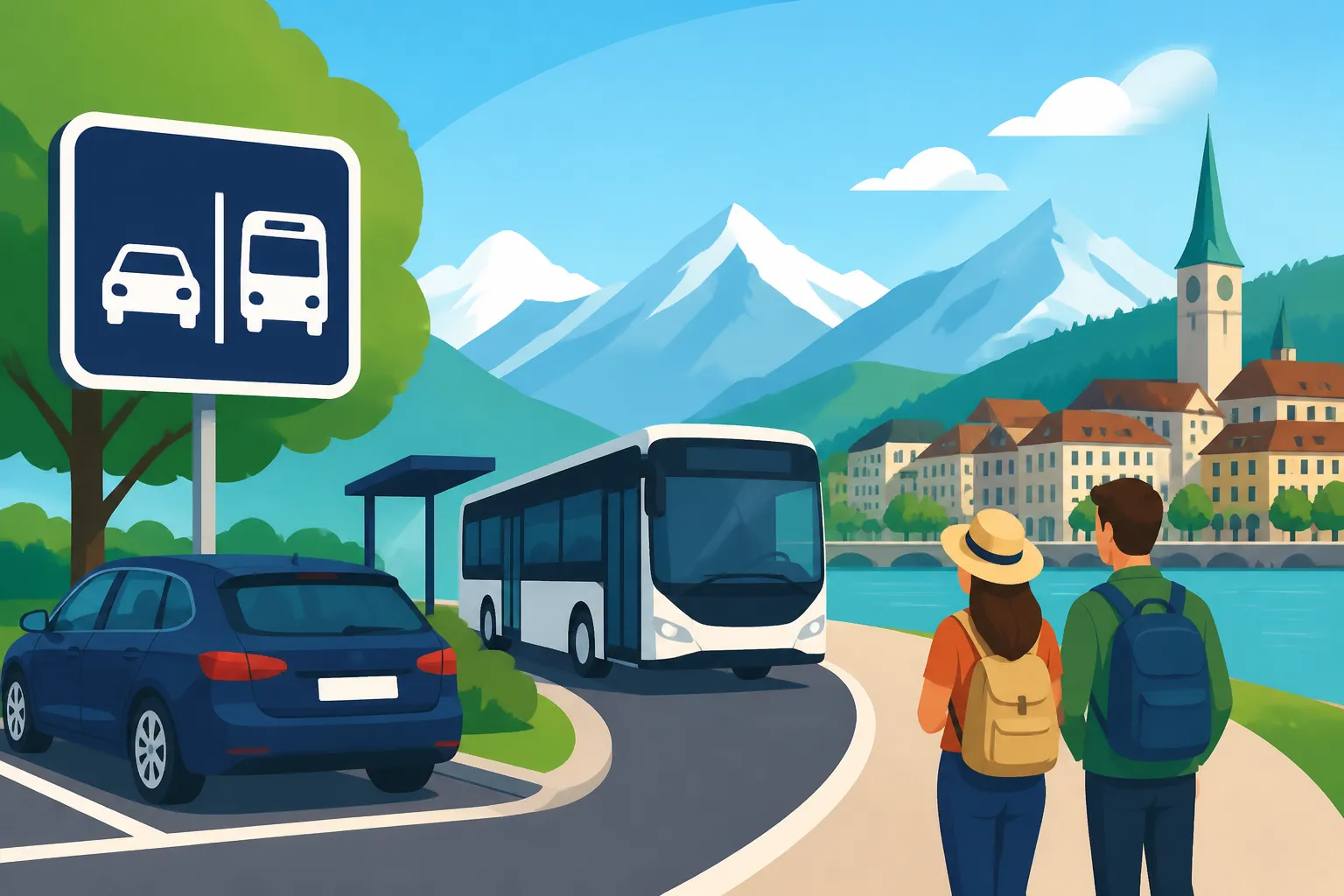
Park and Ride Options for Car-Free City Visits in Switzerland
Oh, the sheer dread of driving into a Swiss city centre! I totally get it. The narrow streets, the zealous tram drivers, the utterly mystifying one-way systems, and then, the ultimate quest: finding parking that doesn't cost you an arm and a leg or require you to perform parallel parking acrobatics worthy of a circus act. It's enough to make you want to throw your car keys into Lake Geneva. But fear not, my fellow expats and visitors, because there's a brilliant, sanity-saving solution that many of us seasoned Swiss residents swear by: the Park & Ride (P+R) system. This guide is all about helping you ditch the driving stress and embrace the wonderfully efficient Swiss public transport for your urban adventures.
Why Embrace the Car-Free City Experience in Switzerland?
Let's be honest, driving in Switzerland has its perks, especially when you're cruising through the mountains with breathtaking views. But once you hit the urban sprawl, the charm quickly fades. Swiss cities, while beautiful, were simply not built for the sheer volume of cars we have today, and the infrastructure reflects a strong preference for public transport.
Navigating Urban Congestion and Parking Woes
You might think, "I'll just find street parking, it can't be that bad." Oh, bless your heart. Trying to navigate rush hour in Zurich or Geneva, only to spend another 30 minutes circling for a spot that usually turns out to be a 'Blaue Zone' (blue zone) requiring a special disc you don't have, is a quintessential expat initiation rite. Even if you find a parking garage, the hourly rates can be eye-watering, often running upwards of CHF 4-6 per hour, and easily adding CHF 30-50 to your day trip budget. And don't even get me started on the size of some of those parking spots – it's like they were designed for Smart cars only! By opting for a P+R, you bypass this entire frustrating dance. You park outside the city's chaotic core, usually for a much more reasonable daily flat rate, and then seamlessly switch to the tram, bus, or train.
The Superiority of Swiss Public Transport
This isn't just about avoiding pain; it's about embracing pleasure. Switzerland boasts one of the world's most impressive and punctual public transport networks. From the moment you step off the train at a major hub, the city is at your fingertips. No need to worry about traffic, finding directions, or the price of fuel. You can simply sit back, enjoy the scenery, and let someone else do the driving. Many of us have come to appreciate the simple joy of reading a book or catching up on emails during our commute, rather than gripping the steering wheel in a stressful urban environment. For anyone looking to understand the broader system, checking out our guide on Transport in Switzerland: SBB, GA, Half-Fare Cards, and Commuting is a fantastic next step. The seamless integration of trains, trams, buses, and even boats truly makes Swiss cities accessible without a car.
Environmental and Financial Benefits
Beyond the convenience, choosing P+R is a greener choice. By reducing the number of cars entering city centers, you contribute to lower emissions and quieter urban environments. It’s a small but significant way to give back to this beautiful country. And let’s not forget the financial aspect. Parking at a P+R combined with a day ticket for public transport is almost always cheaper than battling city parking, especially if you’re traveling as a family or planning a longer stay. For instance, a return journey from a P+R on the outskirts of Zurich into the city might cost you around CHF 10-15 in public transport fares, plus CHF 10-15 for parking for the entire day. Compare that to the potential CHF 50+ you might spend on central parking, and the savings are clear. This is especially true if you already hold a The Half-Fare Travelcard Halbtax: The Must-Have Pass for Swiss Residents, which slashes public transport costs in half.
How Swiss Park & Ride Systems Work
The concept of Park & Ride is beautifully simple, yet executed with Swiss precision. You drive your car to a designated parking facility, usually located on the outskirts of a city or near a major public transport interchange, park it, and then use public transport to complete your journey into the city center.
Locating and Accessing P+R Facilities
Most major Swiss cities and even larger towns offer well-signed P+R facilities. They are typically found near train stations, tram stops, or main access roads into the city. A quick search on Google Maps for "Park and Ride [City Name]" will usually bring up the official options. Many P+R sites are integrated with public transport networks, meaning a tram or bus stop is literally steps away from your parked car. For instance, if you're exploring Day Trips from Zurich: Rhine Falls, Rapperswil, and Lucerne, using a P+R on the edge of Zurich allows for stress-free exploration of the city itself before heading out to those other destinations.
Payment for P+R varies. Some operate with standard parking meters where you pay upon arrival or departure. Others might have barrier systems where you take a ticket upon entry and pay at an automated machine before exiting. A growing number are moving towards app-based payments or even integrated systems where your public transport ticket can validate your parking. Always check the specific P+R facility's website or signage for their current payment methods.
Seamless Integration with Public Transport
This is where the magic happens. Once you've parked, you'll need a public transport ticket for your onward journey. This could be a single ticket, a day pass, or if you're a regular, part of your monthly or annual travelcard. For example, in Zurich, if you park at a P+R in one of the outer zones, you'd purchase a ZVV (Zurich Transport Network) ticket covering the zones you need to travel through to reach the city center. You can find detailed information on this in our guide on Public Transport in Zurich: ZVV Zones, Tickets, and Night Service. Many P+R locations even have ticket machines right at the parking site, making the transition incredibly smooth.
Let's look at a typical scenario: you drive from Winterthur towards Zurich for a day of shopping and exploring. Instead of heading straight into the city, you aim for a P+R like "Hardau" or "Sihlcity" on the edge of Zurich. You park your car, usually for a daily rate of CHF 10-15. From there, you purchase a ZVV day ticket for the relevant zones (perhaps a 1-2 zone ticket if the P+R is still within zone 110, or more if further out). Then, it's a simple tram or bus ride directly into Bahnhofstrasse or the Old Town. Easy peasy!
Here's a quick overview of some common P+R features in Swiss cities:
| Feature | Description |
|---|---|
| Location | Often on city outskirts, near major motorways, train stations (Bahnhof), or tram/bus lines. |
| Cost | Typically CHF 10-25 for a full day. Can be cheaper or more expensive depending on the city and facility. Some offer weekly/monthly passes. |
| Payment | Automated machines (cash, card), mobile apps (e.g., EasyPark, Parkingpay), or integrated with public transport tickets. |
| Connectivity | Direct access to trams, buses, or regional trains. Clearly marked connections to city center and key attractions. |
| Security | Most are well-lit, some have surveillance. It's Switzerland, so generally very safe, but always wise to not leave valuables in plain sight. |
| Hours | Many are 24/7, but always check specific facility for closing times or restrictions. |
Major City Park & Ride Options and Tips
Each major Swiss city offers its own specific P+R solutions, often tailored to its unique geography and public transport network. Getting familiar with a few key ones will save you a lot of headache.
Zurich: The Economic Hub
Zurich has several good P+R options that cater to different entry points into the city.
- Parkhaus Sihlcity: Located in the south of Zurich, it's integrated with a shopping mall and has excellent tram connections (Trams 5, 13, 17) directly into the city center. It's a fantastic spot if you're coming from the south or west.
- Messe Zürich / Hallenstadion: If you're coming from the north or east, parking here makes a lot of sense. It's close to the tram and S-Bahn (local train) lines that whisk you downtown. It's particularly useful if you're attending an event.
- Park & Ride Zürich-Altstetten: This is a good option if you're approaching Zurich from the west. It has strong S-Bahn connections, making the journey into the main station (Hauptbahnhof) very quick.
Once you've safely parked your car at a Zurich P+R, you can quickly hop on a train or tram. Tools like the Omio app can help you plan your onward journey seamlessly by public transport, comparing routes and times to get you exactly where you need to be, whether it's the Bahnhofstrasse for shopping or the charming streets of Niederdorf.
Geneva: The International City
Geneva's P+R system is also very efficient, focusing on points of entry to ease congestion around the lake and international district.
- P+R Genf-Palexpo: Ideal if you're coming from France or other parts of Switzerland via the motorway, especially if you want to avoid driving near the airport. It offers excellent bus connections (e.g., Bus 5, 10, 28) to the city center, the international organizations, and the main train station (Cornavin).
- P+R Étoile / La Chapelle: These are more central P+R options but still offer good public transport links to the heart of Geneva.
- P+R Bernex: Located on the west side, offering good tram connections (Tram 14) into the city.
For those exploring Day Trips from Geneva: Montreux, Gruyères, and the Lavaux Vineyards, a P+R allows you to visit Geneva car-free, then easily retrieve your vehicle for your next adventure. If you're looking for activities once you arrive in the city center, platforms like GetYourGuide are excellent for discovering local tours or attractions easily accessible by public transport, like a walking tour of the Old Town or a boat trip on Lake Geneva.
Basel: The Culture Capital
Basel, with its unique position bordering France and Germany, has P+R options designed for both Swiss and cross-border commuters.
- P+R St. Jakob: A large facility perfect if you're coming from the south. It has excellent tram connections (e.g., Tram 14) directly into the city center and the main train stations.
- P+R Kannenfeldplatz: Located in the north, offering good tram and bus links.
- P+R Grenzübergang Weil am Rhein (Germany) / Saint-Louis (France): For those coming from across the border, these often provide cheaper parking options with seamless tram/bus connections directly into Basel. Be mindful of cross-border commuting rules, which are discussed in our Cross-Border Commuter Taxes: Financial Guide for G Permit Holders if you're a frontier worker.
For an in-depth look at local transport, our guide to Public Transport in Basel: BVB, Trams, and the German/French Connections will be invaluable.
Bern and Lucerne: The Charming Capitals
Even these slightly smaller, but no less bustling, cities have adopted effective P+R strategies.
- Bern: The P+R Wankdorf is a major hub, located near the Stade de Suisse. It’s well-connected by tram and S-Bahn to Bern’s charming Old Town.
- Lucerne: P+R Allmend/Messe is a prominent choice, particularly for those coming from the south or east. It's directly connected by bus and train to Lucerne's main station and the picturesque Chapel Bridge area.
General Tips for P+R Success
- Check Online First: Always look up the specific P+R facility you plan to use before you set off. Websites or apps like Parkingpay (a popular parking payment app in Switzerland) will often provide real-time availability, costs, and specific instructions.
- Arrive Early: Especially on weekends or during special events, P+R spots can fill up quickly. Arriving a bit earlier can save you the stress of finding an alternative.
- Have a Public Transport Pass: If you plan multiple city trips, seriously consider investing in a SBB Travelcards: Is the Generalabonnement GA Worth the CHF 4000+ Cost? or a Half-Fare Card. They make public transport significantly cheaper and simplify your life immensely.
- Day Tickets for Public Transport: For one-off city visits, a day ticket (Tageskarte) for the local transport network (e.g., ZVV in Zurich, TPG in Geneva, BVB in Basel) is usually the most cost-effective way to get around once you've parked. You can purchase these at ticket machines, often directly at the P+R, or through the SBB Mobile app.
Planning Your Car-Free City Adventure
Once you've decided to embrace the Park & Ride system, planning your day becomes a whole lot easier and more enjoyable. It's about shifting your mindset from the car being your primary mode of transport to it being a convenient starting point for your public transport journey.
Integrating P+R with Your Itinerary
Think of your P+R as the gateway to your urban exploration. Let's say you're planning a trip to Bern. Instead of driving into the federal capital and hunting for parking, you park at Wankdorf. From there, it's a quick tram ride to the Bundeshaus, the Zytglogge, and the Bear Park. You can spend the whole day strolling the arcaded streets, visiting museums, or enjoying a coffee without ever thinking about parking meters or traffic. For those considering an overnight stay, Booking.com offers a vast selection of hotels near major transport hubs in any city, allowing you to maximize your car-free city experience without lengthy walks back to your car late at night.
Consider the time of year and any local events. During popular festivals or Christmas markets, city centers become even more challenging for drivers. A P+R becomes an absolute necessity during these times. Our guide to Swiss Christmas Markets: The Best in Zurich, Basel, and Montreux highlights exactly why you'd want to avoid driving into these festive, often pedestrian-heavy, areas.
Essential Apps and Resources
Modern technology is your best friend when navigating Switzerland's integrated transport system.
- SBB Mobile App: This is an absolute must-have. It provides real-time train, bus, and tram schedules, platform information, and allows you to buy tickets directly. You can even check connections from your P+R to any point in the city.
- Local Transport Apps: Many cantons and cities have their own apps (e.g., ZVV-App for Zurich, TPG Mobile for Geneva). These can offer hyper-local information, zone maps, and sometimes even discounted tickets.
- Parking Apps: Services like EasyPark or Parkingpay are widely used at P+R facilities and public parking lots, allowing you to pay for parking directly from your phone.
- Google Maps: Still incredibly useful for pedestrian navigation once you’re off public transport, helping you find those hidden gems or the shortest route between attractions.
Remember, the goal is to reduce stress and enhance your experience. While it might feel like an extra step to park outside the city, the time and frustration saved are well worth it. You get to arrive relaxed, explore at your own pace, and depart knowing your car is safely waiting for you, having spared you the typical urban driving headache. It's truly one of the best ways for expats and tourists alike to experience the charm of Swiss cities without the unnecessary hassle.
Disclaimer
Please note that information regarding parking availability, prices, and public transport schedules is subject to change. While we strive to provide the most accurate and up-to-date details, it is always recommended to verify specific information with official sources (e.g., SBB.ch, cantonal transport websites, or individual P+R facility websites) before making your travel plans. This guide is for informational purposes only and does not constitute official advice.