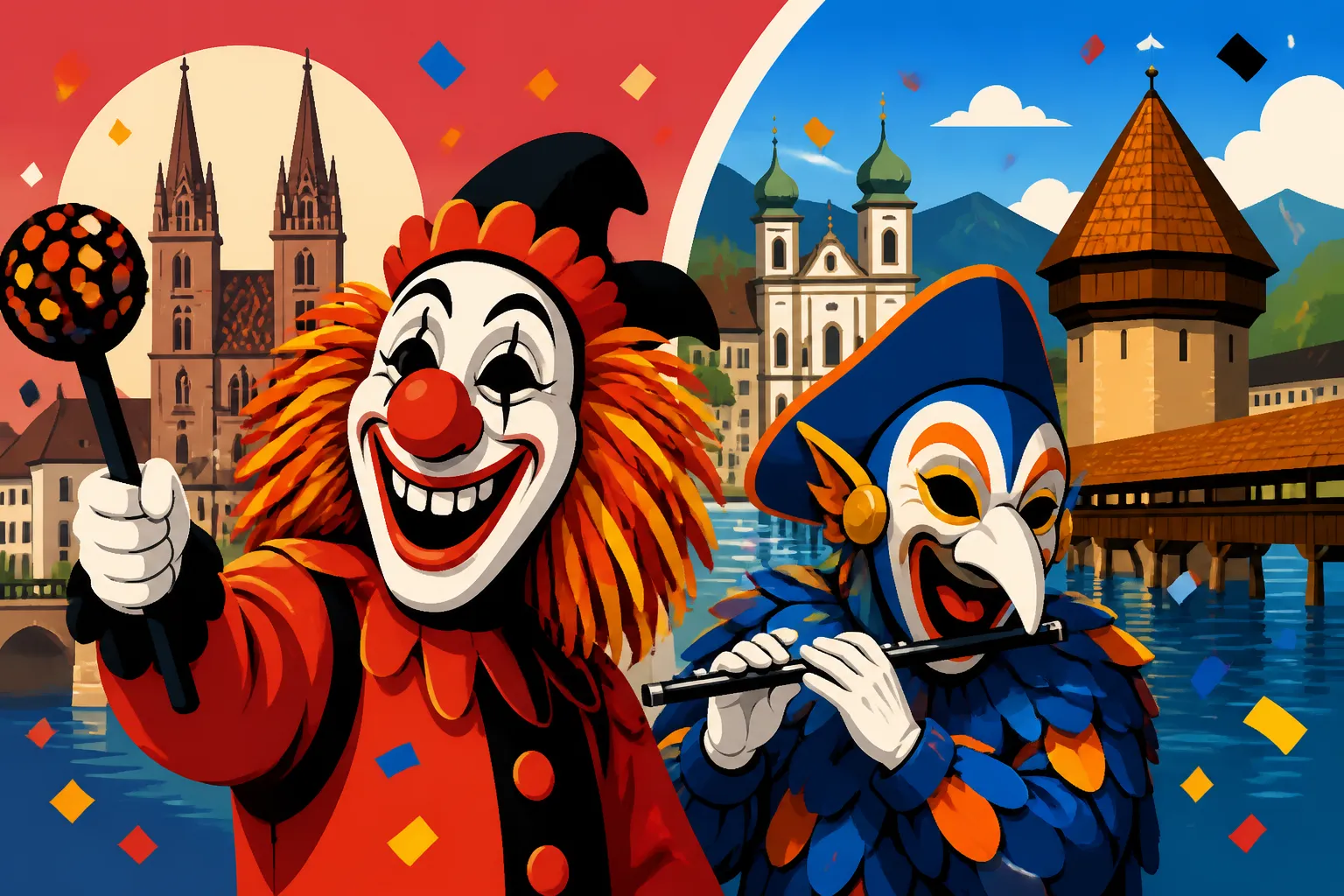
Fasnacht Carnival: Basel and Lucerne’s Wild Pre-Lent Festivals
You've settled into Switzerland, navigated the confusing world of health insurance, perhaps even tackled your first tax declaration, and you're starting to feel like you're getting the hang of things. Then, late winter rolls around, and suddenly everyone is talking about "Fasnacht." You hear whispers of early mornings, loud music, masked figures, and a whole lot of Konfetti. It can feel like suddenly, the famously orderly Swiss have gone completely mad, and you're left wondering if you’re supposed to join in the chaos or hide in your apartment. This guide is here to unravel the wonderful, bewildering world of Fasnacht in two of its most vibrant strongholds: Basel and Lucerne, helping you understand, participate, and truly enjoy these unique pre-Lent festivals without feeling utterly lost.
What Even Is Fasnacht? A Swiss Expat's Introduction to Carnival Chaos
When I first heard about Fasnacht, I pictured something akin to Mardi Gras in New Orleans or Carnival in Rio – a big, boisterous, perhaps a little risqué party. And while there are elements of that, Fasnacht in Switzerland, particularly in Basel and Lucerne, is its own beast entirely. It's deeply traditional, meticulously planned (even when it appears chaotic), and utterly central to the local identity. For us expats, it’s a peek behind the curtain of Swiss reservedness, revealing a side of the culture that’s wild, witty, and surprisingly rebellious. It’s not just a party; it’s a cultural phenomenon that demands respect and a certain level of immersion.
Beyond the Stereotypes: Not Your Average Mardi Gras
Forget floats with scantily clad dancers and beads thrown from balconies. Swiss Fasnacht, especially in Basel, is far more about tradition, satire, and collective performance. It's less about individual hedonism and more about community spirit, often with a subtle (or not-so-subtle) critique of society and politics woven into the fabric of the celebration. The costumes aren't just for show; they often serve to obscure identity, allowing participants to shed their everyday roles and embody something else entirely. In Lucerne, it's a bit more spontaneous and wildly energetic, but still deeply rooted in local customs.
The sheer volume of people, the early hours, and the somewhat inscrutable nature of the masks and music can be overwhelming for a newcomer. You might feel like you've stumbled into a secret society, and in some ways, you have. These traditions have been passed down for centuries, and while locals welcome outsiders, there's an unspoken understanding of how things work. Don't worry, though; the vast majority of it boils down to enjoying the spectacle, embracing the noise, and perhaps accepting a bit of Konfetti in your hair. It’s a temporary inversion of the usual Swiss order, a release valve before the solemnity of Lent. It's a testament to the fact that even in a country renowned for its punctuality and efficiency, there's a deep-seated need to let loose and express a bit of playful anarchy.
The Rhythms of Rebellion: A Historical Glimpse
Fasnacht, or Carnival, historically marks the period before Lent, a time for feasting, revelry, and letting go before 40 days of fasting and introspection. Its roots stretch back to pagan spring rituals, medieval folk customs, and Catholic traditions. In Switzerland, particularly after the Reformation, Fasnacht in places like Basel evolved into a unique form of civic protest and social commentary, especially during times when public expression was otherwise restricted. The masks and anonymity allowed for a freedom of speech that was not tolerated in daily life.
The exact timing varies by canton. Lucerne, being predominantly Catholic, follows the traditional timing leading up to Ash Wednesday. Basel, on the other hand, a historically Protestant city, famously starts its Fasnacht a week later, on the Monday after Ash Wednesday, and continues for precisely 72 hours. This peculiar timing is said to be a historical snub to the Catholic traditions, a way of doing things on their own terms. Understanding this historical context helps to appreciate the deeper layers of these celebrations – they're not just fancy dress parties; they're living history, played out on the streets with a vibrant, pulsating energy that you truly have to experience to believe. It's a window into the evolution of Swiss identity and how communities maintain their distinctiveness, even in a small country.
Lucerne Fasnacht: The Loud, Lively, and Spontaneous Party
Lucerne's Fasnacht is pure, unadulterated revelry. If you're looking for a slightly more approachable and overtly joyous experience than Basel's highly ritualized event, Lucerne is a fantastic starting point. The city transforms into an explosion of color, sound, and general good cheer. It feels less like a performance and more like a city-wide house party, with everyone invited. The air crackles with anticipation, and once it begins, the energy is infectious.
Morgenstreich and the Big Bang: Kicking Off the Frenzy
Unlike Basel's solemn start, Lucerne kicks off its Fasnacht with an explosion of noise and light, traditionally at 5 AM on Dirty Thursday (Schmutziger Donnerstag). This chaotic awakening is known as the Morgenstreich (though it's not the same as Basel's). Instead of just drums and piccolos, you get a full-blown "Urknall" – the Big Bang. A massive, loud explosion signals the official start, and suddenly the streets are alive with thousands of costumed figures and "Guggenmusigen" (brass bands) playing deliberately off-key, vibrant music.
The initial hours are a rush. Everyone gathers around the Kapellbrücke and Weinmarkt, buzzing with excitement. As dawn breaks, the music gets louder, the crowds thicker, and the Konfetti starts flying. It's exhilarating and a little bit disorienting – exactly what you want from a pre-Lent bacchanal! Don't try to sleep in; this is an experience you won't want to miss. Grabbing an early coffee and a Gipfeli (croissant) from a local bakery to fuel up while watching the madness unfold is a core part of the experience. The early start truly sets the tone for the wild days ahead, blurring the lines between night and day in a delightful way.
The Guuggemusig: Brass Bands and Organized Anarchy
The heart and soul of Lucerne Fasnacht are the Guuggemusigen. These aren't your typical polished marching bands. Oh no. These brass bands intentionally play their instruments "out of tune" (or at least, in a very distinct, raucous style) creating a cacophony of sound that is utterly infectious and quintessentially Fasnacht. Each Guuggemusig has its own elaborate, often themed, costumes and masks that they spend months preparing. They parade through the streets, stopping in squares and restaurants to perform their lively, off-key tunes.
Watching a Guuggemusig burst into a confined space, horns blaring, drums pounding, and the energy radiating from the musicians, is an unforgettable experience. It feels like a spontaneous eruption of joy, even though these performances are often part of a loosely planned route. They’re called "organized anarchy" for a reason. Don't be shy; get close, feel the vibrations, and let the music move you. The sheer dedication and creativity that go into these costumes and musical arrangements are truly impressive, demonstrating the deep pride these groups have in their tradition. Many bands even have their own "wagons" (carnival floats) that accompany them, adding to the spectacle.
Costumes, Konfetti, and the Wild Street Scene
In Lucerne, the spirit of costume-wearing is very inclusive. While there are elaborate, traditional masks (known as "Fritschi" figures, specific to Lucerne), many participants simply put together fun, creative, or satirical outfits. This makes it much easier for expats to join in without feeling pressured to conform to centuries-old traditions. The more colorful, the better! You'll see everything from historical figures to contemporary memes, all mingling joyfully.
And then there's the Konfetti. Oh, the Konfetti. It will get everywhere. In your hair, your pockets, your shoes, perhaps even in your teeth. Embrace it. It's a symbol of the playful chaos, the shedding of inhibitions. Kids and adults alike delight in throwing handfuls of the colorful paper confetti, creating a constantly shifting, shimmering carpet on the streets. Alongside Konfetti, you'll encounter the "Orangen" (oranges) that are often thrown from floats or handed out, and the occasional squirt of "Chilbi-Parfüm" (carnival perfume), which is a rather pungent but harmless scent designed to add to the sensory overload. The street scene is a vibrant, moving tapestry of humanity, a truly communal celebration where strangers share laughs and high-fives. Don't be surprised if someone in a bizarre mask suddenly high-fives you – it's all part of the fun!
Basel Fasnacht: The Precise, Punctual, and Profound Tradition
Basel's Fasnacht is in a league of its own. Declared a UNESCO Intangible Cultural Heritage, it’s not just a carnival; it’s the Fasnacht. It is distinct in its timing, its disciplined execution, and its profound cultural significance. While Lucerne’s might feel like an open-armed party, Basel’s feels more like a carefully choreographed, yet equally wild, performance with strict rules and deeper meanings. It is often referred to as "die drey scheenschte Dääg" (the three most beautiful days) by locals, and for good reason. It’s an experience that truly gets under your skin.
Morgestraich: The Dawn Awakens a City
Basel Fasnacht begins dramatically at precisely 4 AM on the Monday after Ash Wednesday with the "Morgestraich" (Morning Strike). All city lights go out, plunging the historic old town into darkness. Then, at the stroke of four, the command rings out: "Morgestraich: Vorwärts, Marsch!" Suddenly, hundreds of elaborately painted lanterns illuminate the night, carried by "Cliques" (carnival groups) marching in formation. Drums beat a steady, rhythmic march, accompanied by the high, haunting tunes of piccolos. It’s an ethereal, almost sacred experience, devoid of the wild noise of Lucerne’s start.
The Morgestraich isn't a party; it's a solemn procession, an ancient ritual. The lanterns, often several meters tall, depict satirical cartoons (the "Sujet") commenting on the past year's political and social events. As an expat, this is your first introduction to the unique blend of precision and artistic expression that defines Basel Fasnacht. Bundle up, get there early (we’re talking 3 AM to get a good spot), and just absorb the atmosphere. It's cold, it's dark, but the feeling of being part of this ancient awakening is truly special. Afterward, head into a restaurant for a traditional Mehlsuppe (flour soup) and Zwiebelwähe (onion tart) – a must-do ritual to warm up.
Cliques, Lanterns, and the Sartorial Significance
The "Cliques" are the heart of Basel Fasnacht. These are highly organized groups, often with generations of family members participating, who spend all year preparing their costumes, masks (Larven), and their Sujet (theme). The costumes are traditional, often based on historical figures, animals, or fantastical creatures, and are never removed in public during the 72 hours of Fasnacht. The anonymity is paramount; it's about the collective identity of the Cliquard.
Each Clique has a large, illuminated lantern, sometimes several, which are stunning works of art, depicting their chosen Sujet with intricate detail. These lanterns are paraded during the Morgestraich and then displayed in the Münsterplatz for the duration of Fasnacht, creating an open-air art gallery. The precision and dedication are astonishing. Unlike Lucerne where you can easily don a store-bought costume, Basel's tradition demands a deeper commitment. The Larven (masks) are custom-made, often from papier-mâché, and are truly works of art in themselves, completely obscuring the wearer's identity. Understanding this dedication helps appreciate the entire event. It's not just a spectacle; it's a living museum of tradition and craftsmanship.
Schnitzelbänke: Satire, Song, and Social Commentary
Beyond the visual spectacle and the musical marches, Basel Fasnacht has a strong satirical tradition expressed through "Schnitzelbänke." These are short, witty, rhyming verses, often sung or recited by individuals or small groups, which lampoon local and global events, politicians, and social trends of the past year. They are typically performed in small pubs, restaurants, or private gatherings during the evenings of Fasnacht Tuesday.
The language is almost always Baslerdytsch, the local Swiss German dialect, which can be a barrier for new expats. However, even if your German isn't perfect, the cleverness and biting humor are often evident in the reactions of the crowd. Some groups even hand out illustrated leaflets with their Schnitzelbänke, which can be helpful for following along. It’s a fantastic example of the dry, often understated, Swiss sense of humor, and it provides a fascinating insight into local concerns and perspectives. You can check local listings or ask a Swiss friend where to catch a good Schnitzelbank performance. It's a key part of the intellectual side of Basel Fasnacht, a moment for reflection and shared laughter over the year's absurdities.
Navigating the Fasnacht Experience: Practical Tips for Newcomers
Fasnacht, whether in Lucerne or Basel, is an immersive experience. For an expat who's used to the quiet, orderly nature of Switzerland, it can be a bit of a shock to the system. But armed with a few practical tips, you can truly enjoy the festivities without feeling overwhelmed or out of place. This isn't just about watching; it's about participating in the collective energy.
Essential Gear: What to Wear and What to Bring
First things first: layers! Fasnacht happens in late winter/early spring, so temperatures can be chilly, especially during the early morning Morgestraich. Think thermal underwear, warm socks, hats, gloves, and a good waterproof outer layer. You’ll be doing a lot of standing and walking, often in damp or messy conditions.
Footwear is crucial. Comfortable, waterproof shoes or boots are non-negotiable. Your shoes will inevitably get covered in Konfetti (Lucerne) or stand up to hours of marching on cobblestones (Basel). If you're going to Lucerne, consider a simple, fun costume. You don't need anything elaborate; even a funny hat or some face paint will help you blend in and feel part of the fun. In Basel, it's generally best to observe rather than try to join a Clique unless you’re with locals who can guide you. However, you can still don a simple mask or a colorful scarf.
Bring a small, secure bag for essentials: cash (many street vendors and small pubs are cash-only), a portable charger for your phone (you'll be taking lots of photos), and perhaps a small snack. Leave valuables at home if possible, and be aware of your surroundings, as large crowds are always a target for pickpockets. If you plan to travel by train, check the SBB Travelcards: Is the Generalabonnement (GA) Worth the CHF 4000+ Cost? or ensure you have your The Half-Fare Travelcard (Halbtax): The Must-Have Pass for Swiss Residents if you're taking public transport.
Where to Stay and How to Get Around
Accommodation fills up fast and becomes expensive, especially in Basel, due to the unique timing. If you’re planning to attend, book well in advance. Check platforms like Booking.com for hotels or look for guesthouses a bit outside the immediate city center, perhaps connected by efficient public transport. Many expats opt to stay in nearby towns and commute in for the main events, which can be a more budget-friendly option. Consider using Omio to check train and bus connections if you're commuting from another city, as they provide an overview of available routes and times.
Within the cities themselves, public transport is often rerouted or suspended in the main Fasnacht areas. Expect to walk a lot. Wear those comfortable shoes! Plan your routes in advance, especially for the early morning starts. Basel's old town is mostly pedestrianized during Fasnacht, making walking the primary mode of transport. In Lucerne, the main bridges and squares are packed, so navigating can be slow. Embrace the journey; the crowds are part of the experience.
It’s worth noting that while you might be tempted to just wander, having a general idea of the parade routes and key gathering points can enhance your experience. For example, in Lucerne, the main parades run on Dirty Thursday and Carnival Monday afternoon. In Basel, the main Cortege (parade) takes place on Monday and Wednesday afternoon.
Respecting Traditions: Unspoken Rules and Local Etiquette
This is where the expat validation comes in: Switzerland has a lot of unspoken rules, and Fasnacht is no exception. It’s not always obvious what you should or shouldn't do, and getting it wrong can feel awkward. Here's a quick rundown:
- Don't Touch the Masks/Costumes: Especially in Basel, the masks and costumes of the Cliques are sacred. Do not touch them, try to pull them off, or try to take selfies too close without permission. Observe from a respectful distance.
- Embrace the Konfetti (and the noise): In Lucerne, you will get hit by Konfetti. Don't get annoyed; it's part of the fun. The loud, off-key music of the Guuggemusigen is also intentional. Just enjoy the joyous din.
- No Smoking/Vaping in Crowds: Especially in Basel's Morgestraich, it's considered disrespectful to smoke or vape in the dense crowds during the solemn procession.
- "Drey scheenschte Dääg": For Baselers, Fasnacht is a sacred tradition. Avoid disparaging comments or comparisons to other carnivals.
- Learn a Few Phrases: In Lucerne, a cheerful "Fasnacht!" or "Häb e gueti Fasnacht!" (Have a good Fasnacht!) is always appreciated. In Basel, "E scheeni Fasnacht!" is the greeting.
- Ask Before Photographing: While public events are generally fair game, if you want a close-up of a specific costume or mask, a polite gesture or "Darf ich ein Foto machen?" (May I take a photo?) can go a long way.
- Don't Block Routes: The parades and Cliques need to move. Be aware of your position and don't deliberately block their path.
Understanding these subtle nuances will help you feel more integrated into the celebration. It’s all part of the unique Swiss Customs and Etiquette: Social Norms Every Newcomer Should Know.
Family-Friendly Fasnacht Fun and Escaping the Mayhem
While Fasnacht can be an intense sensory experience, especially in the thick of the action, both Lucerne and Basel offer plenty of ways for families to enjoy the carnival atmosphere, and also opportunities to escape when it all gets a bit too much. You don't have to sacrifice your eardrums or your child's nap schedule to experience the fun!
Daytime Delight: Carnival for All Ages
During the daytime, both cities offer a more relaxed, family-friendly version of Fasnacht. In Lucerne, the main parades on Dirty Thursday and Carnival Monday afternoon are fantastic for kids. They’ll love the colorful floats, the loud (but not too loud for little ears, usually) Guuggemusig bands, and the constant shower of Konfetti. Many families line the streets with small step stools for their children to get a better view. After the initial morning frenzy, the crowds tend to be a bit thinner and more manageable.
Basel also has its children's Fasnacht on Tuesday afternoon, where kids in costumes and small groups (not official Cliques) march through the streets. It's much less formal than the main Morgestraich or Cortege and is a wonderful opportunity for younger expats to experience the tradition in a gentler way. The large lanterns displayed in the Münsterplatz throughout Fasnacht are also a huge draw for children, offering a chance to marvel at the intricate artistry up close. Many families enjoy visiting these displays during quieter periods.
Consider making a family outing of it, perhaps combining it with a warm drink and a traditional treat from a local bakery. Remember, kids also get excited about the Swiss Festivals and Traditions: A Year-Round Cultural Calendar.
Finding Respite: Quiet Zones and Retreats
Let’s be honest, the constant noise, the crowds, and the sheer energy can be exhausting. Even locals need a break! Fortunately, both cities offer quieter zones where you can retreat, recharge, and enjoy a moment of peace.
In Lucerne, venturing a few streets away from the main parade routes and squares often provides a welcome buffer from the sound. Parks, lakeside promenades, or even a quiet café outside the old town can be good spots for a breather. If you’re traveling with very young children, consider dipping in and out of the main events rather than staying for hours on end.
Basel, despite its intense tradition, also has its quiet moments. The areas immediately surrounding the main parade routes and the Münsterplatz will be dense, but quieter side streets or residential areas often offer respite. Many cafes and restaurants slightly away from the main arteries provide a cozy escape. The museums, while not directly part of Fasnacht, offer a completely different atmosphere if you need a total change of pace. You could even plan a small day trip outside the city if you need a complete break from the "drey scheenschte Dääg." Remember, not every moment has to be spent in the thick of the Konfetti. Even during Fasnacht, the Swiss Everyday Rules: Recycling, Quiet Hours, and Neighborhood Etiquette still mostly apply in residential areas, providing predictable quiet zones.
Beyond the Buzz: The Deeper Meaning for Expats
As expats, we often arrive in Switzerland with a certain image: mountains, chocolate, precision, quiet efficiency. Fasnacht blows that image right out of the water, revealing a vibrant, rebellious, and deeply traditional heart. It's more than just a party; it's a profound cultural statement, a release, and a moment of collective identity that can be incredibly insightful for those of us trying to understand our adopted home.
A Glimpse into the Swiss Soul
Fasnacht offers a rare and beautiful glimpse into the Swiss soul. Beneath the polished exterior of order and efficiency lies a rich tapestry of history, community, and a powerful sense of identity. In Basel, the Cliques, with their year-round dedication, embody the Swiss value of long-term commitment and meticulous planning, even for something as seemingly chaotic as a carnival. The satirical Schnitzelbänke demonstrate a sharp wit and a tradition of civic engagement that might not always be visible on the surface.
In Lucerne, the Guuggemusigen and the unrestrained joy showcase a capacity for collective revelry that might surprise those who only know the quiet politeness of daily Swiss life. It’s a moment where anonymity (through masks) allows for a different kind of freedom, a space for collective expression and temporary inversion of norms. For an expat trying to truly integrate, witnessing and participating in Fasnacht is like unlocking a secret level of understanding. It shows you the passion, the community bonds, and the historical consciousness that underpin Swiss society. You might also find yourself reflecting on the Swiss Coffee Culture and the Best Cafés in Major Cities as sanctuaries before and after the chaos.
Embracing the Unfamiliar: Your Path to Integration
Embracing Fasnacht, even if it feels strange or overwhelming at first, is a fantastic step towards integrating into Swiss life. It’s easy to stay in expat bubbles, but actively engaging with local traditions, no matter how peculiar they seem, opens doors and creates genuine connections. Don't be afraid to ask locals about the traditions, the meaning behind a specific mask, or where to find the best Mehlsuppe. They'll likely be delighted by your interest.
Rent a costume for Lucerne, brave the early morning cold in Basel, let yourself be covered in Konfetti, and try a local specialty. Use this as an opportunity to step outside your comfort zone and experience the raw, unpolished, yet deeply authentic side of Switzerland. You might not understand every joke in a Schnitzelbank, and the off-key music might still sound a bit jarring, but the shared experience, the collective energy, and the sheer joy are universal. It’s a vibrant counterpoint to the more reserved elements of Swiss culture, and an essential part of the puzzle for any expat trying to truly call this country home. Perhaps you'll even want to try a tour from GetYourGuide that focuses on local traditions to deepen your understanding before you dive in.
| Feature | Lucerne Fasnacht (Schmutziger Donnerstag) | Basel Fasnacht (Morgestraich) |
|---|---|---|
| Start Date | Thursday before Ash Wednesday | Monday after Ash Wednesday |
| Start Time | ~5:00 AM (Urknall) | Precisely 4:00 AM (Morgestraich) |
| Duration | 5-6 days, culminating in parades | Exactly 72 hours |
| Overall Mood | Wild, loud, spontaneous, joyful | Disciplined, artistic, satirical, profound |
| Music Style | "Guuggemusig" (intentionally off-key brass) | Drums and Piccolos (precise, traditional) |
| Key Participants | "Guggenmusigen," costumed individuals | "Cliques" (highly organized groups) |
| Costumes/Masks | Diverse, creative, often store-bought | Elaborate, traditional "Larven" (masks), not removed |
| Confetti | Abundant and central to the experience | Less prevalent, mostly thrown at spectators (Waggis) |
| Main Parades | Thursday & Monday afternoon | Monday & Wednesday afternoon (Cortege) |
| Satire | Less central, more general humor | "Schnitzelbänke" (highly prominent) |
| UNESCO Status | No | Yes (Intangible Cultural Heritage) |
Disclaimer
The information provided in this guide is for general informational purposes only and is subject to change. While we strive to offer accurate and up-to-date advice based on personal experience and available public information, specific dates, regulations, and recommendations can vary. We recommend verifying details with official local tourism boards or event organizers. Participation in large public events carries inherent risks; please exercise caution and personal responsibility. We are not liable for any actions taken based on the information provided herein.