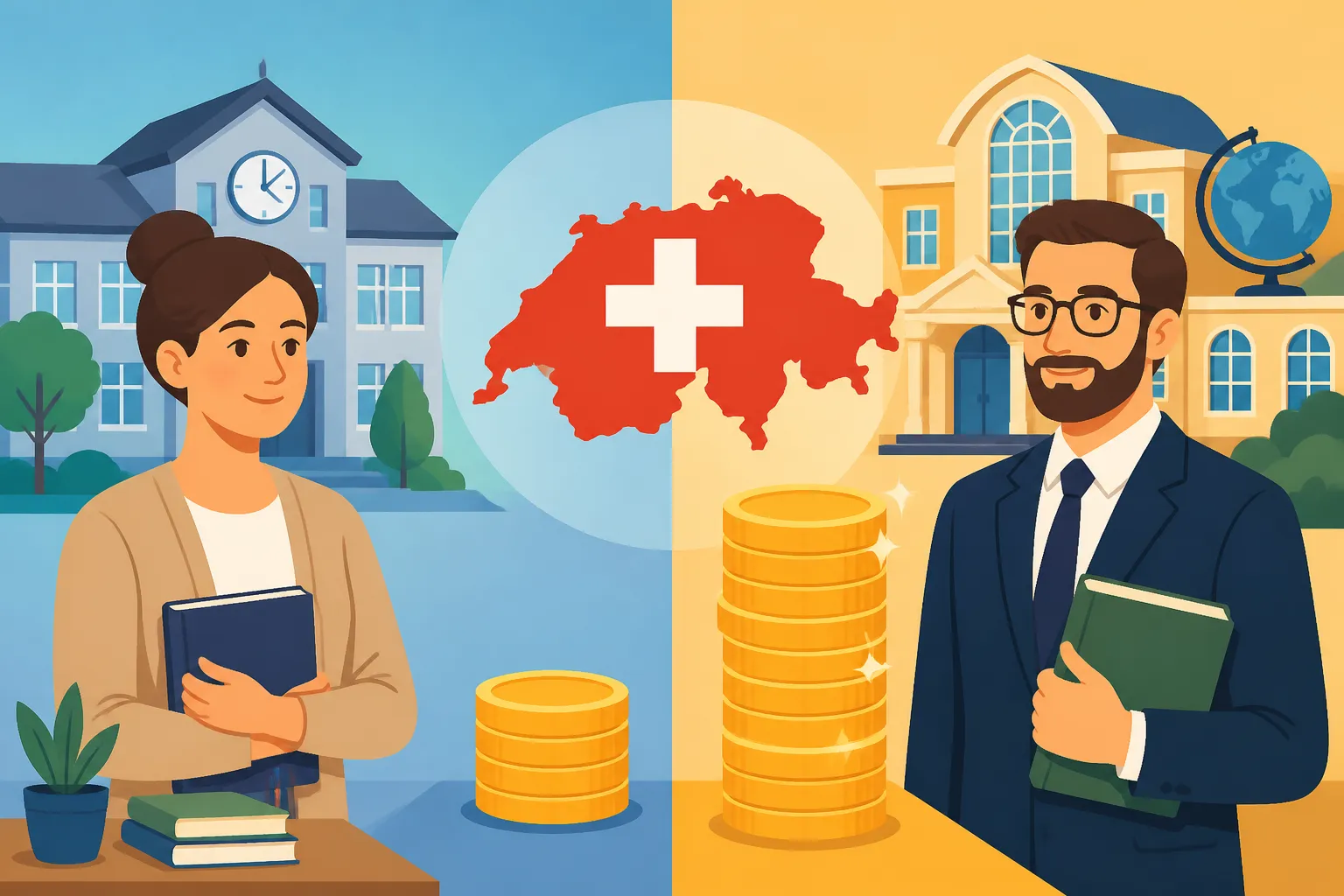
Average Salary for Teachers in Switzerland: Public vs International Schools
So, you're dreaming of bringing your teaching talents to Switzerland, are you? Fantastic! But let's be real, one of the first things on every expat's mind—after "Will I ever afford a fondue?"—is "How much will I actually earn?". Navigating the Swiss job market, especially for teachers, can feel like trying to decipher a cantonal tax form written in Romansh after a long day. It’s confusing, there's a lot of regional variation, and honestly, the official sources aren't always super clear on the nuances for us foreigners. This guide is here to cut through the noise and give you a realistic picture of average teacher salaries in Switzerland, comparing what you might expect in public schools versus the often-glamorous international school circuit.
The Swiss Teaching Landscape: Public vs. International Schools
Alright, let's talk about the two main paths for teachers here: the local public system and the international schools. They operate on very different rules, attract different kinds of teachers, and yes, pay quite differently too. It's not as simple as picking one over the other; your qualifications, language skills, and even your long-term residency goals will heavily influence your best fit.
Understanding Public School Structures and Salaries
The Swiss public school system is… well, it's Swiss. That means it's highly decentralized. Education is primarily a cantonal responsibility, not federal. What this boils down to for you is that salaries, curricula, and qualification recognition can vary wildly from one canton to the next. Seriously, moving just 20 kilometers down the road can mean a significant pay difference and completely different recognition requirements for your foreign degree.
Public school teaching roles generally require a recognized Swiss teaching diploma or a foreign diploma that has been officially recognized by the Swiss Conference of Cantonal Ministers of Education (EDK). This recognition process can be lengthy and quite strict, often requiring additional training, internships, or language proficiency proofs. If your degree isn't from the EU/EFTA, expect more hurdles.
Salaries in public schools are typically transparent and based on set cantonal scales, taking into account your level of education, years of experience, and the grade level you teach (e.g., kindergarten, primary, secondary I, secondary II). These scales are often publicly available on cantonal education department websites. For instance, a primary school teacher with a few years of experience might start around CHF 70,000 to CHF 85,000 annually, while a secondary school teacher could see salaries ranging from CHF 80,000 to over CHF 120,000, depending heavily on the canton and experience.
Cantons with higher costs of living, like Zurich, Geneva, or Zug, tend to have higher salary scales to compensate, though the purchasing power might not feel that much different once you factor in rent and groceries. Cantons like Ticino or Jura, while beautiful, typically offer lower salaries. You'll generally find that the larger, German-speaking cantons like Zurich, Aargau, and Bern often have a higher demand for teachers, but also a fierce requirement for fluent German (or French/Italian in their respective regions).
International Schools: Prestige, Pay, and Perks
International schools are a completely different beast. They cater to expat families and offer curricula like the International Baccalaureate (IB), British, American, or other national systems. This is often the more accessible entry point for foreign-trained teachers, especially those who don't speak a local Swiss language fluently.
The good news? International schools often offer competitive, sometimes even higher, salaries than public schools, especially if you have experience with specific international curricula (like IB). Salary packages for experienced teachers can range from CHF 80,000 to CHF 130,000+ per year, often with additional perks.
The "perks" are where international schools often shine. These can include:
- Housing allowances: Some schools, particularly those recruiting internationally, might offer a contribution towards your rent or even provide subsidized accommodation for a period.
- Relocation packages: Assistance with moving costs, flights, and visa processing.
- Professional development: Funds for workshops, conferences, and advanced degrees.
- Health insurance contributions: While basic KVG is mandatory for everyone, some schools might contribute more than a public employer or offer supplementary packages. For more on the basic system, you should really read up on Understanding KVG/LAMal: Mandatory Basic Health Insurance Explained.
- Tuition discounts: A huge benefit for teachers with their own children, as international school fees are astronomical.
However, the job market for international schools can be highly competitive. They look for specific experience, often IB or British/American curriculum experience, and a strong track record. While local language isn't always a requirement for teaching, many schools appreciate it, and it certainly helps with integrating into the wider Swiss community.
Factors Influencing Your Teacher Salary in Switzerland
Your final salary offer won't just depend on whether you're in a public or international school. Several other crucial factors come into play, making it a rather complex calculation.
Education, Experience, and Qualifications
This might sound obvious, but it's particularly pronounced in Switzerland.
- Degree Level: Holding a Master's degree will almost always place you higher on the salary scale than a Bachelor's. For public schools, specific Swiss teaching diplomas (Lehrdiplom) are key.
- Years of Experience: Proven teaching experience, especially relevant experience in a recognized system, directly translates to higher steps on the salary scale in both public and international schools. If you're coming from abroad, ensure your experience is well-documented and translated.
- Specializations: Being qualified to teach in-demand subjects like MINT fields (Math, IT, Natural Sciences, Technology), or having expertise in special education, can give you an edge and potentially lead to better offers.
- Curriculum Experience: For international schools, prior experience with the IB, AP, or specific national curricula (e.g., English National Curriculum, US Common Core) is highly valued and can influence your starting salary.
Let's say you're a seasoned secondary school physics teacher from Canada with 10 years of IB experience. An international school would likely value that far more than a public school trying to fit you into a very specific Swiss canton's system. On the flip side, if you've got a German Lehramt degree and fluent German, a public school in Aargau would be very interested.
Canton, Language Region, and Cost of Living
As mentioned, the canton makes a massive difference. Not just in salary numbers, but in what those numbers actually mean for your wallet.
- Cantonal Differences: Zurich, Zug, Geneva, and Vaud generally offer higher gross salaries but also have some of the highest living costs in the world. Conversely, cantons like Valais, Jura, or Neuchâtel might have lower salaries but also lower rents and a slightly more relaxed pace of life. You might find that your net disposable income isn't as dramatically different as the gross salary figures suggest, after you account for things like rent, health insurance premiums, and groceries. To get a better handle on these differences, it’s worth checking out comprehensive guides on Cost of Living in Switzerland 2026: Budgeting for Singles and Families.
- Language Region: Switzerland has four official languages (German, French, Italian, Romansh), but the dominant languages are German, French, and Italian. You'll find distinct job markets and salary norms in each region.
- German-speaking Switzerland: The largest region, with the most economic hubs (Zurich, Basel, Bern). Strong demand for German-speaking teachers in public schools. International schools here are plentiful but competitive.
- French-speaking Switzerland (Romandie): Geneva, Vaud, Neuchâtel. Significant international presence, especially around Geneva. Strong demand for French-speaking teachers in public schools. Many international schools.
- Italian-speaking Switzerland (Ticino): Lugano, Bellinzona. Smaller job market, but demand for Italian-speaking teachers. Fewer international schools.
- Cost of Living Impact: A CHF 90,000 salary in Zurich might feel tighter than a CHF 75,000 salary in a smaller town in Valais. This is critical for expats, as Switzerland's cost of living can be a real shock. Factor in average rent, transport, and mandatory health insurance premiums – which also vary by canton! Learn more about the intricacies of premiums and deductibles by reading about The Swiss Franchise System: How Deductibles and Copays Work.
Supplementary Benefits and Perks
Beyond the basic salary, what else might you get?
- Pension Contributions (Pillar 2 – BVG): Swiss employers contribute significantly to your occupational pension. While not immediate cash, it's a huge benefit for your long-term financial security. Understanding your Pillar 2 (BVG): Understanding Your Swiss Occupational Pension is crucial.
- Accident Insurance (UVG): Mandatory for all employees, covering both occupational and non-occupational accidents. This is paid by your employer.
- Continued Education/Professional Development: Many schools invest in their teachers' growth, offering courses or even partial funding for further degrees.
- Travel Passes: Some employers might offer contributions towards your SBB Half-Fare Travelcard or even a full GA. Getting to know The Half-Fare Travelcard (Halbtax): The Must-Have Pass for Swiss Residents is almost a rite of passage for expats.
- Lunch Subsidies: Some schools have subsidized canteens or offer meal vouchers.
- Relocation Assistance: For international school hires, this can include initial accommodation, flights, and assistance with administrative tasks.
Navigating the Job Market and Maximizing Your Earning Potential
Landing a teaching job in Switzerland as an expat isn't just about sending out a CV. It requires strategic planning, especially when it comes to qualifications and language.
Qualification Recognition and Language Proficiency
This is often the biggest hurdle for expat teachers aiming for public schools.
- Public Schools: Your foreign teaching qualification must be recognized by the EDK (Swiss Conference of Cantonal Ministers of Education). This can be a rigorous process, and they may require you to undertake additional training or pass specific exams to meet Swiss standards. The local language proficiency (C1 level, sometimes B2 minimum) is non-negotiable for classroom teaching in public schools.
- International Schools: While formal EDK recognition isn't usually required, having your qualifications recognized in your home country (e.g., teaching license, QTS) is essential. Language proficiency in the local Swiss language, while highly beneficial for daily life, isn't always a teaching requirement if the instruction is in English, French, or another language.
For boosting your language skills, platforms like iTalki can be incredibly helpful. I remember when I first moved here, I used it to practice my (terrible) Swiss German with a tutor from Zurich – made a world of difference for grocery shopping and chatting with neighbours! It’s an accessible way to get real-world practice.
Job Hunting Strategies for Expat Teachers
Don't just hit 'apply' on every ad you see. Be targeted.
- Public Schools:
- Research Cantons: Identify cantons where your qualifications might have a better chance of recognition or where there's a specific demand.
- Language First: If you're serious about public schools, invest heavily in C1-level German, French, or Italian.
- Networking: Attend local education fairs (though these are often Swiss-focused), connect with other teachers, and perhaps consider an initial temporary role or substitute teaching to get a foot in the door.
- Cantonal Websites: Most cantons list their teaching vacancies directly on their education department (Bildungsdirektion/Département de l'instruction publique) websites.
- International Schools:
- Specialized Job Boards: Websites like TES (Times Educational Supplement), Search Associates, or other international school recruitment platforms are your best bet.
- Direct Applications: Keep an eye on the careers pages of specific international schools you're interested in, such as the International School of Geneva, Zurich International School, or Basel International School.
- Curriculum Focus: Highlight your experience with IB, AP, or other relevant curricula prominently in your CV and cover letter.
- Networking: Connect with current international school teachers on LinkedIn or expat forums.
Remember, a strong CV tailored to Swiss expectations (often including a photo and detailed academic/professional history) is crucial. For guidance on creating one, you might find tips in articles like Writing a Swiss CV: Formats, Photos, and Professional Norms.
Realistic Salary Expectations and Financial Planning
Let's talk brass tacks. While Swiss salaries are high, so are the deductions and the cost of living.
- Gross vs. Net: Your gross salary will look impressive, but after deductions for AHV (pension), ALV (unemployment insurance), NBU (non-occupational accident insurance), and pension (BVG), your net salary will be significantly lower. And then there are taxes! For B permit holders, this is often handled via Withholding Tax (Quellensteuer) vs Standard Taxation for Foreigners, but it's important to understand.
- Taxes for Expats can be a real headache. They’re complex and vary by canton and municipality. Understanding your tax obligations is vital for financial planning. Many expats consider using a specialist tax advisor or at least resources like those provided by
Taxes for Expatsto ensure they're compliant and maximizing deductions. Don't underestimate this! - Budgeting: Rent is almost always your biggest expense. A 3.5-room apartment (which is typically a living room plus two bedrooms) in Zurich or Geneva can easily run CHF 2,500 – CHF 4,000+ per month. Groceries are also notoriously expensive. Be sure to create a realistic budget based on your expected net salary and the cost of living in your chosen canton.
Here's a simplified table illustrating potential average salary ranges (gross, annual, CHF) and key differences:
| Feature | Public Schools (Swiss System) | International Schools (English/Other Curriculum) |
|---|---|---|
| Typical Salary Range | CHF 70,000 – 120,000+ (Highly cantonal, experience, and grade-dependent) | CHF 80,000 – 130,000+ (Experience, curriculum, and school reputation-dependent) |
| Qualification Req. | EDK recognition of Swiss/foreign diploma, often strict language (C1) | Home-country certification/license, often specific curriculum (IB, AP, UK) experience, English-led |
| Language Requirement | Mandatory (C1 German, French, or Italian) for teaching | Instruction language (e.g., English), local language beneficial but not always mandatory |
| Job Market | Cantonal; high demand in some cantons/subjects, but strict entry | Global; competitive for experienced international school teachers |
| Benefits | Strong pension, good job security, structured progression | Often include housing allowance, relocation, tuition discounts, professional development |
| Curriculum | Cantonal curricula (Lehrplan 21, Plan d'études romand, Piano di studio) | International Baccalaureate (IB), British, American, other national curricula |
| Key Challenge for Expats | Qualification recognition and stringent language requirements | High competition, often preference for specific curriculum experience |
Please note these are average ranges and can vary significantly based on specific roles, years of experience, and individual cantonal policies.
The Bottom Line for Aspiring Expat Teachers
Switzerland offers excellent opportunities for teachers, but it's crucial to understand the distinct pathways. If you're a highly qualified, experienced teacher passionate about a specific international curriculum and comfortable with English as the primary language of instruction, international schools might be your most direct route. If you're willing to put in the work to get your qualifications recognized, learn a local language to a high proficiency, and integrate deeply into the local system, a public school position offers fantastic stability and benefits.
No matter which path you choose, be prepared for a robust application process, and always, always do your homework on the specific canton or school you're targeting. And remember, while the salaries are good, the cost of living means careful financial planning is essential. Switzerland is an incredible place to live and work, but like everything here, it runs on precision and preparation!
Disclaimer
The information provided in this guide is for general informational purposes only and does not constitute professional advice. While we strive to keep the information accurate and up-to-date, salaries, regulations, and market conditions in Switzerland can change rapidly. Always consult official cantonal education departments, school HR, and qualified legal or financial professionals for personalized advice.