Unmarried Couples (Concubinage) Visas: Cohabitation Agreements in Switzerland
Trying to move to Switzerland as an unmarried couple feels like trying to climb the Eiger without a rope. I remember the sheer panic when my partner and I realized that "we’ve been together for five years" didn't mean anything to the migration authorities without a specific set of stamps and signatures. This guide explains how to navigate the concubinage visa and cohabitation agreements to keep your life together in the Alps.
The Reality of Concubinage in the Swiss Legal System
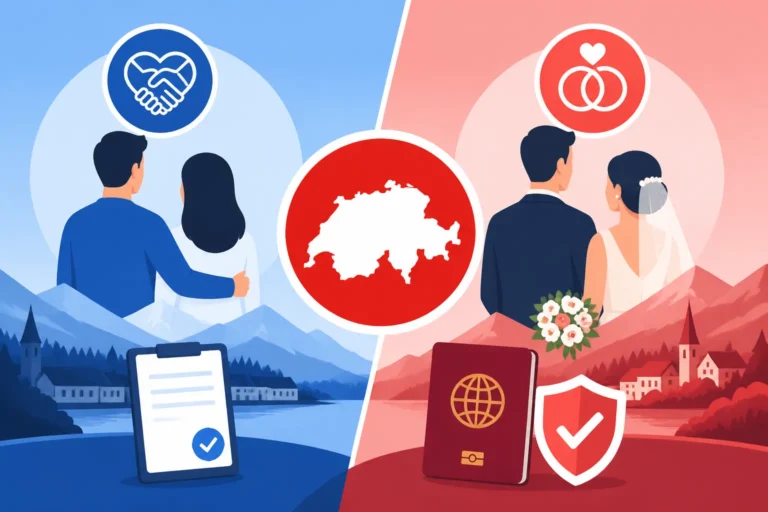
The term "concubinage" might sound like something out of a Victorian novel, but in Switzerland, it is the standard legal term for two people living together in a romantic relationship without being married or in a registered partnership. For expats, the challenge is that while Swiss society is very progressive about "living in sin," the immigration office (Migrationsamt) is decidedly old-school. They want proof that your relationship isn't just a convenient way to bypass the strict quotas for third-country nationals.
Defining a Stable Relationship
In the eyes of the Swiss authorities, a stable relationship—often called a faktische Lebensgemeinschaft—isn't just about love; it’s about shared domesticity. If you are applying for a residence permit based on your partner's right to live in Switzerland, you have to prove that your union is "marriage-like." This usually implies that you have lived together for a significant amount of time, typically at least two years, although this can vary by canton.
When I first looked into this, I was surprised to find that the authorities might even look at your joint bank accounts or shared lease agreements from your previous country. They are looking for a "will to unify," meaning you intend to stay together indefinitely. If you’ve only been dating for six months and haven't lived together yet, the path to a concubinage visa is going to be incredibly steep. You are essentially asking the canton to grant a permit to someone who doesn't technically have a legal claim under Family Reunification: Bringing Your Spouse and Children to Switzerland, so your evidence must be bulletproof.
The Legal Status of the Concubinage Partner
Unlike a spouse, a partner in a concubinage relationship has no automatic right to stay in Switzerland if the relationship ends. This is a hard truth many expats overlook. While a spouse has certain protections under What Happens to Your Spousal Visa if You Divorce a Swiss Citizen?, a concubinage partner is on much shakier ground. Your permit is usually "tied" to the main permit holder's status and the continuation of the relationship.
Furthermore, you don't have the same inheritance rights or social security benefits as a married couple. This is why many couples choose to draft a private cohabitation agreement (Konkubinatsvertrag). This document isn't usually required by the migration office, but it is highly recommended for your own protection to decide how assets, rent, and household costs are split if things go south. It’s about creating a safety net in a country where the cost of living can swallow you whole if you suddenly find yourself single.
The Concubinage Visa Application Requirements
If you are a non-EU/EFTA national trying to join a partner who is already in Switzerland (or moving there), the process is technically a "request for a permit with a financial guarantee." Because there is no federal "unmarried partner visa" written in stone, each canton has the discretion to say yes or no. This is where your paperwork needs to be impeccable.
Proving Your History Together
The migration office will ask for a "written history of the relationship." This isn't the time for a short summary; you need to provide a detailed narrative. When we went through this, we included a timeline of our relationship, photos from various years (with different haircuts to prove time has passed!), and even old flight itineraries from trips we took together.
You will also need to provide official documents proving your current civil status. The Swiss authorities need to know that neither of you is currently married to someone else. This often requires a "Certificate of No Impediment" or a "CENOMAR" depending on your home country. Because these documents must be in one of the official Swiss languages, I highly recommend using a certified service like RushTranslate to ensure the terminology matches what the cantonal officials expect. Any discrepancy in the translation can lead to weeks of delays, which is the last thing you want when your tourist visa is ticking down.
The Financial Guarantee (Verpflichtungserklärung)
This is the most critical part of the application. The partner already living in Switzerland (the "sponsor") must sign a formal declaration of financial responsibility. You are essentially telling the Swiss government, "If my partner runs out of money or needs medical care they can't afford, I will pay for everything."
The canton will check the sponsor’s salary to ensure they earn enough to support two people. They use strict calculations based on the local cost of living. If the sponsor’s income is deemed too low, the permit will be denied. You also need to prove that you have adequate health insurance. While you will eventually need to navigate Mandatory Registration: How to Sign Up for Health Insurance Within 90 Days, having a flexible international policy like Cigna Global during the application phase can provide the proof of coverage that the embassy requires before you even set foot in the country. It shows the authorities that the partner won't become a "public burden" from day one.
The Cohabitation Agreement and Local Registration
In some cantons, like Zurich or Geneva, the migration office may explicitly ask for a signed cohabitation agreement or a declaration of "solidarity." This is a document where you both swear under oath that you are in a long-term relationship and intend to live together in a shared household.
Once you arrive, you have a very tight window to make things official. You must follow The 14-Day Registration Rule: Signing Up at the Gemeinde/Commune to register your arrival. During this registration, you will present your visa or your application for the concubinage permit. Be prepared: the local Einwohnerkontrolle (Resident's Registration Office) can be very thorough. They will check if your apartment is large enough for two people. If you’re trying to squeeze two adults into a tiny studio, you might run into issues with Apartment Size Requirements (Rooms per Person) for Family Visas. The Swiss are very particular about living standards, and "overcrowding" is a legitimate reason for a permit refusal.
Comparing Legal Paths for Couples
It helps to see the requirements side-by-side. While the concubinage path is possible, it is undeniably more rigorous than the path for married couples.
| Requirement | Married Couples | Concubinage (Unmarried) |
|---|---|---|
| Legal Right to Entry | Guaranteed under Federal Law | Discretionary by Canton |
| Proof of Relationship | Marriage Certificate | Photos, letters, shared bills, history |
| Financial Guarantee | Generally assumed via marriage | Mandatory Verpflichtungserklärung |
| Work Authorization | Automatic for B-permit spouses | Dependent on the specific permit issued |
| Integration Agreement | May be required for some nationalities | Often mandatory for the partner |
| Translation Needs | Translation and Apostille Requirements for Marriage Certificates | Full relationship dossier translation |
The Step-by-Step Application Process
Navigating the bureaucracy requires a lot of patience. I remember the smell of stale coffee in the waiting room at the Kreisbüro and the feeling of my heart dropping every time the official frowned at a document. Here is the general flow you should expect.
Step 1: Preliminary Cantonal Inquiry
Before you even apply for a visa at the embassy, the partner in Switzerland should contact their cantonal migration office. Ask for the specific list of documents required for "concubinage." Every canton is its own little kingdom. Zurich might want one thing, while Vaud wants another.
At this stage, you’ll want to make sure your partner’s employer is on board, as they might need to provide a confirmation of employment and salary. If your partner is on a short-term permit, like the ones described in Residence Permits in Switzerland: L, B, C, and G Permits Explained, getting a concubinage visa for you is much harder than if they have a permanent C permit.
Step 2: The Visa D Application (For Non-EU)
If you are a third-country national, you cannot just show up and ask for a permit. You must apply for a Type D national visa from the Swiss embassy in your current country of residence. Along with your passport and photos, you will submit the mountain of evidence you’ve gathered—translated by a pro like RushTranslate—and the financial guarantee from your partner.
The embassy doesn't actually make the decision; they send your file to the canton in Switzerland. This can take anywhere from 8 to 12 weeks. During this time, you are in a state of "limbo." My advice? Don't quit your job or sell your house until you have the "Authorization for Entry" (Ermächtigung zur Visumerteilung) in your hands.
Step 3: Registration and the Biometric Card
Once the visa is approved, you travel to Switzerland and have 14 days to go to the local town hall. This is the process of Registering Your Address at the Kreisbüro Within 14 Days of Moving. You will be asked to provide your fingerprints and have a photo taken for your biometric residence card.
A few weeks later, your B permit will arrive in the mail. This is a glorious day! However, look closely at the "Remarks" section. For many concubinage partners, the permit will say "without gainful employment" (ohne Erwerbstätigkeit). This means you have the right to live there, but you don't yet have the right to work. To get work authorization, you’ll usually need to find a job first and have the employer "convert" your permit, which is a whole other mountain to climb.
Living in Switzerland as a Concubinage Couple
Once you have your permit, you are officially an "Ausländer" (foreigner) in the eyes of the Swiss state. This comes with a set of responsibilities that can be a bit of a culture shock.
Health Insurance and the 90-Day Clock
The moment you register at the commune, the clock starts ticking on your health insurance. In Switzerland, this is not optional. You must get a basic policy (KVG/LAMal). Even if it takes you two months to choose a provider, they will backdate your premiums to the day you arrived.
For a deep dive into how this works, read Is Basic Health Insurance (KVG) Mandatory for Expats? A Plain-English Guide. Because Swiss premiums are high, you’ll want to shop around. While waiting for your Swiss card to arrive, having that Cigna Global policy is a lifesaver for doctor visits, as many local doctors expect cash payments upfront if you can't produce a Swiss insurance card. You can then submit these receipts for reimbursement once your local coverage is sorted.
The Social Integration Expectation
Switzerland takes integration very seriously. As a partner on a concubinage visa, you might be asked to sign an "Integration Agreement." This usually involves proving you are learning the local language (German, French, or Italian) to a certain level (usually A1 or A2).
If you don't show progress, the migration office can actually refuse to renew your permit. I've seen it happen to people who lived in an "expat bubble" and never bothered to learn how to say more than "Grüezi." Take a course, join a local club, and show the authorities that you are making an effort to become part of the community. It makes the renewal process much smoother.
Managing Your Shared Household
In a concubinage relationship, you are legally two separate individuals. This means you should be careful about how you handle bills. Many Swiss couples open a joint account for "household expenses" but keep their main salaries separate.
If you are the partner who is not working, make sure the "sponsor" partner is actually paying your social security contributions (AHV). In Switzerland, even non-working residents must pay a minimum amount to the state pension fund. If you miss these payments, it can cause huge problems later if you ever apply for a C permit or citizenship. It’s those tiny administrative details that can really trip you up in the long run.
Common Pitfalls to Avoid
I’ve seen many couples fail the concubinage application because they underestimated the "Swiss-ness" of the process. Here are the three most common mistakes:
- Insufficient Apartment Size: As mentioned, Apartment Size Requirements (Rooms per Person) for Family Visas are real. If you move into your partner's 1-bedroom apartment, the commune might say it's too small for two people and deny your residency. Always check the square footage requirements for your specific canton before signing a lease.
- The "Tourist Visa" Trap: Don't think you can come as a tourist and "just switch" to a concubinage permit. Unless you are from a very small list of countries with special agreements, you usually have to be outside of Switzerland when the visa is processed. If you try to do it from within, the authorities might accuse you of "circumventing immigration laws" and ban you from applying for a year.
- Lacking a "Plan B": Relationships are unpredictable. Because your permit is tied to your partner, you need to know what happens if you break up. In most cases, you would have to leave the country almost immediately unless you find an employer to sponsor a work permit for you. It’s a cynical thought, but in a high-stakes country like Switzerland, you have to be realistic.
Comparison of Potential Costs for the First Year
Moving as a couple isn't just emotionally taxing; it's expensive. Here is a rough estimate of what you should budget for the administrative side of a concubinage move.
| Expense Item | Estimated Cost (CHF) | Frequency |
|---|---|---|
| Visa Application Fee | 80 – 150 | One-time |
| Document Translation (Professional) | 200 – 500 | One-time |
| Cantonal Permit Fee | 100 – 250 | Per year |
| Biometric Card Fee | 80 – 120 | Per issuance |
| Mandatory Health Insurance | 350 – 500 | Per month, per person |
| Language Course (Integration) | 500 – 1,500 | Per level |
| Cohabitation Agreement (Notary) | 300 – 800 | Optional but recommended |
Final Thoughts on Making it Work
Switzerland is a beautiful place to build a life with your partner, but the "gatekeepers" at the migration office aren't there to be your friends. They are there to follow the law. By being over-prepared, having your documents translated professionally by RushTranslate, and ensuring you have health coverage through a provider like Cigna Global during the transition, you remove the easy reasons for them to say "no."
I remember the day our "B" cards finally arrived in the mailbox. We sat on our balcony, looking at the mountains, and felt a massive weight lift off our shoulders. The paperwork was a nightmare, but the result—waking up every day in a place we love, together—was worth every single stamp and signature.
Disclaimer
This guide is for informational purposes only and does not constitute legal advice. Swiss immigration laws and cantonal practices change frequently. Always consult with the official website of the State Secretariat for Migration (SEM) or a qualified immigration lawyer before making major life decisions. The requirements for unmarried couples can vary significantly between cantons such as Zurich, Geneva, and Ticino.