Quiet Hours (Ruhezeiten): Sunday Rules for Laundry, Mowing, and Noise
You just moved into your dream flat in Zurich, and it is finally Sunday. You decide to catch up on the week’s laundry and—BAM—there is a frantic knocking on your door from a neighbor. I remember my first month in Basel, thinking I was being efficient by vacuuming at 1 PM on a Saturday, only to be met with a lecture on Mittagsruhe. This guide deciphers the unspoken and strictly written rules of Swiss quiet hours so you can avoid the dreaded passive-aggressive notes and legal fines.
The Philosophy of Ruhezeiten and Community Harmony
In Switzerland, silence is not just a preference; it is a collective social contract. The concept of Ruhezeiten (quiet hours) is deeply rooted in the Swiss desire for order and mutual respect. For many expats, this feels like an invisible set of handcuffs, but for the locals, it is the bedrock of a high quality of life. When everyone agrees to be quiet at the same time, everyone gets to rest. It is a system designed to keep stress levels low in a country where high-density apartment living is the norm.
The Legal Framework vs. The Hausordnung
While there are federal guidelines regarding noise, the real "law" you will live by is the Hausordnung (house rules). This is a document usually attached to your lease agreement that specifies exactly when you can and cannot make noise. Before you finalize your move through a platform like HousingAnywhere, make sure to ask for a copy of these rules. Some buildings are more relaxed, while others are governed by a "Blockwart" personality who treats the rules like a sacred text.
The cantonal laws provide a broad umbrella, but the building-specific rules can be even more restrictive. For example, while the city of Geneva might allow certain activities until 10 PM, your specific landlord might demand silence by 9 PM. It is also important to understand that Renting in Switzerland: The Complete 2027 Guide for Expats involves navigating these social expectations from day one. Failing to adhere to the Hausordnung can actually lead to the termination of your lease if you receive enough formal warnings.
Daytime Quiet Hours: The Sacred Lunch Break
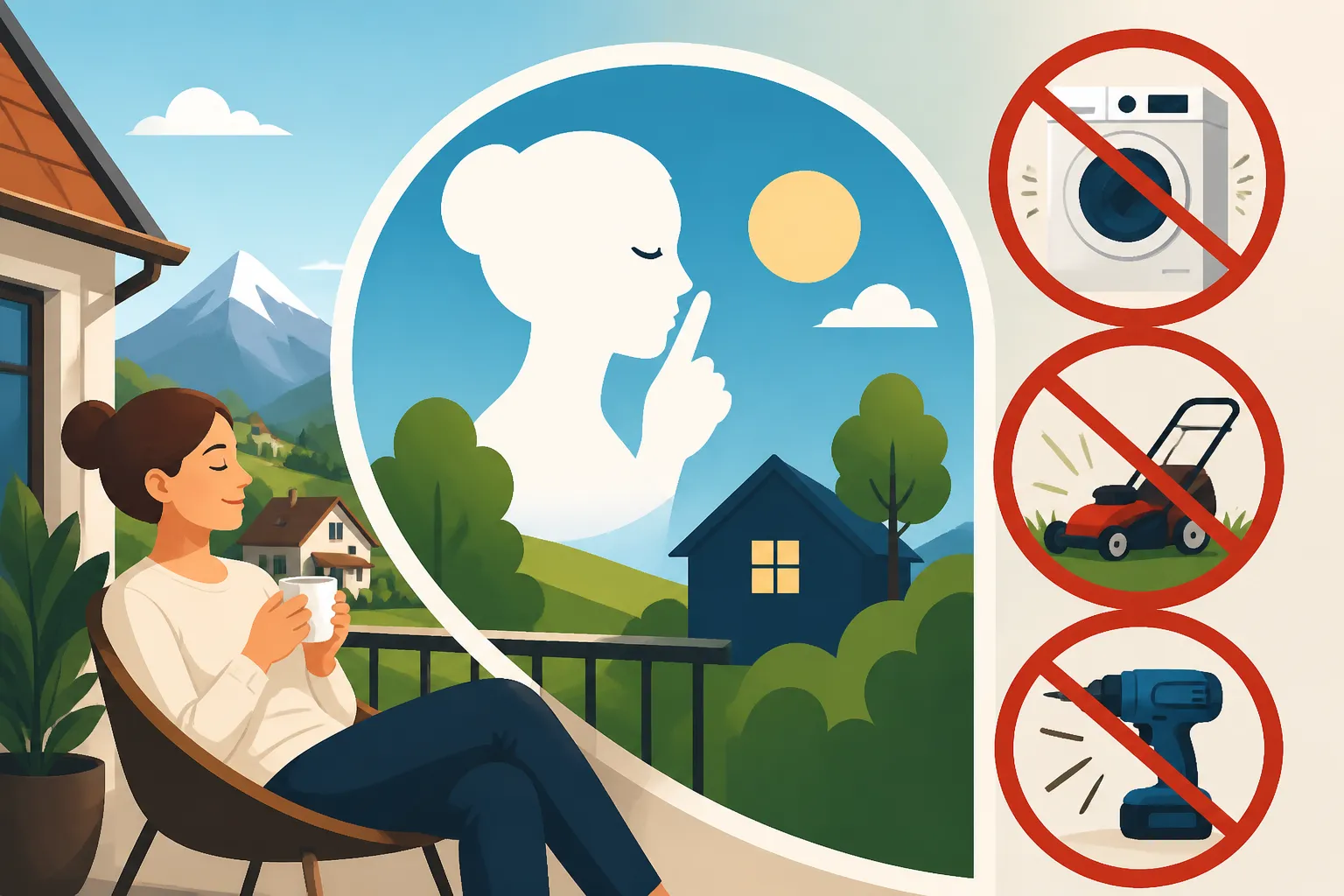
Many newcomers are surprised to learn that quiet hours exist in the middle of the day. This is known as Mittagsruhe, usually occurring between 12:00 PM and 1:00 PM (sometimes extending to 1:30 PM). During this hour, you are expected to refrain from "noisy" activities. This includes using power tools, mowing the lawn, or practicing the saxophone. The idea is that everyone, from office workers to retirees, should be able to enjoy a peaceful lunch.
I once made the mistake of trying to hang a gallery wall at 12:15 PM on a Tuesday. Within ten minutes, I heard a broom handle thumping against my floor from the neighbor below. It felt extreme, but in the Swiss mindset, I was stealing their hour of peace. If you are Working in Switzerland as an Expat: Jobs, Culture, and Employment Laws, you might not even be home during these hours, but on your days off, you must remember that the midday silence is strictly observed.
Sunday: The High Holy Day of Silence
Sunday in Switzerland is fundamentally different from Sunday in the US, UK, or even neighboring Germany. It is the "Ruhetag"—the day of rest. Almost all shops are closed, and the expectation of silence reaches its peak. If you grew up in a culture where Sunday is the day to catch up on DIY projects, mowing the lawn, or power-washing the driveway, you are in for a significant cultural adjustment.
The Laundry Taboo
One of the most frequent sources of conflict for expats is the Sunday laundry. In many older Swiss apartment buildings, the washing machine is located in a communal basement. These buildings often have a strict Managing the Shared Waschküche: Wash Calendars and Cleaning the Lint Filter system. Using these machines on a Sunday is almost universally forbidden because the vibration and noise of the spin cycle can travel through the plumbing and walls of the entire building.
Even if you have a private washing machine in your apartment, check your lease. Many Hausordnungen explicitly forbid using private machines on Sundays to prevent noise disturbance to neighbors. If you find yourself in a bind and absolutely need clean clothes, you might have to wait until Monday morning or risk a formal complaint. This is one of those Swiss Everyday Rules: Recycling, Quiet Hours, and Neighborhood Etiquette that seems trivial until you receive a stern letter from the building management.
Gardening and Outdoor Maintenance
If you are lucky enough to have a garden, Sunday is the day to enjoy it, not work on it. Motorized lawnmowers, leaf blowers, and hedge trimmers are strictly prohibited. The peace of a Swiss Sunday is a protected commodity. Even manual activities that create repetitive noise, like hammering a fence post or vigorously shaking out a heavy rug over a balcony, can be frowned upon.
The restriction also extends to glass recycling. You will notice that public recycling bins often have signs forbidding the dumping of glass on Sundays and public holidays. The clattering of bottles is considered a disruption of the peace. If you are struggling to adapt to these restrictions, just remember that everyone else is in the same boat. It forces a slower pace of life that, while frustrating at first, eventually becomes quite addictive.
Nighttime Rules and the Myth of the Flush
Nighttime quiet hours usually begin at 10:00 PM and last until 7:00 AM. This is the period of "Nachtruhe." During this time, all noise must be kept to "Zimmerlautstärke" (room volume). This means your TV, music, and conversations should not be audible through the walls.
Debunking the 10 PM Toilet Myth
There is a long-standing urban legend that it is illegal to flush your toilet after 10 PM in Switzerland. Let us clear this up: you can absolutely flush your toilet. Modern Swiss plumbing is quite good, and no judge is going to uphold a complaint against a basic bodily function. However, the myth persists because the underlying sentiment is true: you should avoid unnecessary water noise.
While flushing is fine, taking a long, high-pressure shower or filling a deep bathtub at 2 AM might result in a complaint if your building has thin walls. If you are curious about other common misconceptions, reading about Can You Flush the Toilet After 10 PM? Debunking Swiss Noise Myths will give you a better idea of what is reality and what is just expat lore. Generally, the rule is to be sensible. If you come home late, be mindful of heavy footsteps and slamming doors.
Entertaining Guests at Night
Socializing is part of life, but Swiss etiquette requires a "heads up" if you plan to have people over past 10 PM. A common practice is to put a small, polite note in the building's entrance or in each neighbor's mailbox a few days in advance. State that you are having a small gathering, apologize for any potential noise, and provide your phone number so they can text you if things get too loud.
This simple gesture goes a long way in building "Nachbarschaftshilfe" (neighborly help). If neighbors know you are mindful of their peace, they are much more likely to be lenient. However, even with a note, you are still expected to move the party indoors and turn down the music at the 10 PM mark. If you need to order supplies for a quiet night in, like soft rugs to dampen noise, you can often find what you need on Amazon Germany which delivers quite reliably to Switzerland.
Navigating the Shared Laundry Room Wars
The communal laundry room (Waschküche) is the battlefield where many expat-neighbor relationships are won or lost. Because of the quiet hour rules, the window of time available to wash clothes is limited, making the schedule highly competitive.
Understanding the Wash Calendar
Most buildings use a physical calendar or a digital booking system. You are assigned specific slots, and you must adhere to them strictly. If your slot ends at 8 PM, the machine must be empty and the room cleaned by 8 PM. Leaving your wet laundry in the machine for an extra hour is a major faux pas. It prevents the next person from starting their wash before the nighttime quiet hours kick in.
I have seen neighbors get into heated arguments over five minutes of overlap. To avoid this, be the most organized person in the building. Follow the rules for Managing the Shared Waschküche: Wash Calendars and Cleaning the Lint Filter to the letter. This includes wiping down the machine, cleaning the lint filter in the dryer, and mopping the floor. It sounds like overkill, but in Switzerland, cleanliness is the ultimate sign of respect for the next user.
Laundry Room Do's and Don'ts
| Activity | Permitted on Sundays? | Nighttime Rules (After 10 PM) |
|---|---|---|
| Washing Machine (Communal) | Strictly No | No |
| Washing Machine (Private) | Usually No (Check Lease) | No |
| Tumble Dryer | No | No |
| Hanging Clothes to Dry | Yes | Yes (Inside your flat) |
| Hand Washing Delicates | Yes | Yes |
Setting Up Your Life Without the Noise
When you first arrive, the urge to get everything set up immediately is strong. However, moving in is a noisy process that requires careful timing. If you are arriving on a weekend, try to schedule the heavy lifting for Saturday morning.
Arrival Logistics and Connectivity
Moving into a new place usually involves a lot of coordination. You will need to get your internet and mobile service sorted immediately to stay in touch with family. Using an eSIM from a provider like Airalo can be a lifesaver during those first few days when you haven't yet had time to visit a local shop. It allows you to stay connected without needing a physical SIM card or a noisy technician visit on your first day.
Once you are settled, you might want to look into more permanent solutions. Setting Up Swiss Home Internet: Swisscom, Sunrise, and Salt Compared is a great resource to ensure you have the bandwidth you need for work and entertainment without any disruptive installation delays. Remember that drilling holes for cables or mounting TV brackets must be done outside of quiet hours—never on a Sunday and never during Mittagsruhe.
Managing Deliveries and Furniture Assembly
Ordering furniture is another potential noise trap. If you order from Amazon Germany or local giants like Galaxus, the delivery might arrive in several large, heavy boxes. Dragging these across hardwood floors can be incredibly loud for the neighbor below. Invest in some felt pads (Filzgleiter) immediately.
Assemble your furniture during the mid-morning or mid-afternoon. Avoid the temptation to finish that IKEA wardrobe at 11 PM just because you want your bedroom to be finished. The sound of a hammer or an electric screwdriver at night is the fastest way to get a visit from the police. If you are unsure about the assembly times, checking the Handover Protocol (Übergabeprotokoll): Documenting Damages to Protect Deposits can sometimes yield clues about the building's specific sensitivities regarding noise and floor protection.
Practical Tips for Conflict Resolution
Even if you follow every rule, you might still encounter a neighbor who is particularly sensitive. The Swiss culture of "direct but polite" intervention can be jarring if you are used to people minding their own business.
The Ten-Minute Grace Period
Usually, the Swiss will give you a "ten-minute grace period." If you are vacuuming and it hits 12:00 PM, you have about five to ten minutes to finish up before a neighbor feels justified in complaining. If you know you are going to be loud for a short burst (e.g., you dropped a jar of pickles and need to vacuum the glass), most people will understand. The problem arises when the noise is persistent and shows a lack of awareness of the clock.
How to Handle a Complaint
If a neighbor knocks on your door, do not get defensive. The best approach is to apologize immediately, even if you think they are being unreasonable. A simple "Entschuldigung, ich habe nicht auf die Uhr geschaut" (Sorry, I didn't look at the clock) usually de-escalates the situation instantly.
If the complaints persist and you feel you are being targeted unfairly, it might be worth joining a tenant's association. Learning How Much Does ASLOCA Membership Cost? (CHF 50-80 Guide) can provide you with legal protection and advice on how to handle unreasonable landlords or neighbors. Often, just knowing your rights and the specific wording of the law can stop a "noise bully" in their tracks.
Important Disclaimer
The information provided in this guide is for informational purposes only and does not constitute legal advice. While we strive to provide the most up-to-date and accurate information regarding Swiss quiet hours and housing regulations, local and cantonal laws can change. Always refer to your specific lease agreement (Hausordnung) and consult with a legal professional or a tenant's association like ASLOCA or Mieterverband for advice on your specific situation. Adherence to local customs and rules is the responsibility of the individual resident.