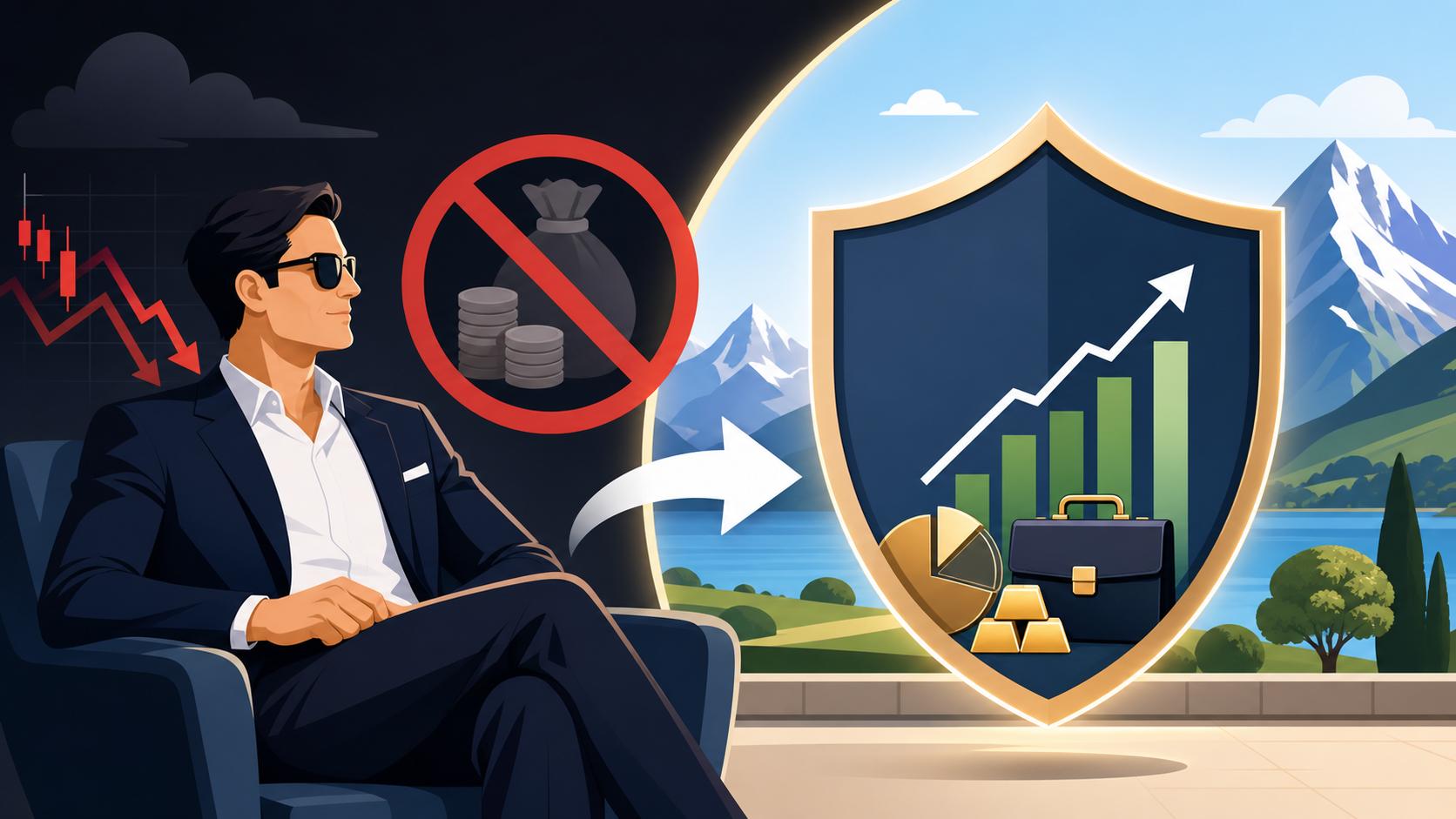
Professional Investor Status: How to Avoid Capital Gains Taxes in Switzerland
The primary nightmare for any expat investor in Switzerland is waking up to a tax bill that treats your hard-earned stock market gains as regular income. I remember the cold sweat I felt during my second year in Zurich, staring at a stack of trading confirms and wondering if the Steueramt would decide I was a "pro." This guide breaks down how to avoid that label and keep your gains tax-free.
The Golden Rule of Swiss Private Investing
Switzerland is famous among the global expat community for one incredible perk: there is generally no capital gains tax on private movable assets. This means if you buy shares of a tech giant or a handful of Bitcoin and sell them for a profit, you typically get to keep every single cent of that gain. In a world where most countries take a 15% to 35% cut, this is a life-changing advantage for building long-term wealth.
However, this "tax-free" status is not a divine right; it is a conditional exemption for "private" investors. The moment the Swiss Federal Tax Administration (ESTV) decides your trading activity looks more like a business than a hobby, they will reclassify you as a "Professional Investor." This shift is catastrophic for your finances because your capital gains are then taxed as self-employment income. Not only do you pay the high progressive income tax rates, but you also get hit with social security contributions (AHV). If you are already working a high-paying job in Basel or Geneva, adding another CHF 50,000 in "trading income" can push your tax bracket into painful territory.
To navigate this, you must understand the nuance of the Capital Gains Tax in Switzerland: The Tax-Free Stock Market Rule. The tax authorities don't have a single "hard" line, but they do have a "Safe Harbor" policy. If you stay within these lines, you are legally protected from the professional classification. If you step outside them, you enter a "grey zone" where a tax auditor has the discretion to judge your intent. This is why many expats using modern, high-frequency platforms like Trade Republic need to be particularly careful about their trading cadence.
The Five Pillars of the Safe Harbor Rules
The ESTV circular No. 36 outlines five specific criteria that, if met, guarantee you will be treated as a private investor. Think of these as your suit of armor during tax season. While failing one doesn't automatically make you a professional, it does mean the tax office will look much closer at your Swiss Taxes Explained: Federal, Cantonal, and Municipal Rates to see if you are trying to game the system.
The Six Month Holding Period
The most important rule is the duration of your investment. To stay safe, you must hold any security for at least six months before selling it. This is specifically designed to separate "investors" from "day traders." When I first moved here, I was tempted to flip stocks during the volatile earnings seasons, but I quickly realized that the tax savings of the six-month rule far outweighed the small gains of a quick trade.
If you are using a platform like Binance to trade crypto, this rule becomes even more critical. High-frequency "scalping" or day-trading is the fastest way to get flagged. The tax office wants to see that you are participating in the long-term growth of an asset, not just exploiting market micro-fluctuations.
The Transaction Volume Limit
Your total capital gains in a calendar year should not exceed 50% of your total net income. This rule exists to ensure that your primary source of livelihood remains your job or your business, not your portfolio. If you earn CHF 120,000 at a pharmaceutical company in Basel but make CHF 200,000 trading options on the side, the tax office will logically conclude that you are a professional trader who happens to have a side job.
For most of us, this isn't an issue in the early years. But as your portfolio grows, or if you experience a "moon" event with a specific stock or token, you might find yourself hitting this ceiling. In those years, it is often wiser to delay selling a portion of your holdings until the next tax year to keep your ratios balanced. This is a common strategy when Filing a Swiss Tax Return (C Permit or High Earners on B Permit) to avoid accidental reclassification.
The Capital Gains vs. Net Income Ratio
Another metric the ESTV looks at is the "transaction volume." The total sum of all your purchases and sales in a year should not exceed five times the value of your portfolio at the start of the year. For example, if you start the year with CHF 100,000 in your brokerage account, you shouldn't trade more than CHF 500,000 in total volume.
This sounds like a lot, but if you are "churning" your portfolio—constantly selling one ETF to buy another—you can hit this limit surprisingly fast. If you are regularly moving funds via Wise to fund your brokerage accounts, keep an eye on your total yearly inflows and outflows. Excessive movement of cash suggests a level of professional activity that the "buy and hold" private investor simply doesn't exhibit.
Understanding the Professional Label Consequences
If you are deemed a professional investor, the tax man doesn't just ask for a small percentage; they treat you like a small business. This means your gains are added to your salary, and you are taxed on the total. In many cantons, this can mean losing 25% to 40% of your profit to the tax office.
The Social Security Trap
Perhaps the most overlooked consequence is the social security impact. In Switzerland, self-employed individuals must pay their own AHV (Old-Age and Survivors' Insurance) and ALV (Unemployment Insurance) contributions. When your capital gains are reclassified as income, the AHV office will come knocking for their roughly 10% cut.
This is where Understanding Swiss Payslips: Deductions for AHV, ALV, and NBU becomes so relevant. When you are an employee, your company handles half of these costs. As a "Professional Investor," you are the employer and the employee, meaning you bear the full weight. I have seen expats lose nearly half of their "tax-free" profits because they traded too aggressively and triggered these mandatory contributions.
Wealth Tax and the Offsetting Myth
It is also a common misconception that if you are a professional investor, you can at least deduct all your losses. While true, the Swiss tax system is designed so that the bar for deducting losses is quite high, and the paperwork is a nightmare. As a private investor, you cannot deduct capital losses, but since you don't pay tax on gains, it’s a fair trade. Most expats are much better off staying in the private category, even if it means they can't write off a bad year on the market.
| Criteria | Private Investor (Tax-Free) | Professional Investor (Taxed) |
|---|---|---|
| Holding Period | At least 6 months | Less than 6 months (Day trading) |
| Transaction Volume | < 5x portfolio value | > 5x portfolio value |
| Income Source | Main income from employment | Gains > 50% of total income |
| Financing | Personal savings only | Significant use of loans/leverage |
| Derivatives | Used for hedging only | Used for speculation/income |
Navigating Modern Platforms and Crypto
The rise of user-friendly apps has made it easier than ever to fall into the "professional" trap. When you use an app like Trade Republic, the interface is designed to make trading feel like a game. The ease of clicking "buy" and "sell" can lead to a transaction volume that exceeds the safe harbor limits before you even realize it.
Leveraging Wise and Trade Republic Safely
If you are funding your investments using Wise to convert your home currency into CHF or EUR, you are already being smart about fees. However, the tax office looks at the source of your investment capital. One of the safe harbor rules is that you must not use "outside financing" to fund your investments. This means no trading on margin. If you take out a personal loan to buy stocks, or even if your brokerage account has a significant margin debt, the Swiss authorities will almost certainly label you a professional. They view "leverage" as a hallmark of professional risk-taking.
The Binance and Crypto Grey Zone
Crypto is where the ESTV is currently focusing its most intense scrutiny. Because the Crypto Taxation in Switzerland: Declaring Bitcoin and Staking Rewards system is still evolving, many expats assume the "no capital gains" rule is a free-for-all. It isn't. If you are using Binance to stake tokens, provide liquidity, or engage in "yield farming," those activities generate "income," not capital gains.
Income from staking is taxed as wealth income (like dividends), but the frequency of these rewards can sometimes make your entire crypto portfolio look like a professional operation. If you are an active DeFi user, it is vital to keep meticulous records. The Swiss tax office is increasingly sophisticated at tracking blockchain transactions, and "forgetting" to report your Binance gains is a recipe for a heavy fine and a professional classification.
Wealth Tax: The Fee You Can't Avoid
Even if you successfully maintain your private investor status and avoid capital gains tax, you are not totally off the hook. Switzerland has a "Wealth Tax" (Vermögenssteuer). This is a small annual tax (usually between 0.1% and 0.5% depending on your canton) on your total net worth, including your stocks, crypto, and bank balances.
You must declare the "tax value" of your portfolio as of December 31st every year. For stocks, this is usually the closing price on the last trading day. For crypto, the ESTV publishes an official year-end exchange rate for major coins like Bitcoin and Ethereum. This is a crucial part of Banking and Finance for Expats in Switzerland: The 2027 Guide. Many expats are shocked that they have to pay tax on a portfolio that has decreased in value, but that is the nature of the wealth tax.
To ensure you have the cash on hand to pay this, I always recommend setting aside a small percentage of your dividends. While the wealth tax is low, it is mandatory, and failing to report global assets—even those held in a brokerage account back in your home country—can lead to severe penalties. For a deeper dive into how this is calculated, check out Wealth Tax in Switzerland: How Global Assets Are Assessed.
Practical Steps to Protect Your Status
If you want to sleep soundly and keep the "Professional" label far away from your tax file, there are several proactive steps you can take. Most of these are about discipline and record-keeping.
- Avoid Margin Trading: Never use the "leverage" or "margin" features on your brokerage. Using borrowed money to invest is the "smoking gun" the tax office uses to prove you are a professional.
- The Six-Month Rule is Sacred: If you buy a stock, commit to holding it for 181 days. If you absolutely must sell sooner due to a company emergency, ensure it is a one-off event and not a pattern.
- Watch Your Derivatives: Trading options or futures is viewed with extreme suspicion. If you use them, ensure they are for "hedging" (protecting your existing stocks) rather than "speculation." If your gains from options exceed your gains from the underlying stocks, you are in the danger zone.
- Use Pillar 3a for Active Bets: If you want to be more aggressive with your investments without worrying about the professional label, consider doing so within the tax-sheltered environment of a 3a account. However, remember that Is Pillar 3b Worth It for Expats? Tax Inefficiencies Explained because "3b" (unrestricted) accounts don't offer the same shield against the professional classification rules as the standard private holdings do.
- Diversify Your Income: The more "stable" your primary employment income is, the less likely the tax office is to care about your side investments. If you are unemployed and living off your stock gains, you are almost guaranteed to be classified as a professional.
By staying within these boundaries, you can enjoy one of the greatest financial benefits of living in Switzerland. The "no capital gains" rule is a powerful tool for building generational wealth, provided you don't get greedy and try to play the market like a Wall Street pro. Stay boring, stay long-term, and keep your gains for yourself.
Disclaimer
This article is for informational purposes only and does not constitute professional tax, legal, or financial advice. Swiss tax laws are complex and vary significantly between cantons. Regulations regarding professional investor status and capital gains are subject to change and interpretation by local tax authorities. Always consult with a qualified Swiss tax advisor or "Steuerberater" before making significant investment decisions or filing your tax return.