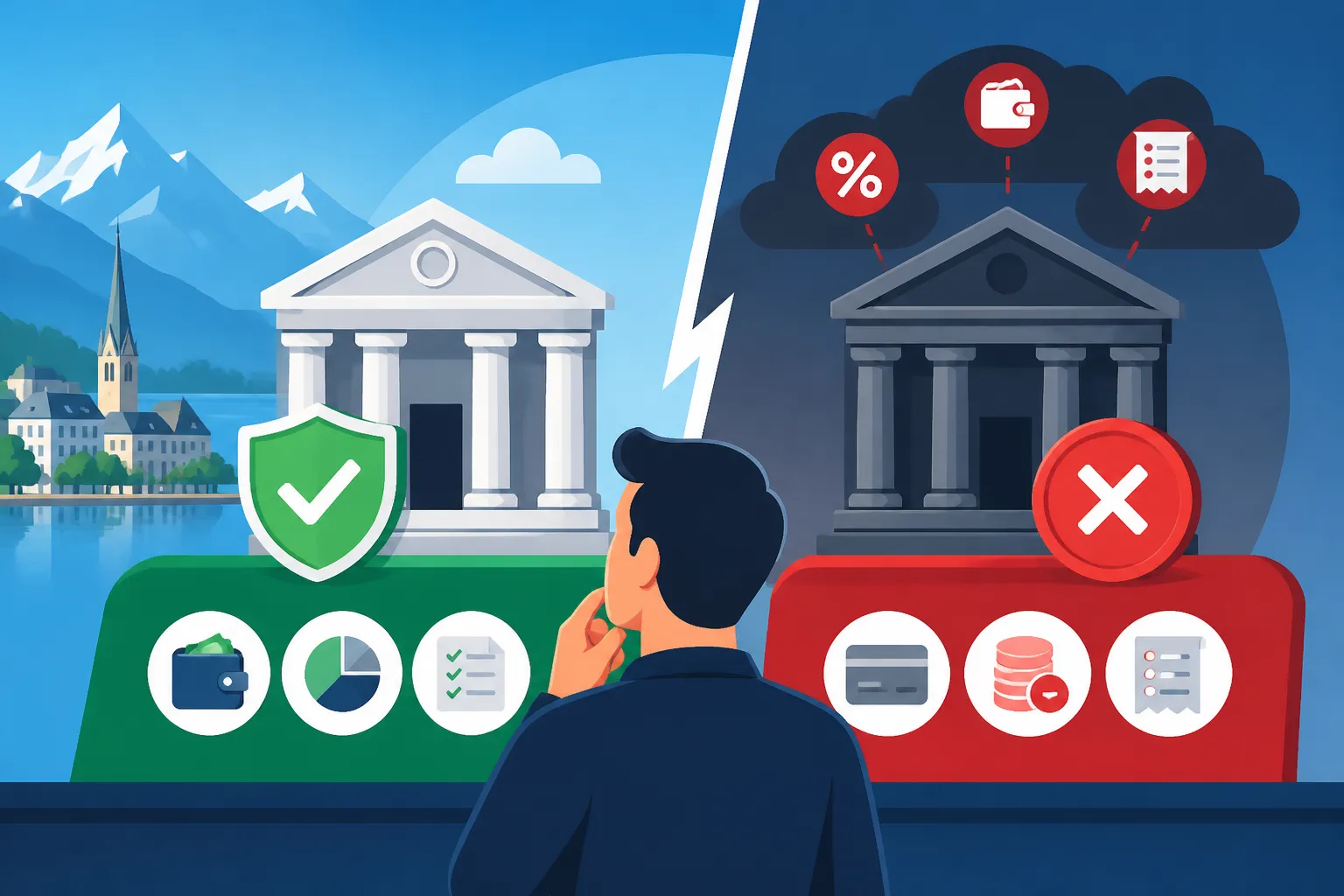
Swiss Bank Account Monthly Fees Compared: Avoiding Hidden Charges
Moving to Switzerland often comes with the expectation of high-quality services, but many newcomers are stunned by the sheer number of fees associated with basic banking. From monthly maintenance charges to "postal fees" for digital accounts, the costs add up quickly. This guide breaks down the complicated fee structures of Swiss banks to help you keep more of your hard-earned francs.
The Hidden Reality of Swiss Banking Costs for Expats
When I first arrived in Zurich, I walked into a major bank thinking I’d get a simple checking account for a few francs a month. I was quickly disabused of that notion. In Switzerland, banking is rarely a "free" service unless you are a student or have a very high net worth. For the average expat, the base fee is just the starting point of a much longer list of micro-charges that can easily exceed 300 CHF per year if you aren't careful.
One of the most frustrating hurdles is the non-resident surcharge. If you haven't yet secured your local residence permit or if you maintain a home address outside of Switzerland, many traditional banks will slap on a "domiciliation fee" that can range from 20 to 40 CHF per month. This is on top of the standard account fee. It’s a bitter pill to swallow when you’re already dealing with the high Cost of Living in Switzerland 2026: Budgeting for Singles and Families. Even once you have your permit, you must be proactive in updating the bank to stop this charge, as they rarely do it automatically.
Then there is the infamous "Porto" or postal fee. You might think that by opting for "e-documents," you’ve escaped the cost of physical mail. However, some banks still charge a quarterly "administration fee" for generating those PDFs. I once spent thirty minutes on the phone arguing over a 2 CHF fee for a digital statement, only to realize that this was simply "the Swiss way." Understanding these nuances is a key part of your Financial Checklist for Your First 30 Days as an Expat in Switzerland.
Finally, keep an eye on the "closing fees." If you decide to switch banks because you found a better deal, your old bank might charge you 50 CHF or more just to shut down the account. They call it an "administrative processing fee," but to most expats, it feels like a parting tax. Always read the fine print before you sign the opening documents, particularly the sections regarding account termination and data transfer.
Comparing Monthly Maintenance Fees Among Major Players
The Swiss banking landscape is divided into three main categories: the global giants (like UBS), the cantonal banks (like ZKB or BCV), and the newer digital-first neobanks. Each has a drastically different fee philosophy. If you are a high-earner on a B permit, your needs will differ significantly from someone just starting out. You can learn more about how your residency status affects your finances in our guide on Withholding Tax (Quellensteuer) vs Standard Taxation for Foreigners.
Traditional Giants: UBS and the Post-Merger Landscape
UBS is often the default choice for expats because they have excellent English-speaking support and a presence in every major city. However, they are also among the most expensive. Their "Global" or "Individual" packages typically start around 10 to 15 CHF per month. While this includes a debit card and a couple of accounts, it rarely covers everything. If you want a credit card with decent rewards, expect to pay a higher tier or an annual card fee.
The value proposition for these big banks often lies in their integrated services. If you are looking to set up a Pillar 3a in 2026: Tax Deductions, Limits, and Investment Options, having everything under one roof might seem convenient. However, you pay a premium for that convenience. I’ve found that many expats stick with UBS because they are the only ones who make Opening a Swiss Bank Account: UBS, ZKB, PostFinance, and Neobanks feel straightforward for Americans or those with complex tax situations.
PostFinance: The Middle Ground
PostFinance was traditionally the "cheap" option, but those days are largely over. They now charge a flat 5 CHF monthly fee for their basic private account. While this is lower than UBS, it doesn't include as many "free" ATM withdrawals at non-PostFinance machines. For a veteran expat, PostFinance remains a solid choice because of their ubiquitous yellow ATMs, but you have to be careful about the additional services that can push the monthly cost higher.
One thing to watch with PostFinance is their threshold for free banking. In the past, keeping a balance of 7,500 CHF would waive your fees. Nowadays, that limit is much higher or has been replaced by requirements to hold investment products or mortgages with them. For the average person just looking for a place to park their salary, you should expect to pay that 60 CHF per year regardless of your balance.
The Rise of Swiss Neobanks: Neon, Yuh, and Zak
If you want to truly avoid monthly fees, the neobanks are your best bet. Apps like Neon and Zak have disrupted the market by offering accounts with zero monthly maintenance fees. Neon, for example, has no base fee and offers one of the best exchange rates for spending abroad. This is a game-changer for people who frequently travel to neighboring Germany or France for weekend trips.
Yuh, a joint venture between PostFinance and Swissquote, is another popular option that focuses on ease of use and small-scale investing. These digital players are essential for anyone trying to optimize their budget. For a deeper dive into these options, check out our comparison of the Best Neobanks in Switzerland: Neon, Yuh, and Zak Compared. The trade-off is that you won't have a physical branch to visit if things go wrong, but for most digital natives, the savings are worth the risk.
| Bank Provider | Basic Monthly Fee | Non-Resident Surcharge | ATM Fee (Other Banks) |
|---|---|---|---|
| UBS | 10 – 15 CHF | 30 – 40 CHF | ~2 CHF |
| PostFinance | 5 CHF | 25 CHF | 2 CHF |
| ZKB (Cantonal) | 8 – 12 CHF | Varies by Canton | Free in Cantonal network |
| Neon | 0 CHF | Not Available | 2 free per month |
| Yuh | 0 CHF | Not Available | 1 free per week |
Decoding the Extra Charges: ATM Withdrawals and Foreign Transfers
The monthly fee is just the tip of the iceberg. The real "hidden" charges happen during daily transactions. In most countries, using an ATM is free if you stay within your bank's network. In Switzerland, even within the network, some "basic" accounts limit you to a certain number of free withdrawals per month. Go over that limit, and you’ll be paying 2 CHF every time you need cash for a mountain hut or a local market.
Foreign currency exchange is where traditional Swiss banks really make their money. When you use your Swiss debit card to buy something in Euros, the bank doesn't just charge a transaction fee (usually 1.5% to 2.5%); they also give you a terrible exchange rate. This "spread" is a hidden fee that most people never notice because it isn't listed as a separate line item on their statement.
This is why I always recommend using Wise for international needs. If you are sending money back home or paying a bill in another country, Wise offers the mid-market exchange rate with a transparent, low fee. Traditional Swiss banks will often charge a flat 5 to 20 CHF for an international wire, plus the hidden currency markup. Over a year of sending money home, using Wise can save you enough for a very nice dinner in the Alps. For more on this, see our guide on Cheapest Ways to Transfer CHF Abroad: Wise vs Revolut vs Swiss Banks.
Another charge to watch is the "Search Fee." If you lose a transaction record or need the bank to dig up a document from three years ago, they will charge you by the hour. I’ve seen bills for 50 CHF just to find a single proof of payment. It pays to be organized. Save every PDF and keep a digital folder of your banking history to avoid these punitive "human intervention" fees.
Strategies to Minimize Your Annual Banking Costs
The most effective way to avoid fees is to use a "hybrid" banking strategy. Many expats use a traditional bank like UBS or a Cantonal bank to receive their salary and pay their rent. This gives you the security of a physical branch and the necessary documents for residency and tax purposes. However, for daily spending, groceries, and travel, they switch to a neobank or Wise.
When it comes to tax time, the complexity of Swiss banking can become a headache. If you have accounts in multiple currencies or significant assets, you may find that the "Tax Statement" provided by your bank costs 50 to 100 CHF. For US citizens especially, these statements are vital for FBAR and FATCA reporting. Many of my friends use Taxes for Expats to navigate this. Taxes for Expats specializes in helping Americans living abroad stay compliant without losing their minds over Swiss bank paperwork.
Another pro tip: check the "Package" vs. "A la Carte" pricing. Sometimes, a bank will try to sell you a 20 CHF monthly package that includes "free" travel insurance and a credit card. If you already have insurance through your work or a private provider, you are paying for something you don't need. Switching to a bare-bones account and getting a separate, free credit card can save you 150 CHF a year.
Finally, don't be afraid to negotiate. If you are a long-term resident with a C permit, or if you are Filing a Swiss Tax Return (C Permit or High Earners on B Permit) and showing a significant income, your bank might be willing to waive some fees to keep your business. It doesn't always work, but in a country where "loyalty" is highly valued, a polite conversation with your account manager can sometimes lead to a "special discount" on your monthly maintenance.
Remember that keeping your accounts compliant is just as important as saving on fees. Using a service like Taxes for Expats ensures that even if you have several small accounts to avoid fees, you aren't accidentally triggering a massive fine from your home country's tax authority. Taxes for Expats provides the expert oversight needed to manage the cross-border financial life of a modern resident in Switzerland.
Important Disclaimer
The information provided in this guide is for educational and informational purposes only. Banking fees, terms, and conditions in Switzerland are subject to frequent change by the respective financial institutions. Always consult the official fee schedules of a bank before opening an account. This content does not constitute financial, legal, or tax advice. For specific tax concerns, especially for US citizens, please consult with a qualified professional.