Joint vs Separate Bank Accounts for Expat Couples in Switzerland
Moving to Switzerland often feels like a full-time job in administration. Between the mountain of residency paperwork and the search for an apartment that doesn’t require a kidney as a deposit, couples must face a crucial financial decision: how to structure their banking. This guide breaks down the cultural, legal, and practical realities of joint versus separate accounts for expats navigating the Swiss system.
The Swiss Banking Landscape for Couples
When you first arrive, you’ll notice that Switzerland remains a surprisingly traditional society in its administrative structures, yet it offers some of the most sophisticated financial tools in the world. For expat couples, the choice isn't just about convenience; it’s about how the Swiss authorities, tax offices, and landlords perceive your household. Whether you are moving to Zurich for a tech role or Geneva for an NGO, your banking setup will dictate how smoothly you can pay your bills and manage your wealth tax obligations.
One of the first things you’ll encounter is the concept of joint liability. In Switzerland, a joint account usually operates under a "solidarity" principle. This means either partner can typically withdraw the full balance without the other’s signature, but it also means both are equally liable for any debts or overdraws. If you are just starting your journey, reviewing a Financial Checklist for Your First 30 Days as an Expat in Switzerland can help you prioritize these banking decisions alongside your residence permit.
For many newcomers, the instinct is to open a joint account immediately to prove "integration" or shared household status to a landlord. However, the Swiss system is perfectly comfortable with separate accounts, especially for unmarried couples living in what is locally known as a "Konkubinat." If you are in this category, it is vital to understand the nuances of Can I Open a Joint Bank Account in Switzerland if We Aren't Married? before approaching a major bank like UBS or ZKB, as their requirements for non-married partners can sometimes be more stringent.
The Case for Separate Accounts: Privacy and Tax Precision
Maintaining individual accounts is becoming the standard for many modern expat couples in Switzerland, particularly those where both partners are working. Switzerland is an expensive country, and having your own "financial bucket" allows for a level of autonomy that can prevent friction. When you are both earning Swiss-level salaries, the sheer volume of transactions for personal hobbies, professional development, or individual travel can make a shared statement look like a confusing mess.
From a tax perspective, separate accounts can actually simplify your life. Switzerland has a wealth tax, and you are required to declare every cent held in your accounts as of December 31st each year. If you have complex international assets, keeping your Swiss income separate from your pre-move savings makes it much easier for firms like Taxes for Expats to help you file accurate returns in both Switzerland and your home country. This is especially true for those who might still be Filing a Swiss Tax Return (C Permit or High Earners on B Permit).
The biggest downside of separate accounts in the past was the cost. Swiss banks are notorious for their monthly maintenance fees, which can range from CHF 5 to CHF 30 per account. However, the rise of Swiss neobanks has changed the game. You can now maintain separate accounts with zero monthly fees by Comparing Best Neobanks in Switzerland: Neon, Yuh, and Zak Compared. When you need to move money between your separate accounts or send funds back home, using a service like Wise is often much more cost-effective than a traditional bank-to-bank transfer, which can be riddled with hidden exchange rate markups.
The Case for Joint Accounts: Transparency and Shared Costs
Despite the rise of individual banking, the joint account remains a powerful tool for managing a Swiss household. Life in Switzerland involves a high number of recurring, high-value monthly payments. Rent for a modest apartment in a major city, mandatory health insurance premiums for two people, and the quarterly The Serafe Fee 2026: Paying the Mandatory CHF 335 Media Tax can easily total CHF 5,000 or more per month. Having a single account where both partners contribute a fixed amount makes managing these "fixed costs" significantly easier.
A joint account also serves as a safety net. If one partner handles the majority of the administrative tasks—common when one spouse is the primary permit holder and the other is still searching for work—a joint account ensures that both have immediate access to Swiss Francs for daily necessities. This is particularly relevant if you are Finding an English-Speaking Family Doctor in Major Cantons and need to pay for a consultation or medication on the spot, as Swiss medical billing can sometimes require upfront payment depending on your insurance model.
However, be aware of the "blocking" risk. In the unfortunate event that one partner passes away, some Swiss banks have the right to temporarily freeze joint accounts until the inheritance process is clarified. This is a cold reality that veteran expats often warn newcomers about. To mitigate this, even if you rely heavily on a joint account, each partner should maintain at least a small individual "emergency" fund. When setting up these accounts, many expats use Wise to transfer their initial relocation capital into the joint account to avoid the poor exchange rates offered by their legacy banks back home.
The Three-Account Strategy: The Veteran Expat’s Choice
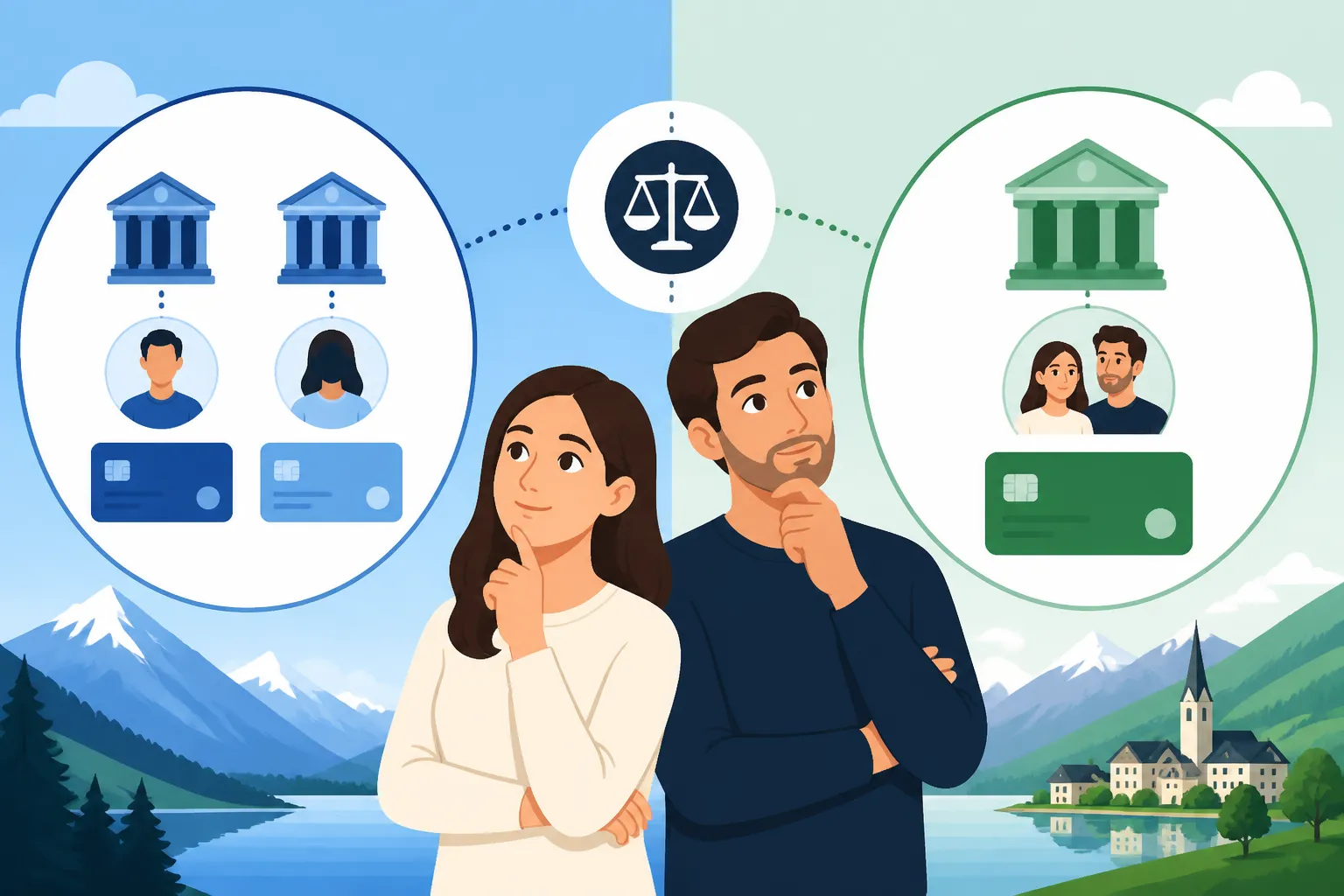
After a few years in the Alps, most expat couples eventually settle on a hybrid model often called the "Three-Account Strategy." This setup involves three distinct accounts: one personal account for Partner A, one personal account for Partner B, and one shared "Household Account."
Here is how the workflow typically looks for a couple living in a city like Basel or Bern:
- Both partners receive their salaries into their respective private accounts.
- On the first of the month, each partner transfers a pre-agreed amount (either 50/50 or proportional to income) into the joint account.
- All shared expenses—rent, groceries at Migros or Coop, utilities, and internet—are paid from the joint account.
- Personal expenses—clothes, individual gym memberships, or that expensive Friday night apéro with colleagues—come from the private accounts.
This model strikes a perfect balance. It provides transparency for the "big" Swiss expenses while preserving individual freedom. It also makes it much simpler to track your Out-of-Pocket Maximums: Calculating Your True Annual Healthcare Costs because all medical-related payments can be funneled through one card. For those who want to keep fees low while maintaining this three-account structure, Swiss Bank Account Monthly Fees Compared: Avoiding Hidden Charges provides a roadmap for which banks allow for multiple sub-accounts without doubling your costs.
Comparison of Banking Options for Expat Couples
| Feature | Separate Accounts Only | Joint Account Only | The Hybrid (3-Account) Model |
|---|---|---|---|
| Administrative Simplicity | Low (constant transfers needed) | High (everything in one place) | Medium (requires 1 monthly transfer) |
| Financial Autonomy | Maximum | Minimum | High |
| Monthly Fees | Can be high if using traditional banks | Generally lower (one set of fees) | Can be optimized with Neobanks |
| Tax Reporting | Very clear for individual assets | Can be complex for wealth tax split | Clear separation of assets |
| Emergency Access | Limited to own funds | Full access to shared funds | Balanced access |
Special Considerations for US Citizens and TCNs
If one or both of you are United States citizens, your banking choices are governed by a different set of rules entirely. Due to FATCA (Foreign Account Tax Compliance Act), many Swiss banks are hesitant to open accounts for Americans, and even fewer are willing to offer joint accounts where one partner is a "US Person" and the other is not. This often forces American expat couples into keeping separate accounts by default.
When navigating this, it is essential to work with professionals like Taxes for Expats who understand the reporting requirements of Form 8938 and the FBAR. Opening a joint account as a US person in Switzerland can lead to significant paperwork for the non-US partner, who may suddenly find themselves subject to IRS reporting requirements simply by having their name on the account. To find a way through this, check our guide on Opening a Swiss Bank Account as a US Citizen: Banks That Still Accept You.
For Third-Country Nationals (non-EU/EFTA), your permit status (L vs. B permit) may also influence how easy it is to open a joint account in your first few months. Some cantonal banks prefer to see a B permit and a signed employment contract before granting joint access. If you are still waiting for your physical card, you might need to rely on separate accounts or a Wise multi-currency account to manage your initial CHF expenses until your residency status is fully finalized.
Managing the Practicalities: TWINT and Bill Pay
Regardless of the account structure you choose, you will quickly discover that Switzerland runs on two things: QR-bills and TWINT. TWINT is the national digital payment app, and it is usually linked to a single bank account. If you choose separate accounts, you will each have your own TWINT linked to your own funds. If you have a joint account, you can often both link to the same account (depending on the bank’s app capabilities), making it incredibly easy to split a dinner bill or pay for a find at a local "Brockenhaus."
Learning How to Set Up and Use the TWINT Payment App as an Expat is a rite of passage. If you go with the hybrid model, many couples link their TWINT to their personal accounts for small daily spends and use the joint account’s debit card for the weekly grocery run. This keeps the joint account statement clean and focused on major household items.
Finally, remember that Swiss banking is a "sticky" relationship. Once you have your accounts set up, your salary, insurance, and rent will all be tied to those IBANs. Changing them later is a logistical headache involving dozens of phone calls and updated forms. Take the time in your first month to decide which structure fits your relationship and your long-term goals in Switzerland. Whether you are saving for a down payment or just trying to survive the high cost of living, your banking setup is the foundation of your Swiss life.
Disclaimer
The information provided in this article is for informational purposes only and does not constitute legal, financial, or tax advice. Switzerland's banking regulations and tax laws are subject to change, and requirements may vary significantly based on your nationality, residency permit, and canton. Always consult with a qualified professional or your banking institution before making significant financial decisions.