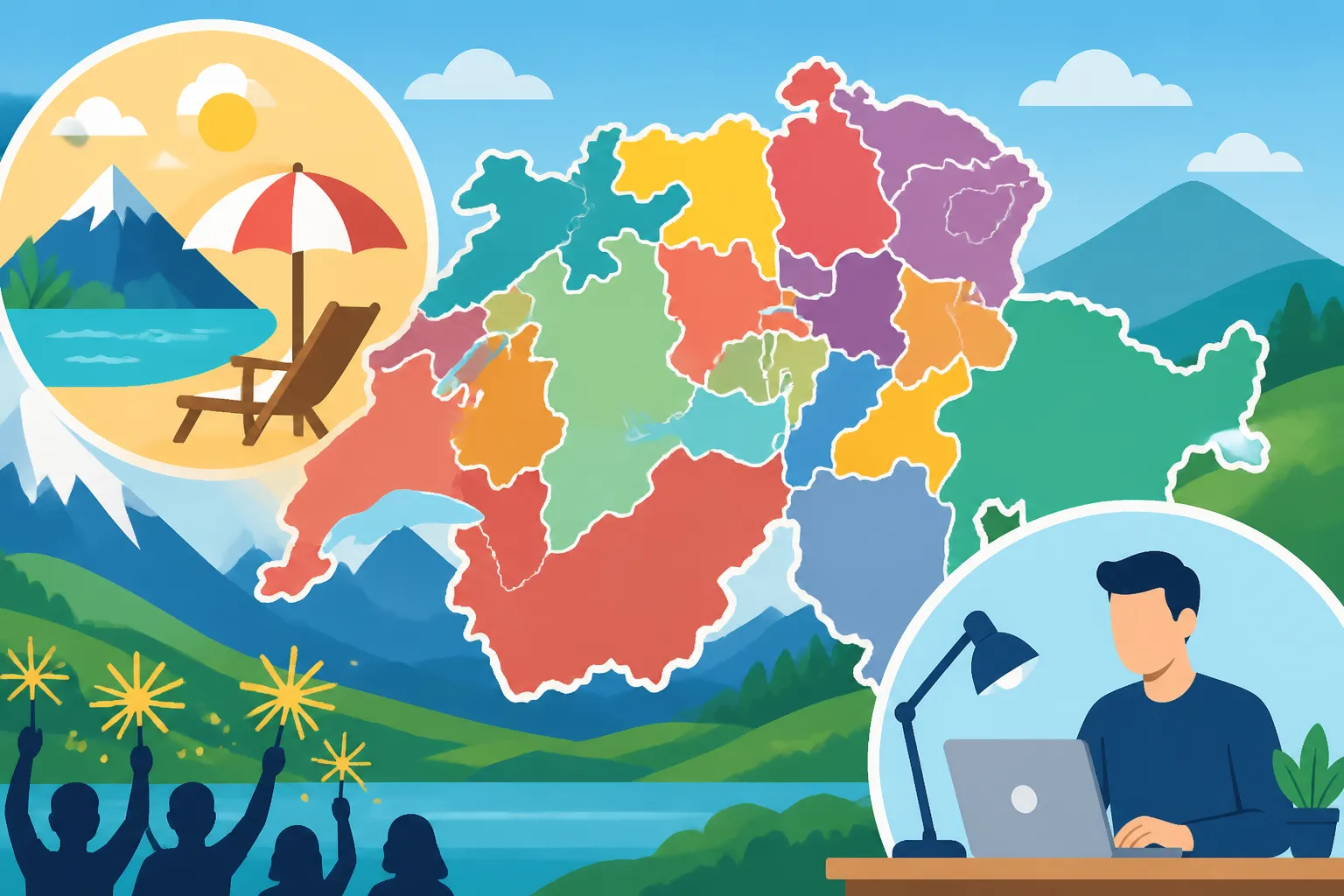
Public Holidays and Work in Switzerland: Which Cantons Get Which Days Off
One of the first things that throws expats for a loop in Switzerland is the sheer variability of public holidays. You might be excitedly planning a long weekend, only to find out your friend in the next canton over has a different day off, or even no holiday at all! This guide will dive deep into the fascinating, and sometimes frustrating, world of Swiss public holidays, helping you understand which days are off, where, and what it all means for your work life.
The Swiss Public Holiday Landscape: A Cantonal Patchwork
Switzerland, with its 26 cantons, operates on a highly decentralized system, and public holidays are a prime example of this. Forget a unified national calendar like you might be used to; here, local traditions and historical ties dictate when you get to put your feet up. It's truly a cultural immersion just trying to figure out which days count as a "Feiertag" in your particular corner of the country.
Federal versus Cantonal Holidays: Understanding the Divide
At first glance, it might seem chaotic, but there's a method to the madness. Officially, Switzerland only has one truly federal public holiday, and that's the Swiss National Day on August 1st. Every single canton observes this day, and it's a nationwide celebration with bonfires, fireworks, and general merriment. You'll definitely want to experience a Swiss National Day (August 1): How Switzerland Celebrates at least once during your time here.
Beyond August 1st, however, the landscape becomes a beautiful, albeit confusing, mosaic of cantonal autonomy. Each canton has the right to declare up to eight additional public holidays per year, and some cantons choose to observe more, while others stick to fewer. This means that a holiday celebrated with great fanfare in, say, Valais, might be just another working day in Aargau. It's not uncommon for people living on a cantonal border to experience their colleagues having a day off while they head into the office, leading to a mild sense of holiday envy!
Why the Difference? A Historical Perspective
To truly grasp why Switzerland has such a varied holiday schedule, you need to look back at its history. Switzerland didn't form as a unified nation overnight; it evolved over centuries as a confederation of independent cantons, each with its own customs, legal frameworks, and even religious affiliations. Many of the cantonal holidays today are deeply rooted in these historical and religious traditions.
For instance, predominantly Catholic cantons, particularly in Central Switzerland and parts of Valais and Ticino, often observe holidays like Corpus Christi, Assumption Day, and All Saints' Day. These days are significant religious observances that have been enshrined as public holidays for generations. Conversely, predominantly Protestant cantons, especially in the German-speaking north and east, might celebrate different days, or fewer religious holidays overall. For example, while Good Friday and Easter Monday are widely observed, other religious days vary greatly. The French-speaking cantons, too, have their unique observances; Geneva's Jeûne genevois is a fantastic example of a deeply local, historically significant holiday that you won't find anywhere else. These days aren't just days off; they're living reflections of a canton's past and identity.
Key Public Holidays Across Switzerland and Their Work Implications
Alright, let's get down to brass tacks: which specific days are you likely to get off, and what are the rules around working on them? This is where your personal calendar and local knowledge become essential tools.
Nationally Recognized Holidays (Mostly)
While only August 1st is universally federal, several other holidays are so widely observed that they might as well be. These are your best bets for a guaranteed day off, regardless of your canton, though there are always exceptions.
- New Year's Day (1. Januar): Almost every canton observes this, making it a reliable start to the year.
- Good Friday and Easter Monday: These movable Christian holidays are nearly universally observed, giving most of Switzerland a lovely four-day weekend.
- Ascension Day (Auffahrt/Ascension): Always falls on a Thursday, approximately 40 days after Easter. It's widely observed and often results in a popular "Brückentag" (bridge day) on Friday, extending the weekend for many. You'll find that many Swiss companies will grant the Friday off automatically, or at least encourage employees to take a vacation day to create a long weekend.
- Whit Monday (Pfingstmontag/Lundi de Pentecôte): This holiday, occurring 50 days after Easter, is also very commonly observed across most cantons.
- Christmas Day (25. Dezember): A definite universal holiday, celebrated with family and plenty of festive food.
It's important to remember that "mostly" means there can still be regional nuances. Always double-check your specific canton's official holiday calendar or your employer's policy.
The Major Cantonal Players: What to Expect Regionally
Beyond these broadly observed days, each canton adds its flavor. Here's a snapshot of some common cantonal holidays you might encounter:
- Berchtold's Day (Berchtoldstag – 2. Januar): Primarily observed in several German-speaking cantons, including Bern, Zurich, Aargau, Glarus, and Thurgau. It's a lovely way to extend the New Year's celebrations.
- Epiphany (Heilige Drei Könige – 6. Januar): Mostly celebrated in a few Catholic cantons like Uri, Schwyz, and Ticino.
- Labour Day (Tag der Arbeit/Fête du Travail – 1. Mai): Widely observed in many urban and French-speaking cantons, including Zurich, Basel-Stadt, Geneva, Vaud, and Neuchâtel. However, some cantons do not observe it, which can be a surprise for expats from countries where May 1st is a universal holiday.
- Corpus Christi (Fronleichnam/Fête-Dieu): A significant Catholic holiday, observed in cantons such as Lucerne, Uri, Schwyz, Zug, Obwalden, Nidwalden, Fribourg, Valais, and Ticino.
- Assumption Day (Mariä Himmelfahrt/Assomption – 15. August): Another Catholic holiday, celebrated in cantons like Lucerne, Uri, Schwyz, Zug, Obwalden, Nidwalden, Fribourg, Valais, and Ticino.
- All Saints' Day (Allerheiligen/Toussaint – 1. November): Also a Catholic observance, common in cantons such as Lucerne, Uri, Schwyz, Zug, Obwalden, Nidwalden, Fribourg, Valais, and Ticino.
- Immaculate Conception (Mariä Empfängnis/Immaculée Conception – 8. Dezember): Observed in some Catholic cantons, including Lucerne, Uri, Schwyz, Zug, Obwalden, Nidwalden, and Valais.
- St. Stephen's Day (Stephanstag/St. Etienne – 26. Dezember): Widely observed as a second Christmas day, particularly in German-speaking cantons. Many companies close, allowing for an extended festive period.
Then there are the truly unique, local holidays:
- Jeûne genevois (Geneva only): A fast and thanksgiving day specific to Canton Geneva, falling on the first Thursday after the first Sunday of September. It's a special tradition, often resulting in a four-day weekend if you work in Geneva.
- Knabenschiessen (Zurich only): While not a public holiday for everyone, some schools and public offices in Zurich close for parts of this traditional shooting festival, which usually happens in September.
This table provides a generalized overview of some major public holidays and their cantonal observance. Remember, exceptions can always apply based on specific municipalities or even company policies.
| Holiday (German/French) | Date | Key Cantons Observing | Type of Holiday |
|---|---|---|---|
| Neujahr/Nouvel An | 1 January | All | Federal/Common |
| Berchtoldstag | 2 January | BE, ZH, AG, GL, TG, SH, ZG, FR, OW, NW (some others) | Cantonal |
| Heilige Drei Könige | 6 January | UR, SZ, TI | Cantonal (Catholic) |
| Karfreitag/Vendredi Saint | Movable | Most (exceptions exist, e.g., TI, VS partially) | Common (Christian) |
| Ostermontag/Lundi de Pâques | Movable | Most | Common (Christian) |
| Tag der Arbeit/Fête du Travail | 1 May | ZH, BS, BL, SH, TG, AG, SO, LU, TI, NE, GE, VD, JU, FR (some others) | Cantonal |
| Auffahrt/Ascension | Movable (Thursday) | All | Federal/Common |
| Pfingstmontag/Lundi de Pentecôte | Movable | Most | Common (Christian) |
| Fronleichnam/Fête-Dieu | Movable | LU, UR, SZ, OW, NW, ZG, FR, VS, TI (some others) | Cantonal (Catholic) |
| Nationalfeiertag/Fête Nationale | 1 August | All | FEDERAL |
| Mariä Himmelfahrt/Assomption | 15 August | LU, UR, SZ, OW, NW, ZG, FR, VS, TI (some others) | Cantonal (Catholic) |
| Jeûne genevois | 1st Thursday after 1st Sunday in September | GE only | Cantonal (Geneva) |
| Allerheiligen/Toussaint | 1 November | LU, UR, SZ, OW, NW, ZG, FR, VS, TI (some others) | Cantonal (Catholic) |
| Mariä Empfängnis/Immaculée Conception | 8 December | LU, UR, SZ, OW, NW, ZG, VS | Cantonal (Catholic) |
| Weihnachten/Noël | 25 December | All | Federal/Common |
| Stephanstag/St. Etienne | 26 December | Most (especially German-speaking cantons) | Common (Christian) |
Work Rights and Compensation on Public Holidays
This is a critical point for any expat working in Switzerland. Unlike many countries where public holidays are automatically paid days off, Switzerland has some specific rules. The Swiss Code of Obligations (OR) generally states that employees are only entitled to one paid public holiday per year – the 1st of August. Yes, you read that right. Just one!
However, before you panic, most employment contracts and Collective Bargaining Agreements (GAV – Gesamtarbeitsvertrag) will be more generous. For instance, it's very common for employers to pay for all public holidays observed in their canton, as if they were regular working days. This is a huge relief, of course! But it's not a legal given beyond August 1st. You absolutely must check your employment contract or the GAV applicable to your industry and company to understand your specific entitlements.
If you are required to work on a public holiday that is not recognized as a paid day off in your contract, or if you work on August 1st, the compensation rules usually involve receiving your regular salary plus a premium (often 50% or 100% extra) or compensatory time off. Again, this is highly dependent on your contract, GAV, and the specific canton's regulations. For complex situations, particularly if you're dealing with issues around salary deductions or overtime on these days, you might want to consider consulting with a specialist on Swiss Work Contracts and Labor Law: Notice Periods, Leave, and Rights. This can be especially important if you're navigating your first year and still getting a feel for local norms.
Navigating Holiday Schedules as an Expat Employee
Okay, so you understand the patchwork, but how do you actually use this knowledge in your day-to-day expat life? It's about being proactive and informed.
Checking Your Canton's Official Holiday Calendar
This is step number one. Every cantonal government and often even individual municipalities will publish an official calendar of public holidays for the upcoming year. A quick search for "Feiertage [Canton Name] 2026" (e.g., "Feiertage Zürich 2026") will usually lead you to the official list. Make this a habit each year. Print it out, stick it on your fridge, or add it to your digital calendar.
Knowing these dates in advance is not just for planning leisure; it's crucial for managing appointments, understanding public transport schedules, and knowing when shops will be closed. Swiss Sundays and public holidays often mean nearly everything is shut down, which can be a real culture shock if you're used to 24/7 convenience. Plan your grocery runs accordingly! You'll quickly learn that What Shops Are Open on Sundays in Switzerland? is a very short list.
Collective Bargaining Agreements (GAV) and Company Policies
As mentioned, your employer's policies and any relevant GAV are your best friends when it comes to understanding your personal holiday entitlements. Many companies will list their observed public holidays in their internal HR handbook or on their intranet. If you're unsure, don't hesitate to ask your HR department or a trusted Swiss colleague for clarification. It's much better to clarify upfront than to assume and be disappointed.
For those working in industries covered by a GAV, these agreements often specify not only which holidays are paid but also how overtime on holidays is compensated. This is particularly relevant in sectors like retail, hospitality, or certain manufacturing roles. Understanding these documents is key to ensuring you are correctly compensated.
Maximizing Your Time Off: Bridge Days and Vacation Planning
One of the beloved Swiss traditions, especially in German-speaking areas, is the "Brückentag" (bridge day). This refers to taking a single vacation day between a public holiday and a weekend to create a longer break. For example, if Ascension Day falls on a Thursday, many people will take the Friday off, turning it into a four-day weekend. Smart vacation planning around these movable holidays can significantly increase your leisure time. This strategy is also popular for Bridge Days (Brückentage): Maximizing Vacation Around Swiss Holidays.
Consider these common bridge day opportunities:
- Ascension Day (Thursday): Take Friday off.
- Corpus Christi (Thursday): Take Friday off (in Catholic cantons).
- All Saints' Day (if it falls on a Thursday or Tuesday): Take the connecting day off.
If you're strategic, you can turn just a few days of annual leave into several extended breaks throughout the year. Remember to book these vacation days early, as bridge days are highly sought after by your Swiss colleagues!
Cultural Significance and Expat Experience of Swiss Holidays
Beyond the legalities and logistics, public holidays are a fantastic window into Swiss culture and a chance to truly integrate.
Embracing Local Traditions
Swiss holidays aren't just about days off; they're often steeped in local traditions, some of which are centuries old. From the solemn processions of Corpus Christi in Catholic villages to the vibrant fireworks of National Day, there's always something unique happening. Don't be shy about participating! Attend a local festival, watch a parade, or simply enjoy the quiet ambiance of a town on a truly local holiday like Jeûne genevois. It's a great way to meet people and understand the rhythms of your new home. For more insight, you might want to look into Swiss Festivals and Traditions: A Year-Round Cultural Calendar.
Planning for Closures and Quiet Days
This is perhaps the biggest cultural adjustment for many expats. Switzerland takes its quiet hours and public holiday closures seriously. Sundays and public holidays mean grocery stores, department stores, and most other shops are closed, except for those in major train stations and airports. Restaurants usually remain open, but service hours might be reduced. Expect public transport to run on a reduced holiday schedule.
This quietness can be both serene and frustrating. It forces you to plan ahead for groceries and errands. Embrace it as a chance to slow down, enjoy nature, or catch up with friends. Many expats use these days to head into the mountains for a hike or visit a lake. When planning trips, factor in that these "quiet days" are a Swiss reality; otherwise, you might find yourself without essentials.
The Language Barrier and Holiday Information
Understanding the nuances of holiday information, especially regional ones, can be tricky if you're still grappling with German, French, or Italian. Holiday names often differ slightly, and local news or community announcements about celebrations might be exclusively in the local language.
This is where investing in language skills really pays off. Even a basic understanding of your local language will help you navigate these cultural aspects. Resources like iTalki can be fantastic for finding local tutors who can explain these cultural intricacies and help you understand regional dialects. Learning the local terms for "public holiday," "bridge day," or "opening hours" will save you a lot of confusion and make you feel more at home. Moreover, understanding the language can help you read official notices about Public Holidays and Work in Switzerland: Which Cantons Get Which Days Off or other local events.
Disclaimer
Please remember that while this guide aims to provide comprehensive and up-to-date information, rules and regulations in Switzerland can change, and specific situations may vary. Always consult official cantonal government websites, your employment contract, and relevant Collective Bargaining Agreements (GAV) for the most accurate and personalized information regarding public holidays and your work entitlements.