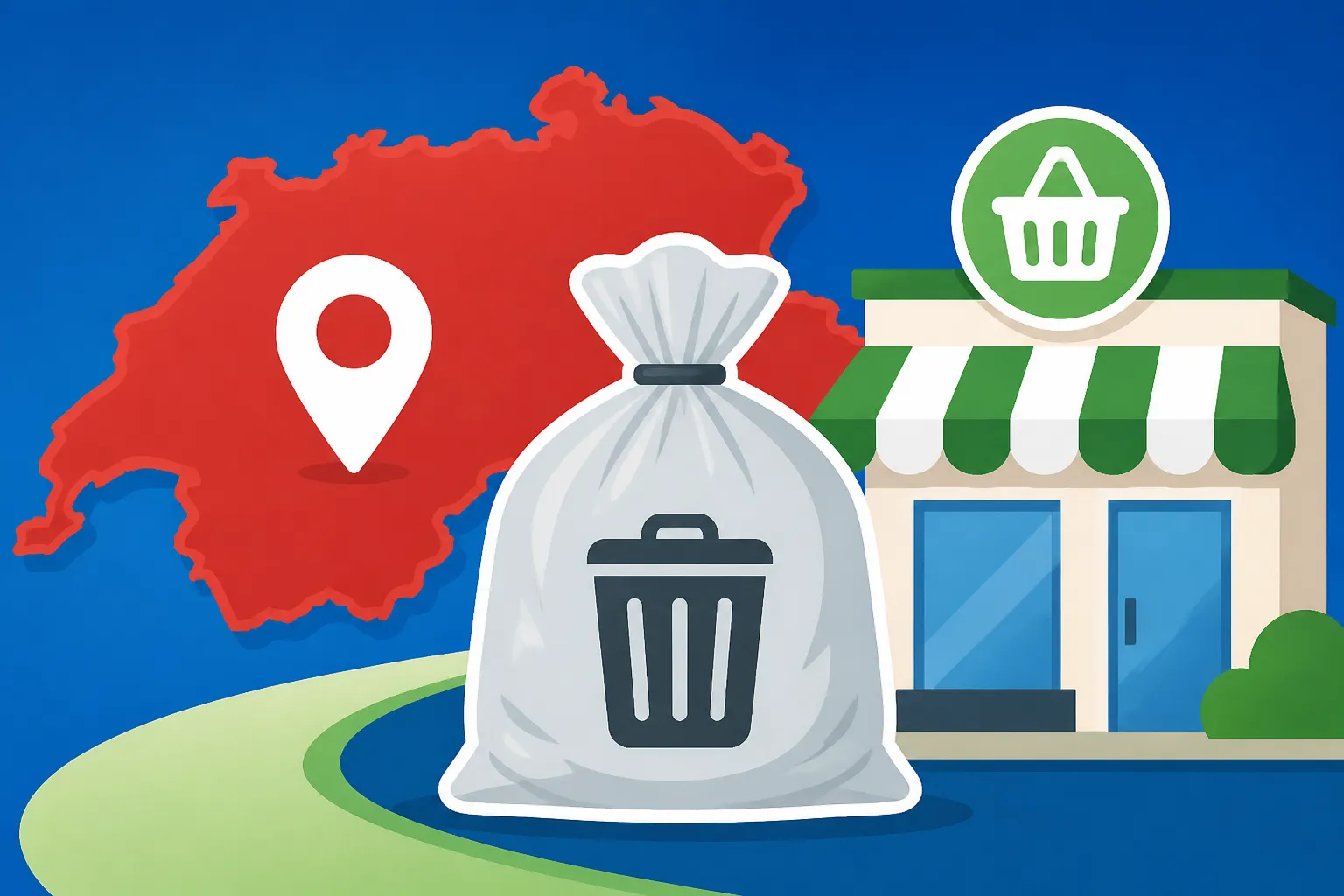
Where to Buy Official Cantonal Garbage Bags (Gebührensäcke)
One of the most jarring "welcome to Switzerland" moments is realizing that your standard black bin liners are essentially illegal for household waste disposal. I remember my first week in Zurich, standing in the aisle of a Coop for twenty minutes, sweating under the fluorescent lights while trying to understand why a roll of trash bags cost nearly 20 francs. This guide solves the mystery of the Gebührensäcke, explaining exactly where to buy them, how much to pay, and how to navigate the strict local waste laws without losing your deposit or your mind.
Understanding the Swiss Polluter Pays Principle
The first thing you have to wrap your head around is that in Switzerland, trash disposal isn't usually covered by a flat monthly tax like it might be in the US, UK, or other parts of Europe. Instead, the country operates on the Verursacherprinzip, or the polluter pays principle. This means the more trash you produce, the more you pay. The "tax" is actually built into the price of the bags themselves. When you buy a roll of official cantonal bags, you are pre-paying for the collection, transport, and incineration of that waste.
Why You Cannot Use Regular Trash Bags
If you recently moved into a place you found via HousingAnywhere, you might be tempted to just use the cheap, generic bags you brought from home or bought at a discount shop. Please, for the sake of your wallet, don't do it. Every canton has a specific color and design for its bags. In Zurich, they are white with blue lettering (the Züri-Sack); in Basel, they are grey (the Bebbi-Sagg); in Bern, they are white with green accents.
Using an unofficial bag is considered tax evasion. The local "trash police" (Abfalldetektive) are notorious for opening unofficial bags found in public bins to look for a stray envelope or a receipt with your name on it. If they find you, the fine often starts at 200 CHF and goes up from there. This is why Swiss Recycling Rules: Cantonal Paid Garbage Bags (Züri-Sack, Bebbi-Sagg) are something every expat needs to memorize within their first 48 hours in the country.
The Standard Sizes and What They Cost
Across almost all cantons, the bags come in standardized sizes: 17 liters, 35 liters, 60 liters, and 110 liters. For a single person or a couple, the 35-liter bag is the gold standard. It’s large enough to last a few days but small enough that it doesn't start smelling before it's full.
Prices are regulated by the municipality or the waste association, so you won't find "sales" on these bags. In 2026, a roll of ten 35-liter bags generally costs between 16 and 22 CHF, depending on which canton you live in. While this seems astronomical for plastic film, remember that you are paying for the entire infrastructure of a world-class waste management system. It’s a significant part of the Cost of Living in Switzerland 2026: Budgeting for Singles and Families that catches many off guard.
| Bag Size (Liters) | Typical Quantity per Roll | Estimated Price (CHF) | Best For… |
|---|---|---|---|
| 17L | 10 Bags | 8.50 – 11.00 | Singles / Minimalist households |
| 35L | 10 Bags | 16.50 – 22.00 | Average 2-4 person household |
| 60L | 10 Bags | 31.00 – 38.00 | Large families / Weekly cleanouts |
| 110L | 5-10 Bags | 55.00 – 65.00 | Heavy waste / Post-party cleanup |
Primary Retailers and How to Ask for Them
The most common place to buy your Gebührensäcke is at the supermarket. However, if you walk through the aisles of a Migros or Coop looking for them, you likely won't find them on the shelves next to the aluminum foil and Ziploc bags. Because these bags are high-value items (effectively cash-equivalents), they are usually kept behind the customer service desk or at the checkout counter.
Buying at Major Supermarkets
When you get to the checkout at Coop, Migros, Denner, Aldi, or Lidl, you simply ask the cashier for the bags. In German-speaking areas, you can say, "Einsatz 35-Liter Züri-Säcke, bitte" (or whatever the local name is). In French-speaking regions like Geneva or Lausanne, you’d ask for "sacs taxés."
The cashier will pull a roll from a drawer or a shelf behind them. Note that you cannot usually use supermarket points (like Migros Cumulus or Coop Supercard) to pay for the "tax" portion of the bag, though this can vary slightly by branch. If you are struggling to find the nearest supermarket because you haven't set up your local SIM yet, using an Airalo eSIM can get you connected immediately so you can GPS your way to the nearest Denner before they close at 8:00 PM.
Local Administration and Post Offices
If you aren't a fan of the supermarket rush, most local post offices (Die Post/La Poste) also stock the official bags. This is particularly helpful if you have just finished Registering Your Address at the Kreisbüro Within 14 Days of Moving and need to pick up your first set of supplies.
Additionally, the Gemeinde or Stadthaus (city hall) usually sells them. Some smaller villages even have vending machines outside the municipal office that dispense rolls of bags 24/7. This is a lifesaver if you realize on a Sunday night—when all stores are closed—that you’ve run out of bags and the collection is early Monday morning. Just remember that doing chores late at night might run afoul of Quiet Hours (Ruhezeiten): Sunday Rules for Laundry, Mowing, and Noise.
Convenience Stores and Kiosks
In major train stations like Zurich HB or Geneva Cornavin, the K-Kiosk or Avec shops often stock the local bags. You will pay a small premium in some cases, or they might only sell the 35L size, but they are open later than standard supermarkets. If you’ve just moved into a temporary apartment found via HousingAnywhere and it’s 9:00 PM on a Tuesday, the train station kiosk is your best bet for avoiding a trash pile-up in your hallway.
Managing Your Trash to Save Money
Since every bag costs money, the Swiss have become masters of the "compact and sort" method. You will quickly learn that if you throw everything into the taxed bag, you will be spending 100 CHF a month just on plastic. The secret to living affordably in Switzerland is to ensure that only non-recyclable waste goes into that expensive bag.
The Art of the Squeeze
You will see Swiss neighbors putting incredible physical pressure on their trash bags to fit that one last item in. It’s a national pastime. While you should be careful not to rip the bag (if it's ripped, the collectors might leave it behind), you want to maximize the volume.
One thing I learned the hard way: don't throw away bulky air-filled packaging. If you order items from Amazon Germany, they often come with those plastic air pillows. Pop them before they go in the bag. Better yet, recycle the cardboard separately. If you are still setting up your home, check out Renting in Switzerland: The Complete 2027 Guide for Expats for tips on how to handle the massive amounts of cardboard that come with new furniture.
Recycling Everything Else for Free
Almost everything that isn't food waste or "dirty" trash can be recycled for free, which saves you from using your expensive cantonal bags. Glass, aluminum, and PET plastic bottles have dedicated drop-off points in every neighborhood.
Cardboard and paper are even more specific. Usually once or twice a month, there is a dedicated collection where you put your paper out on the curb. But beware: you cannot just put it in a bag. You must follow the Recycling Paper and Cardboard: Strict Stacking and Tying Rules. If you don't tie it with a specific type of twine in a neat bundle, the collectors will leave a "shame sticker" on it, and you'll have to drag it back inside.
Composting and Food Waste
Many modern apartment buildings now provide a "Bio-Abfall" (organic waste) bin. Using this is a massive money-saver. Food waste is heavy and takes up space. By diverting your vegetable scraps, coffee grounds, and old leftovers to the green bin, you can often downgrade from a 35L bag to a 17L bag, effectively halving your trash costs. If you are buying a kitchen compost bin on Amazon Germany, make sure it fits the small green compostable bags sold in Swiss supermarkets, as these are also regulated.
What Happens if You Get It Wrong?
The Swiss waste system is built on trust, but it is enforced with typical Swiss precision. If you put your bag out on the wrong day, or if you use an unofficial bag, the consequences are more than just a dirty look from your neighbors.
The Abfalldetektive (Trash Detectives)
It sounds like a joke from a sitcom, but trash detectives are very real. In cities like Zurich and Basel, municipal employees are authorized to tear open "illegal" bags. They are looking for any identifying information. I once heard of an expat who was fined because they threw away a pill bottle with their name on it in a black bag.
If they catch you, you'll receive a bill in the mail that includes the disposal fee, an administrative fee, and the fine itself. This can easily top 300 CHF for a single bag. It’s much cheaper to just buy the official bags at the Coop counter.
Missing the Collection Window
Each neighborhood has specific days for "Kehricht" (general trash) collection. You are generally allowed to put your bags out either the night before or before 7:00 AM on the day of collection. If you miss the window, you cannot leave the bag on the street. You must take it back inside until the next collection day. Leaving it out is considered littering and attracts foxes, crows, and—you guessed it—fines.
Special Cases: Stickers and Containers
While most of Switzerland uses the "official bag" system, some communes (especially in rural areas or specific parts of Romandie) use a "sticker" system. Instead of buying a special bag, you buy a sheet of stamps or stickers. You can use any bag you like, but you must prominently display the correct number of stickers on the bag before putting it out.
Weight-Based Systems
In some very high-tech apartment complexes or specific communes, you might have access to a "trash silo" or a large underground container. In these cases, you might use a key fob (linked to your apartment) to open the hatch. The system weighs your trash and bills your property management company directly. If you live in a building like this, you don't need the Gebührensäcke, but you still pay based on how much you throw away. Check your lease or ask your landlord if you are unsure; it’s a common question when Renting in Switzerland: The Complete 2027 Guide for Expats.
Bulk Waste and "Sperrgut"
If you have a broken chair, an old mattress, or a large piece of wood that won't fit in a bag, you need "Sperrgutmarken" (bulk waste stickers). You can buy these at the same supermarket counters where you find the bags. You stick the required number of labels on the item and place it next to the regular trash on collection day. For very large clear-outs, you might need to visit a local "Ökihof" or recycling center, where you pay by the weight of your car's load.
Final Advice for New Expats
Don't let the complexity of the trash system intimidate you. Within a month, it will become second nature. You'll find yourself judging people who throw PET bottles in the general waste, and you'll become an expert at the "Swiss stomp" to get that last bit of space in your Züri-Sack.
- Always have a spare roll: Don't wait until you're on your last bag to buy more. Shops close early, and Sunday is a "no-buy" day.
- Ask the cashier: Don't wander the aisles. Go straight to the service desk or the till.
- Check the calendar: Every commune issues an "Abfallkalender" (trash calendar) at the start of the year. Pin it to your fridge. It tells you when paper, cardboard, and trash are collected.
- Join the community: If you see your neighbor putting out their paper bundles, it's a good sign you should do the same.
Living in Switzerland is about following the small rules that keep the big machine running smoothly. The Gebührensäcke might be expensive, but they contribute to the cleanest streets and most efficient energy-from-waste plants in the world.
Disclaimer
This guide is for informational purposes only. Waste disposal regulations, bag colors, and prices are determined at the cantonal and municipal levels and are subject to change. Always verify the specific rules of your local commune or Stadtverwaltung to avoid fines. The author is a veteran expat, not a legal or municipal official.