Swiss Mobile Plans Without Credit Checks: Prepay vs Contract Options
Landing in Switzerland often feels like a series of administrative hurdles where every solution requires a prerequisite you don't yet have. I remember the sinking feeling of being told I couldn't get a simple mobile contract because my credit history was a blank slate. This guide solves the "no credit history" paradox by detailing exactly how to secure Swiss mobile connectivity through prepay and no-check contract options.
The Reality of Credit Checks in Switzerland
When you first arrive, the Swiss system views you as a financial ghost. Even if you have a high-paying job offer and a shiny new residence permit, the automated credit check systems used by major telecommunications providers like Swisscom, Sunrise, and Salt often return a "reject" status for new arrivals. This process, known as a Solvenzprüfung, relies on local databases that track your payment history and debt records over several years.
The frustration is real because a local phone number is essentially your digital ID in Switzerland. You need it for two-factor authentication for Opening a Swiss Bank Account: UBS, ZKB, PostFinance, and Neobanks, and you certainly need it when Registering Your Address at the Kreisbüro Within 14 Days of Moving. Without a history, the system assumes a default risk level that often leads to an immediate rejection of your application for a "post-paid" or monthly billed contract.
Why the System Rejects New Expats
The primary reason for rejection is the lack of a Checking Your Debt Register Extract (Betreibungsauszug) for Loans. In Switzerland, the Betreibungsauszug is the holy grail of financial reliability. Since you haven't lived here long enough to potentially owe anyone money, the credit agencies have no data on you. Providers also look at your residence permit type. If you are on a short-term L permit, traditional providers are even more hesitant, fearing you might leave the country with a subsidized iPhone and an unpaid bill.
The Catch-22 of Swiss Residency
You are in a loop where you need a phone to manage your life, but your life hasn't "started" enough in the eyes of the credit bureaus to qualify for a phone. This is particularly difficult if you are staying in temporary accommodation through services like HousingAnywhere, where you might not have a permanent lease to show as proof of residence yet. Understanding that this is a systemic hurdle and not a personal reflection of your finances is the first step toward finding a workaround.
Prepay Options: The Path of Least Resistance
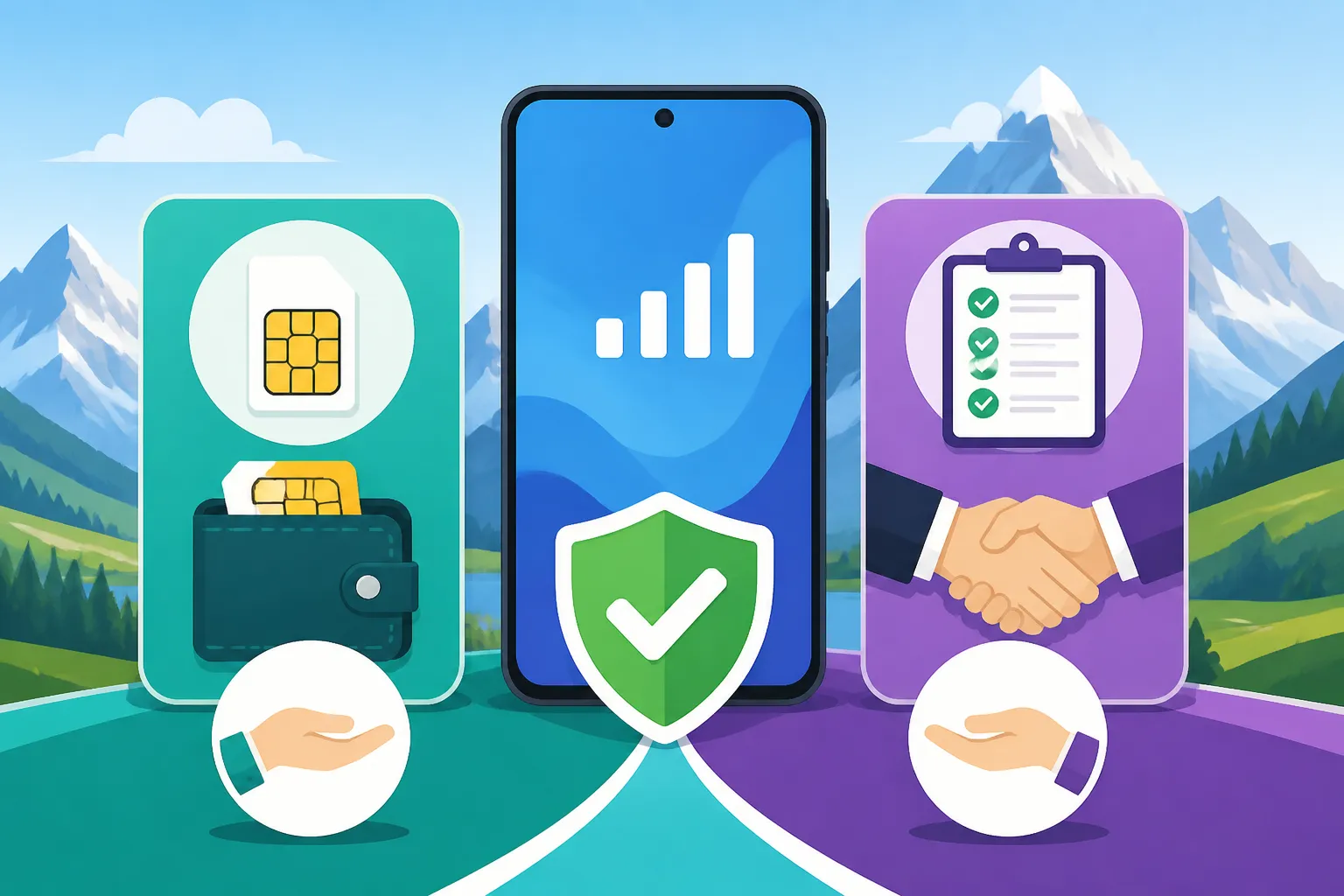
If you need a working Swiss number within twenty minutes of landing at Zurich or Geneva airport, prepay is your only realistic option. Prepay (or "Prepaid" as it is often called here) requires no credit check whatsoever because you are paying for the service upfront. There is no risk to the provider, making it the most expat-friendly entry point into the Swiss ecosystem.
Instant Connectivity with Major Providers
Every major provider offers a prepaid SIM card. You can walk into any Swisscom, Sunrise, or Salt shop, show your passport (EU and non-EU are both accepted), and walk out with a working number. While these are often more expensive per gigabyte than a contract, they bridge the gap during your first few months. If you are looking for a quick data fix before you even get to a physical shop, using Airalo for a temporary eSIM can keep you connected while you navigate the city, though it won't provide a local +41 number for administrative tasks.
MVNOs and Supermarket Brands
The real secrets to affordable prepay are the Mobile Virtual Network Operators (MVNOs). Brands like M-Budget Mobile (using the Swisscom network) or Coop Mobile (using the Salt network) offer prepaid cards that you can buy at any supermarket. These are excellent because they often provide better data packages than the "Big Three" directly. For example, a Mucho Mobile SIM can be picked up at many kiosks and offers competitive international calling rates, which is vital if you are still calling home frequently.
Contract Models That Bypass the Credit Check
Not all contracts are created equal. In recent years, a new wave of digital-first mobile providers has emerged in Switzerland. These companies operate on a "subscription" model rather than a traditional "contract" model. This distinction is crucial for expats because subscriptions often charge your credit or debit card at the start of the month, much like Netflix. Because the payment is secured upfront or via a card on file, many of these providers skip the deep credit dive.
Digital-First Providers and App-Based Subscriptions
Digital Republic and Galaxus Mobile are two standouts in this category. They offer "flat rate" data and calling plans that you manage entirely through an app. When you sign up, you simply provide a scan of your ID and link a payment method—often even a neobank card. If you are wondering Is Neon Bank Safe? Swiss Deposit Protection up to CHF 100,000, the answer is yes, and its cards are perfect for these types of mobile subscriptions. These providers usually don't care about your Swiss credit score because you can cancel anytime, and they don't provide "free" phones, which is where the main risk lies for providers.
Wingo and Yallo: The Semi-Traditional Workaround
Wingo (owned by Swisscom) and Yallo (owned by Sunrise) are the "cool younger siblings" of the big providers. They frequently run "lifetime" promotions that offer unlimited everything for a fraction of the cost of a standard plan. While they do technically perform a credit check, it is often significantly more relaxed than the checks performed for high-end Swisscom Blue plans. Many expats find that after just one or two months of residency, they can pass the Wingo check even if they were rejected by the main Swisscom brand earlier. This is a great intermediate step when navigating the Cost of Living in Switzerland 2026: Budgeting for Singles and Families.
Comparing Prepay vs Contract for Expats
| Feature | Prepay (Prepaid) | Digital Subscription | Traditional Contract |
|---|---|---|---|
| Credit Check | None | Minimal / Soft Check | Strict / Deep Check |
| ID Required | Yes (Passport/Permit) | Yes (Digital Scan) | Yes (Physical Copy) |
| Setup Time | Instant | 1-2 Days (eSIM is instant) | 3-7 Days |
| Device Subsidy | No | No | Yes (Phone included) |
| Cancelation | Any time | Monthly | 12-24 Months |
| Best For | First 30 days | Long-term value | Long-term residents |
Hardware: Buying vs Financing Your Phone
One of the biggest traps for new expats is trying to get a subsidized phone (e.g., an iPhone for CHF 0 down). This is the absolute fastest way to trigger a "Hard Reject" on your credit check. To the provider, you are asking for a CHF 1,000 loan the moment you step off the plane.
Buying Unlocked and Staying Flexible
My strongest recommendation is to bring an unlocked phone with you or buy one outright. If you need a new device, ordering from Amazon Germany is often significantly cheaper than buying in a Swiss retail store, even with the import duties (which are often calculated at the checkout). By owning your hardware, you are free to jump between Swiss Mobile Plans: Best Subscriptions and Prepaid eSIMs for Expats without being tied to a 24-month payment plan that you might not even qualify for.
Using eSims for the Transition
If your phone supports eSIM, your life in Switzerland will be much easier. You can keep your home country's SIM active for emergencies while instantly activating a Swiss "subscription" plan like those from Digital Republic. This prevents the need for physical mail, which can be a nightmare if you are still waiting for your name to be added to a mailbox—a strangely strict requirement in Swiss apartment culture.
Strategic Tips for Your First Six Months
Your goal during the first half-year is to build a "paper trail" of reliability. Even if you are on a prepay plan, ensure your name is correctly registered with the provider. When you eventually apply for a more permanent solution, like Setting Up Swiss Home Internet: Swisscom, Sunrise, and Salt Compared, having a clean history with a mobile provider (even a prepay one) can sometimes help.
Moving from Prepay to Subscription
Once you have your first three months of payslips and a permanent address, you can usually port your prepay number to a subscription plan. Porting (transferring) your number is a standard process in Switzerland and is almost always free. This allows you to keep the +41 number you've already given to your HR department and bank while moving to a more cost-effective unlimited data plan.
Roaming and Cross-Border Considerations
If your work involves Cross-Border Commuting: Working in Switzerland with a G Permit, you must be careful with prepay plans. Many basic Swiss prepay SIMs charge exorbitant rates the second you cross the border into France, Germany, or Italy. If you live near the border, look specifically for "Europe" options within the prepay apps or choose a digital subscription like Wingo that often includes "Roaming" in its base price.
Digital Solutions for International Needs
While you are sorting out your local mobile situation, don't forget the tools that make the transition smoother. Services like Airalo are perfect for those first 48 hours when you are lost at a train station and haven't found a Swisscom shop yet. However, remember that data-only eSIMs do not provide a local number, which you will desperately need for the "SMS-TAN" codes that Swiss banks and government portals love to send.
The Role of Neobanks in Mobile Setup
Since most "no credit check" contracts require a recurring card payment, having a Swiss bank account ready is vital. If you haven't opened one yet, the digital-first nature of these mobile plans pairs perfectly with neobanks. They are generally more accepting of new residents and provide the Visa or Mastercard debit cards required to set up your monthly mobile sub.
Navigating the Registration Process
Whether you choose prepay or a contract, Swiss law requires every SIM card to be registered to a verified identity. This was implemented to combat crime and is non-negotiable. When you buy a SIM, the shop assistant will take a digital scan of your passport or residency permit.
Registration for Third-Country Nationals
If you are a non-EU/EFTA citizen, ensure you have your physical residency permit (B or L) or at least the "Stempel" (stamp) in your passport. Some smaller kiosks might be confused by temporary paper permits, so going to a main branch of a provider in a city center is usually more efficient. They are used to dealing with the nuances of expat documentation and will get you through the system faster.
Legal and Contractual Awareness
Always read the "Small Print" regarding the duration of your plan. While prepay has no notice period, some "subscription" models require a 60-day notice to cancel. If you are only in Switzerland for a short project, ensure you aren't accidentally signing up for a plan that will charge you long after you've left the country.
Challenging a Rejection
If you are rejected for a contract you really want, you can sometimes ask for a manual review if you can provide a copy of your employment contract. However, in my experience, it is rarely worth the stress. The automated systems are rigid, and it is almost always better to use a "no-check" provider for six months and then switch once your credit data has been populated in the national databases.
Disclaimer
This guide is provided for informational purposes only. While I have made every effort to ensure the accuracy of this information for the year 2026, telecommunications laws, credit check policies, and provider offerings in Switzerland change frequently. Always verify the current terms and conditions with your chosen mobile provider before signing any agreement or purchasing a SIM card. I am a lifestyle blogger, not a legal or financial advisor.