Language Differences: Navigating Swiss German (Schwiizertüütsch) Dialects
Landing in the German-speaking part of Switzerland with a pristine certificate in High German is a rite of passage that usually ends in total confusion. I still remember sitting in a Zurich cafe during my first week, confidently ordering in my best "Hochdeutsch," only to have the waiter respond in what sounded like a series of rhythmic, melodic throat-clearing sounds. This guide solves the mystery of Schwiizertüütsch and helps you navigate the complex world of Swiss dialects without losing your mind.
The Great Language Divide: High German vs Schwiizertüütsch
The first thing every expat needs to understand is that Switzerland exists in a state of diglossia. This is a fancy linguistic term that basically means the country uses two distinct versions of the same language for very different purposes. High German (Standard German) is the language of writing, formal education, and news broadcasts. However, Schwiizertüütsch (Swiss German) is the language of the heart, the home, and the street. It isn't just one dialect; it is a collection of Alemannic dialects that vary from one valley to the next.
When you are Working in Switzerland as an Expat: Jobs, Culture, and Employment Laws, you will quickly notice that while your contract and official emails are in High German, the banter around the coffee machine is 100% dialect. This creates a psychological barrier for many newcomers. You might feel like an outsider even if you speak fluent German because you lack the "secret code" of the local dialect. It is important to realize that Swiss German has no official written standard. People write text messages phonetically, and because there are no strict rules, the spelling can change depending on who is typing.
The phonetic differences are the most jarring. Where High German uses a soft "ch" or a "k" sound, Swiss German often uses a deep, uvular scratch. The word for "cake," which is "Kuchen" in Germany, becomes "Chueche" in Switzerland. The "ei" sounds often transform into "ii" sounds, so "Eis" (ice/ice cream) becomes "Is." If you are using a service like HousingAnywhere to find your first apartment, don't be surprised if your prospective flatmates transition into dialect the moment the formal viewing is over. It is their way of relaxing and being themselves.
Regional Flavors: A Map of Major Swiss Dialects
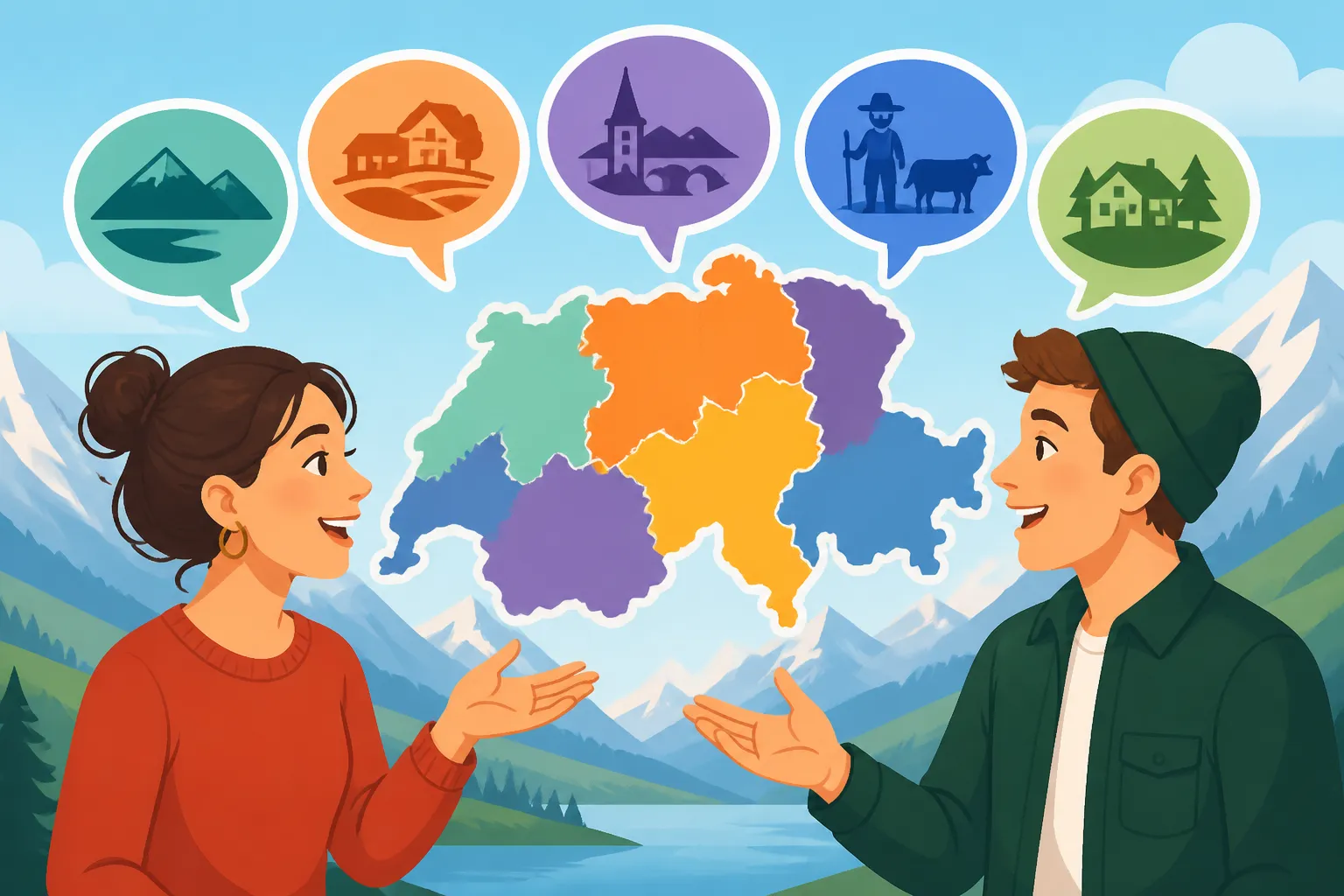
One of the most fascinating—and frustrating—aspects of Swiss German is how much it changes based on geography. You cannot simply learn "Swiss German" because a person from Zurich sounds nothing like someone from Bern or Valais. Each canton takes immense pride in its specific sounds, and being able to identify these differences is a major step in your integration.
Züritüütsch: The Urban Pulse of Zurich
Zurich German is often considered the "standard" dialect simply because of the city's economic weight, though people from other cantons might find it a bit "harsh" or "aggressive." In Zurich, the sounds are fast and the "k" sounds are very prominent. If you are following a Zurich Expat Healthcare Guide: Hospitals, Clinics, and Emergency Contacts, you’ll find that most medical professionals will switch to High German or English for you, but the administrative staff will likely be chatting in Züritüütsch amongst themselves. It is a dialect that feels efficient and modern, matching the pace of the city.
Bärndütsch: The Melodic Slow Pace of Bern
Bernese German is famous across Switzerland for being slow, melodic, and charming. While Zurich is "ch" heavy, Bern is known for its vocalized "l" sounds. For example, the word "clear" or "bright" (hell) sounds more like "heu" in Bern. Expats often find Bärndütsch slightly easier to parse because the speakers tend to take their time. If you’ve spent time looking at a Bern Expat Healthcare Guide: Inselspital and Local Care Facilities, you might have noticed the locals have a reputation for being more laid back than their Zurich counterparts, and their language reflects that perfectly.
Baseldütsch: The Sophisticated Rhine Influence
Basel sits at the corner of France and Germany, and its dialect reflects a unique, almost nasal quality that sets it apart. It is often described as "finer" or more "aristocratic" than the mountain dialects. In Basel, you’ll hear distinct vowel shifts that don't exist elsewhere. If you are navigating the Basel Expat Healthcare Guide: Medical Networks and Cross-Border Options, you’ll notice that the local language culture is heavily influenced by the city’s international pharmaceutical industry, yet the locals cling fiercely to their Baseldütsch, especially during the famous Carnival (Fasnacht).
Wallisertüütsch: The Ultimate Level Boss of Dialects
Even for native Swiss German speakers, the dialect spoken in the Canton of Valais (Wallis) can be unintelligible. It is an extremely archaic form of Highest Alemannic. It features grammar and vocabulary that have remained unchanged for centuries due to the isolation of the mountain valleys. If you go skiing in Zermatt or Saas-Fee, you might feel like you’ve wandered into a different country entirely. Don't feel bad if you don't understand a single word; most people from Zurich don't either!
Practical Strategies for the Brave Expat
Navigating the dialect landscape requires a mix of humility and strategy. You don't necessarily need to speak Swiss German fluently to be successful, but you do need "passive understanding." This means being able to follow a conversation even if you respond in High German or English.
One of the best ways to pick up the local rhythm is to immerse yourself in local media. While you can order language books from Amazon Germany to brush up on your grammar, there are very few "textbooks" for dialect. Instead, try listening to local radio stations like SRF 3 or watching Swiss movies with subtitles. Using an eSIM from a provider like Airalo ensures you have constant data access to look up regional slang on the fly when you're out and about in the city.
The "Passive Response" method is a lifesaver. When a local speaks to you in dialect, feel free to respond in High German. This is perfectly acceptable and quite common. The Swiss are used to this "bilingual" exchange. It shows that you respect the local culture by listening, while still communicating clearly in a language you have mastered. If you are Finding an English-Speaking Family Doctor in Zug, you might find that the staff appreciates your effort to understand their dialect even if the medical consultation happens in English.
| High German | Swiss German (Zürich) | Swiss German (Bern) | English |
|---|---|---|---|
| Guten Tag | Grüezi | Grüessech | Hello / Good day |
| Auf Wiedersehen | Uf Wiederluege | Ade / Uf Wiederluege | Goodbye |
| Ein bisschen | Es birebitzeli | Es mützi | A little bit |
| Arbeiten | Schaffe | Schaffe | To work |
| Fahrrad | Velo | Velo | Bicycle |
| Schauen | Luege | Luege | To look |
| Brötchen | Weggli | Mütschli | Bread roll |
| Küche | Chuchi | Chuchi | Kitchen |
Social Etiquette and Language in the Workplace
The workplace is where the dialect struggle becomes most apparent. Switzerland has a very specific corporate culture where the lines between formal and informal are often blurred by language. Understanding High German vs Swiss German in the Workplace: What You Must Learn is crucial for your career progression.
Navigating the Office Apéro and Coffee Breaks
In most Swiss offices, meetings are held in High German (or English if it’s an international firm), but the moment the meeting ends, everyone switches back to dialect. This transition can feel like a door slamming in your face. However, it isn't meant to be exclusionary. It’s simply the "natural" state for the Swiss. During the "Apéro" (after-work drinks), the dialect will be even thicker. This is the best time to practice your listening skills. Don't be afraid to ask, "What does that word mean?" Most Swiss people are actually very proud of their dialect and will be happy to explain the nuances to an interested expat.
The Du vs Sie Paradox in Dialect
One of the quirks of Swiss German is that it feels inherently more informal than High German. In High German, the distinction between "Sie" (formal you) and "du" (informal you) is very strict. In dialect, while the distinction still exists, it often feels softer. You might find that Addressing Colleagues in German: Du vs Sie in Swiss Corporates follows different unwritten rules depending on whether you are speaking dialect or Standard German. Generally, the rule of thumb is: if you are speaking High German, stick to the formal "Sie" until invited otherwise. If you are attempting a few words in dialect, the tone automatically becomes more "neighborly."
Understanding Customer Service and Bureaucracy
When dealing with local authorities or shops, you will often be greeted with "Grüezi" (in Zurich) or "Grüessech" (in Bern). This is the standard polite greeting. Even if the rest of your conversation is in English, starting with a local greeting goes a long way. The Swiss value "Anständigkeit" (decency/politeness), and acknowledging their local tongue is a sign of respect. This applies to everything from buying groceries to Community and Integration: Making Friends and Adapting to Swiss Life. The more you use these small linguistic markers, the more the locals will view you as someone who is trying to integrate rather than just a temporary resident.
Integration and Survival: Beyond the Words
At the end of the day, language is about more than just grammar; it's about belonging. You might never sound like a native, and that is okay. The goal is to bridge the gap between being a "foreigner" and being a "local expat."
Your integration journey is heavily influenced by your willingness to engage with the dialect. If you stay in an "English bubble," you will miss out on the subtle humor and the "Gemütlichkeit" (coziness) of Swiss life. Even something as simple as knowing that a "Chuchichäschtli" is a kitchen cupboard—the classic shibboleth used to test foreigners—can be a great icebreaker.
The transition is slow. For the first six months, it might feel like noise. By the end of the first year, you’ll start to recognize individual words. By year three, you’ll likely have developed a favorite dialect and might even find yourself saying "Merci vielmal" instead of "Vielen Dank" without even thinking about it. The Swiss Corporate Culture: Meetings, Hierarchy, and Professional Etiquette becomes much easier to navigate when you can sense the mood of the room through the tone of the dialect, even if you don't catch every syllable.
Remember that the Swiss themselves are often self-conscious about their High German. For many locals, speaking High German feels a bit like speaking a foreign language. When you struggle with their dialect and they struggle with your High German, you are actually on a level playing field. This shared vulnerability can actually lead to stronger connections if you approach it with a sense of humor.
Language Learning Resources for Expats
While there isn't a single "Swiss German" course that covers everything, there are several regional resources that are incredibly helpful for those living in major hubs.
- Voicic: A great app for learning the Zurich dialect through audio and repetition.
- Hoi Zäme: A popular book series and vocabulary trainer specifically designed for expats in Switzerland.
- Local Volkshochschule: Most cantonal adult education centers offer "Swiss German for High German Speakers" courses. These are fantastic because they focus on the specific dialect of the city you are living in.
- SRF Play: Use the national broadcaster's app to watch local documentaries. It's a great way to hear various accents from across the country.
Using these tools, combined with a steady stream of data from Airalo to translate on the go, will significantly lower the barrier to entry. Don't forget that learning the language of your neighbors is the fastest way to turn a house into a home in the Swiss Confederation.
Disclaimer
The information provided in this guide is based on personal expat experiences and general linguistic trends in Switzerland. Dialects and social norms can vary significantly between cantons and even individual communes. This content is for informational purposes only and does not constitute professional linguistic or legal advice regarding residency or employment requirements. Always consult with local authorities or certified language instructors for official requirements.